Quick answer: Attic mold in San Diego almost always traces back to one of four things: a roof leak you can’t see from inside the house, poor attic ventilation that traps warm, moist air against the roof deck, a bathroom or kitchen exhaust fan that was vented into the attic instead of outside (a surprisingly common builder shortcut), or condensation that forms on the cold underside of the roof sheathing on cooler nights. Because almost nobody climbs into their attic on a regular basis, any one of these can feed mold growth across the rafters, decking, and insulation for months or years before a musty smell or a ceiling stain gives it away. A visual inspection with moisture readings is the only reliable way to tell which of these is happening in your home.
Most homeowners think about mold in terms of bathrooms, basements, or crawlspaces — places that are damp, enclosed, and close to plumbing. An attic is a different animal entirely. It isn’t a plumbing space; it’s a semi-outdoor cavity sandwiched between your insulation and a roof deck that can swing from over 130°F on an August afternoon to well below the dew point on a clear December night. That swing, combined with San Diego’s mix of coastal marine-layer humidity and inland dry heat, makes the attic a mold environment governed by ventilation, air leakage, and roofing details — not a leaky pipe.
Why Attics Behave Differently Than Crawlspaces or Living Spaces
A crawlspace sits low, near grade, and its moisture problems are usually about soil moisture, standing water, or poor vapor barriers. An attic sits at the top of the house, and its moisture problems are almost always about air movement: warm, humid air from inside (or from a misrouted duct) finding its way into a space with a cold surface to condense on, or rain finding a gap in the roofing it was never supposed to find. The roof deck — the plywood or OSB sheathing directly under your shingles or tiles — functions almost like the “ceiling” of the attic environment, and it’s the surface mold tends to colonize first, long before anything shows up on the drywall ceiling you see from inside your rooms. That distinction changes where the problem hides and how long it goes unnoticed, which we’ll get into below. First, the four causes.
The Four Most Common Causes of Attic Mold in San Diego Homes
1. Roof Leaks You Can’t See From Below
San Diego County has a lot of housing stock built in the mid-century tract boom and again through the 1980s and ’90s, with composition shingle or clay/concrete tile roofing now well past its original service life or with flashing degraded around chimneys, skylights, vent boots, and valleys. A slow leak at one of these spots doesn’t necessarily show up as a dramatic ceiling stain. Instead, water tracks along the underside of the sheathing and down a rafter, soaking insulation and wood fiber in a concentrated area while the drywall below stays dry for a surprisingly long time. By the time a stain finally appears on the ceiling, mold has often already colonized the sheathing and framing around the original entry point.
2. Poor Attic Ventilation Trapping Warm, Moist Air
Most attics are designed to “breathe”: cooler air enters low through soffit vents, and warm air exits high through a ridge or gable vent, carrying moisture out with it. When that balance breaks down — soffit vents painted shut, insulation piled over the eaves blocking intake, a ridge vent never properly cut open, or simply not enough vent area for the roof — air stops moving. Warm, humid air then sits stagnant against the underside of the roof deck instead of being flushed out, and that stagnant layer is exactly the environment mold needs: organic wood sheathing, elevated moisture, and little airflow to dry it back out.
3. Bathroom and Kitchen Exhaust Fans Vented Into the Attic Instead of Outside
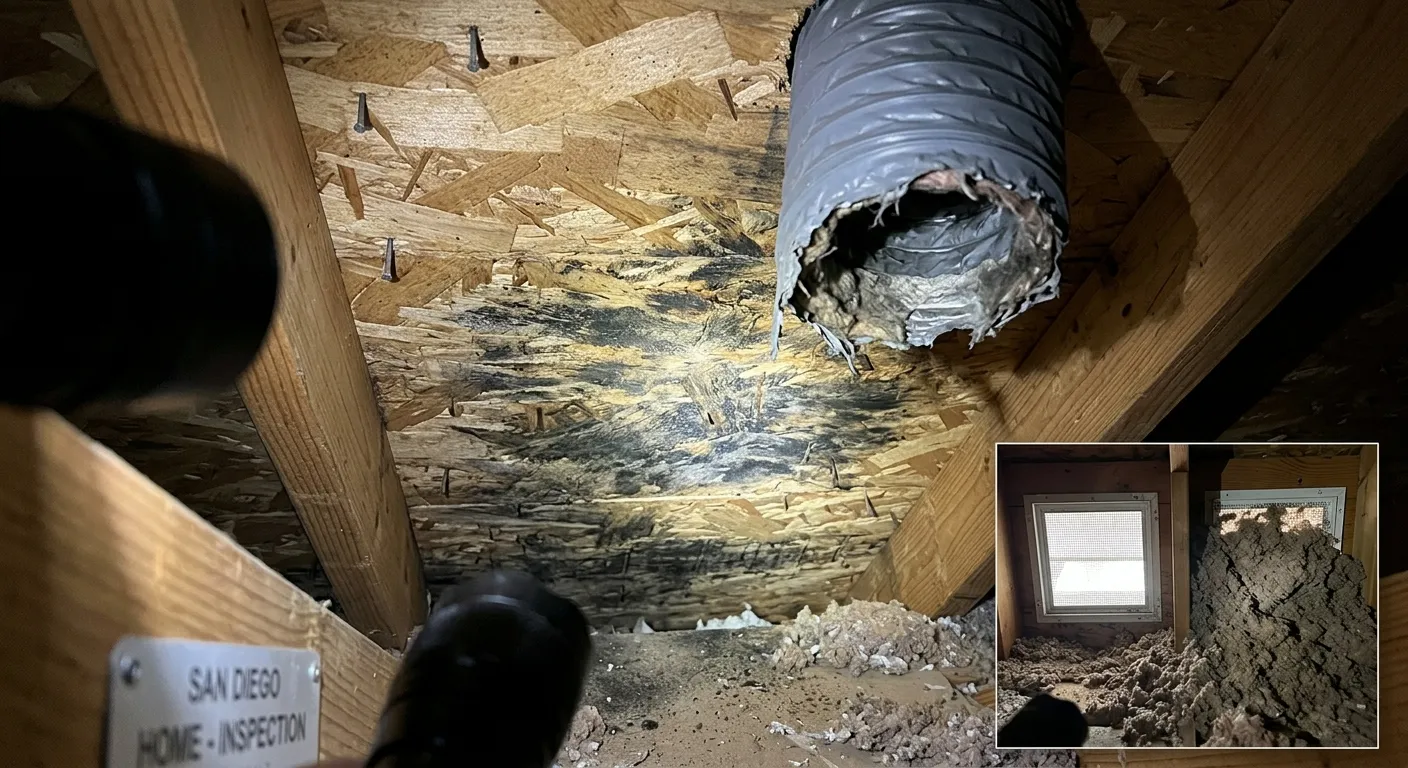
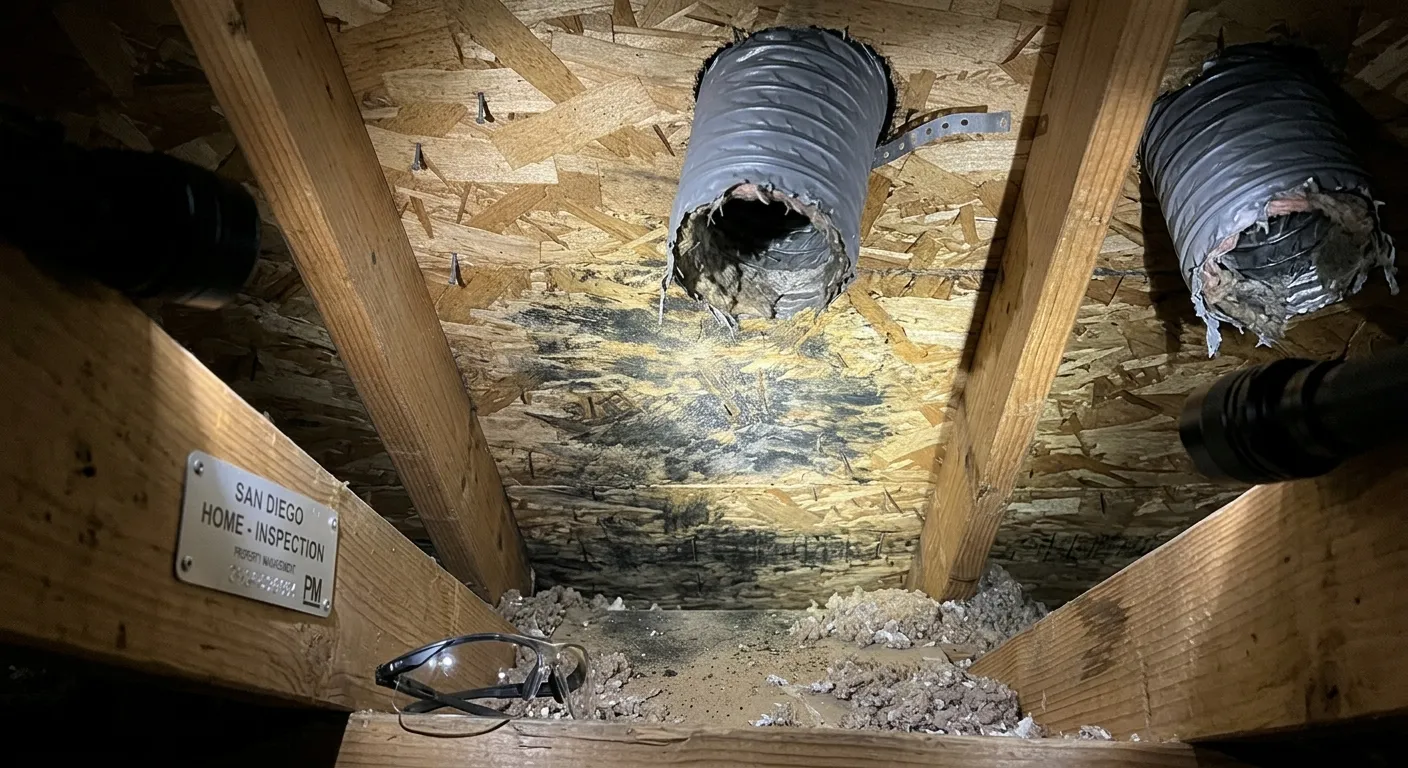
This is the cause homeowners are least likely to know about, and it’s far more common than most people assume. A bathroom exhaust fan is supposed to carry the half-pint to pint of water vapor generated by a hot shower through a dedicated duct, out through the roof or a wall cap, and away from the house entirely. In a meaningful number of homes, that duct was never actually finished during construction or a remodel — it “snorkels” straight up and dumps into the open attic a foot or two above the fan housing, it dead-ends against a joist with no outside termination, or it was run next to a soffit vent where incoming attic air simply blows the moisture back inside. Builders sometimes take this shortcut because running a proper rigid duct to a roof or wall cap takes more time than just aiming the fan into open attic space.
The fan still runs, still clears the fogged mirror, so the homeowner has no idea anything is wrong. But every shower, every kitchen exhaust cycle, that moisture gets pumped onto cold rafters and sheathing instead of leaving the house. Building code generally requires exhaust ducts to terminate outdoors for this reason, but it’s a detail easy to get wrong during construction and easy to miss on a typical home inspection, since it’s invisible once insulation is blown in around it.
4. Condensation on the Underside of the Roof Deck in Cooler Months
Even without a malfunctioning fan, warm household air naturally rises, finding its way into the attic through gaps homeowners rarely think about: recessed “can” lights, the attic hatch, plumbing stacks, and HVAC ductwork (common in San Diego attics) that isn’t perfectly sealed. On cooler nights — plentiful inland, when clear skies let roof surfaces radiate heat away quickly — that warm, moist air hits a roof deck cooled well below its dew point. The result is condensation, sometimes visible as beads of moisture or light frost on the underside of the sheathing, the same way water beads on a cold glass on a warm day. That moisture gets absorbed into the wood, and repeated night after night through the cooler season, it’s enough to sustain mold growth even with no leak and no obvious ventilation defect.
Common Attic Mold Causes and Their Telltale Signs
| Cause | What’s Happening | Telltale Signs |
|---|---|---|
| Roof leak | Water enters through damaged flashing, aged shingles/tile underlayment, or a roof penetration | Dark, localized staining on sheathing and rafters directly below one specific spot; stain trail runs down the rafter slope |
| Poor attic ventilation | Soffit, ridge, or gable vents are blocked, undersized, or missing | A broad haze of gray or black mold spread across large sections of sheathing, often worse near the ridge; attic feels unusually stuffy or hot |
| Bath/kitchen fan vented into attic | Exhaust duct dumps moist air straight into the attic instead of outdoors | Concentrated staining or mold in one localized spot where a duct enters the attic, often with visible disconnected or dead-ended flex duct nearby |
| Winter/cool-night condensation | Warm indoor air leaks into the attic and meets a cold roof deck below the dew point | Spotty mold, water beading, or light frost that appears mainly in cooler months, often near recessed lights, the attic hatch, or plumbing stacks |
Why Attic Mold Goes Unnoticed for So Long
Unlike a kitchen, bathroom, or living room, nobody looks at their attic regularly. There’s no daily reason to open the pull-down ladder or pop the ceiling scuttle hole, and most attics are hot, dark, and uncomfortable to move around in — reasons enough for homeowners to avoid them for years at a stretch. Meanwhile, mold doesn’t need much to establish itself: organic wood sheathing, a sustained moisture source from any cause above, and time. A patch that starts as a few inches across a joist bay can spread across a large section of the roof deck before anyone has reason to look.
Most attic mold here is first discovered one of three ways: a musty odor drifts down through return air vents (especially where the HVAC air handler sits in the attic, which is common locally), a home inspector flags it during a sale or refinance, or a homeowner finally climbs up for holiday decorations or a cable run and sees it with a flashlight. By any of those points, the mold has typically had months — sometimes years — of uninterrupted growth.
What You Can Safely Check Yourself
A quick, cautious look can tell you a lot before you ever need to call anyone. Precautions first: attics get extremely hot in the afternoon, so check in the morning or evening; wear an N95 mask and avoid skin contact with insulation; step only on joists or walk boards, never on insulation or drywall, since the ceiling below can’t support your weight; and bring a flashlight.
- Shine a light across the roof deck for dark staining or a fuzzy gray/black texture, especially near the ridge and around roof penetrations.
- Trace bathroom and kitchen exhaust ducts from the fan housing to see whether they continue all the way to a roof cap, wall cap, or soffit termination — or simply end in the open attic.
- Check that soffit vents are clear from the inside; insulation piled against the eaves is a common ventilation problem in homes that have had insulation added over the years.
- Look for water staining or daylight gaps around chimneys, skylights, and roof-to-wall intersections.
- Note any musty smell, which often shows up before visible mold does.
If you see heavy, widespread growth, feel respiratory irritation, or aren’t comfortable navigating the attic structure, stop and call a professional instead.
When to Call a Professional
Call a licensed mold professional if you find visible mold beyond a small, isolated patch; if a musty smell persists even when the attic looks clean; if you’re not sure whether a fan duct actually terminates outside (tracing flex duct through dense insulation is genuinely hard to do safely); if you or a family member has unexplained respiratory symptoms that improve away from the house; or if you’re preparing to sell and want a documented, honest assessment before it becomes a negotiating point in escrow. A professional inspection should include a visual assessment plus moisture readings, since mold can be present on wood that looks only lightly discolored.
Frequently Asked Questions
How do I know if my attic has mold without going up there myself?
Warning signs include a musty odor near the attic hatch or coming through HVAC vents, a ceiling water stain, or higher indoor humidity than usual. None of these confirm mold alone, but any of them is reason enough for a professional inspection.
Does San Diego’s dry climate mean attic mold isn’t really a risk here?
No. San Diego’s often-humid coastal air, combined with cool overnight temperatures and attics that still trap warm indoor air, creates plenty of opportunity for condensation and mold even without heavy rain. Low rainfall mainly reduces the odds of a roof-leak-driven problem, not the ventilation or fan-venting causes.
Can a bathroom fan really cause mold if it “feels” like it’s working fine?
Yes. A fan that clears the mirror and sounds normal can still be venting straight into the attic instead of outside; its performance inside the bathroom tells you nothing about where the moist air ends up. This is one of the most overlooked causes of attic mold because it produces no symptoms inside the living space at all.
Is attic mold dangerous to my health?
It can contribute to indoor air quality problems, especially where the attic shares air pathways with living space through return ducts, recessed lighting, or an attic-mounted air handler. Reactions vary by person, but persistent exposure is worth addressing rather than ignoring.
How much does attic mold removal cost in San Diego?
Cost depends on the size of the affected area, whether insulation needs replacing, and whether the underlying cause also needs correcting. An isolated patch costs far less than widespread growth across the whole roof deck, which is why catching it early matters.
Will homeowners insurance cover attic mold removal?
It depends on the cause. Mold from a sudden, covered event like a storm-damaged roof leak is more likely to have some coverage; mold from long-term condensation or a chronically misrouted exhaust fan is often treated as a maintenance issue and may not be covered. A documented inspection helps clarify which situation you’re in before filing a claim.
Why Gold Coast Flood Restorations
Gold Coast Flood Restorations has worked on San Diego County homes for more than 35 years, and attic mold rewards exactly that kind of experience — the difference between a staining pattern caused by a roof leak, a ventilation problem, and a misrouted bath fan isn’t always obvious on a first look. We’re the only water damage and mold remediation contractor in San Diego certified by ToFixIt, and as a Christian-owned company, we built our reputation on honest assessments rather than inventing problems to pad a job — if your attic doesn’t need remediation, we’ll tell you that too. Our work has been featured on Channel 10 News, and we’re available 24/7 across San Diego County, from Carlsbad and Encinitas down to La Mesa and Rancho Santa Fe. First-time customers get a $50 discount on their first service call.
If you’ve spotted staining, smelled something musty, or just want peace of mind, call Gold Coast Flood Restorations for an honest attic mold inspection today.
Sources consulted: U.S. EPA, “A Brief Guide to Mold, Moisture and Your Home” / Mold Course Chapter 2 (ventilation, condensation, and indoor humidity thresholds); GreenBuildingAdvisor, “Venting Bathroom Exhaust Air” by Allison Bailes (bathroom fan ducts terminating in the attic instead of outdoors); U.S. Department of Energy Building America Solution Center (PNNL), “Condensation Control in Attics and Roofs in Cold Weather” (dew point and roof-deck condensation mechanics); U.S. Department of Energy, “Guide to Durable Attics” (moisture as the primary threat to attic durability and the code concerns around venting exhaust fans into attics).