A water loss in a single-family home is a homeowner’s problem. A water loss in an apartment building or condo complex is a property manager’s problem multiplied by however many units share a wall, ceiling, or plumbing stack with the source. A second-floor supply line failure in a Mira Mesa two-story doesn’t just soak one unit — it drips into the unit below and wicks into shared corridor drywall before anyone downstairs knows something is wrong. That’s the core difference: the clock runs against square footage you can’t see, in units you don’t control, occupied by tenants who have real legal protections while it gets fixed.
This guide is written for property managers, HOA and building owners, and on-site maintenance staff across San Diego County — including the apartment- and condo-dense corridors of Mira Mesa, University City, Miramar, and Sorrento Valley, where older garden apartments and newer mid-rise construction make plumbing failures and roof leaks a routine part of ownership. It covers containing damage across shared walls and floors, meeting California habitability rules, coordinating the building’s commercial policy with tenants’ renters insurance, and protecting vacancy numbers by moving fast and correctly the first time.
The First 24 Hours After a Multi-Unit Water Loss
How expensive and disruptive a multi-family water loss becomes depends heavily on how the first 24 hours are handled. Category 1 (clean) water can begin reclassifying into Category 2 contaminated water in roughly 24 to 48 hours as it sits in wall cavities and flooring — a window recognized in the IICRC’s S500 water damage restoration standard. In a multi-unit building, that clock runs simultaneously behind several doors at once.
| Timeframe | Priority action | Who typically handles it |
|---|---|---|
| 0–30 min | Shut off the water source; confirm no active electrical hazard | On-site maintenance |
| 30–60 min | Identify every unit that could be affected — not just the unit of origin | Property manager |
| First hour | Call a commercial water damage restoration company for emergency extraction | Property manager |
| 1–3 hours | Photo-document every affected unit and common area before cleanup begins | Property manager |
| 2–6 hours | Notify all affected tenants directly; assess habitability of each unit | Property manager |
| Same day | Set up containment barriers and dehumidification between the source and neighboring units | Restoration contractor |
| Same day | Open the commercial claim; flag units that may need to file under renters insurance | Property manager |
| 24–48 hrs | Confirm moisture readings in adjacent units are trending down, not up | Restoration contractor |
Containing Damage Before It Spreads to Adjacent Units
Containment is the piece of multi-family water response with no real equivalent in a single-family home. A detached house bounds water damage inside its own envelope; an apartment or condo building doesn’t — water follows plumbing chases, shared subfloors, party walls, and HVAC returns into units your team may not even have a key to yet.
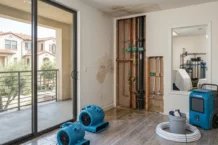
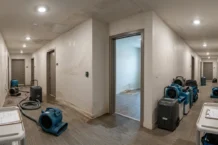
A restoration crew experienced with multi-family properties treats containment as the first job, not an afterthought to extraction: isolating drying zones with poly barriers and negative air pressure, opening the ceiling or subfloor below a leak to check the joist bay before mold establishes, and moisture-mapping every unit sharing a wall, ceiling, or riser with the source — not just the unit where the leak was reported. In stacked construction common to Mira Mesa and Miramar garden apartments, a second-floor leak almost always needs the ceiling below opened, even if that tenant hasn’t reported anything. Waiting for a stain to appear is waiting too long — by the time drywall shows it, the framing behind it has often been wet for days.
This is also where an existing relationship with a restoration company pays off: a crew that already knows your building’s plumbing routing and wall assemblies can move straight to containment instead of learning the property on the fly during an emergency.
Tenant Notification and Habitability Obligations Under California Law
California imposes real, specific obligations on landlords when a unit becomes uninhabitable, and water damage and mold are two of the most common triggers. Civil Code § 1941.1 requires rental units to have effective weatherproofing and plumbing maintained in good working order as part of the implied warranty of habitability; a leak or flood that compromises those systems can put a unit out of compliance until repairs are complete. Health & Safety Code § 26147 further requires written disclosure when a landlord knows, or reasonably should know, that mold or water damage presents a potential health threat.
In practice, fixing the pipe isn’t enough. Each affected tenant should be notified promptly and directly — not just via a posted hallway notice — about what happened and what to expect. If a unit is genuinely uninhabitable (no working plumbing, active mold, unsafe electrical exposure), tenants have remedies including repair-and-deduct (Civil Code § 1942), rent withholding, and constructive eviction claims. Where a unit can’t be safely occupied during drying, many property managers arrange relocation or a rent credit rather than risk a habitability dispute.
This is general information, not legal advice. California habitability law has real nuance around timelines and what qualifies as “substantially” uninhabitable, and local ordinances can add further requirements. Confirm specifics with a landlord-tenant attorney or your property management association (such as the San Diego County Apartment Association) before finalizing tenant communications on any individual loss.
Coordinating the Building’s Commercial Policy and Tenants’ Renters Insurance
Multi-family water losses almost always touch two separate insurance tracks at once, and confusing them slows everyone down. The building’s commercial property policy typically covers the structure — framing, drywall, flooring, common areas — plus loss-of-rent for vacant units during repairs. It generally does not cover a tenant’s personal belongings — furniture, electronics, rugs — which fall under that tenant’s own renters insurance, if they have one.
The job in the first 24–48 hours is getting both tracks moving in parallel: open the commercial claim promptly with clear documentation of every affected unit, and separately advise each affected tenant in writing to contact their own carrier and photograph their own losses before discarding items. Restoration invoicing should cleanly separate structural work billed to the master policy from any personal-property work that may fall to a tenant’s policy — mixing them creates disputes later. Not every tenant carries renters insurance, and that gap isn’t the property manager’s responsibility, but flagging it early and documenting that you did protects the building from later disputes.
Minimizing Vacancy and Turnover Cost From a Slow Restoration
The financial damage from a multi-unit water loss rarely stops at the repair invoice. Every day a unit sits in “drying” status is a day of lost rent, and a poorly coordinated restoration — containment, drying, and repairs split across disconnected vendors — routinely turns a two-week job into a six-week one. In a competitive market like Mira Mesa or University City, near the UC San Diego and Sorrento Valley/UTC job corridor, that extended vacancy risks losing a tenant altogether, stacking turnover costs on top of the restoration bill.
A few practices consistently shorten that timeline: one contractor handling extraction, drying, containment, and mold prevention as a single scope; daily moisture readings and a written drying log so there’s an objective basis for when a unit is ready for repairs, not just “looks dry”; and pre-authorizing emergency mitigation up to a set dollar threshold so a crew can start immediately instead of waiting on a purchase-order cycle. The gap between extraction starting the same night versus days later is often the difference between a straightforward drying job and one with mold remediation added on.
What Your On-Site Staff Can Handle vs. When to Call a Restoration Professional
On-site staff play a real role in the first minutes of a water loss, but the line between “handle in-house” and “call a professional now” matters, especially across multiple units.
| Maintenance staff can typically handle | Call a licensed restoration company for |
|---|---|
| Shutting off the water source at the unit or building level | Extraction across multiple units, beyond a small contained puddle |
| Moving belongings away from active water in the unit of origin | Moisture mapping behind walls, under flooring, in adjacent units |
| Initial photo documentation for the claim file | Water that’s contacted sewage, stood for hours, or is Category 2/3 |
| Tenant notification and coordination logistics | Structural drying with commercial dehumidification equipment |
| Placing towels/barriers to slow spread while awaiting the crew | Any visible mold, or any loss affecting more than one unit |
| Opening the insurance claim and coordinating with tenants’ policies | Containment setup between units and post-repair mold/moisture clearance testing |
Train this rule into every on-site team: if water has reached a second unit, sat for more than a few hours, or has any possibility of sewage contamination, it’s a professional job. Not because staff can’t mop up water, but because what’s invisible — moisture inside a wall cavity, contamination level, mold onset — is what actually determines the outcome, and that requires equipment and documentation staff generally don’t have.
The Value of an Emergency-Response Vendor Relationship Before You Need One
The worst time to find a water damage restoration contractor is at 2am with three units flooding. Multi-family losses don’t wait for business hours — a supply line fails on a Friday night, a water heater lets go over a holiday weekend. Property managers who scramble to find an available, qualified crew during the emergency itself lose hours that translate directly into more units affected and a higher chance a Category 1 leak becomes a Category 2 or 3 problem with mold attached.
An established relationship with a restoration company before a loss happens changes that. A vendor who already knows your buildings’ construction, plumbing routing, and on-site contacts can mobilize immediately instead of starting from zero. Many property management companies formalize this with a standing emergency-response agreement, so there’s no scramble to sign a work authorization or verify licensing mid-crisis — that paperwork is already on file, and pricing and communication expectations are set in advance across every property in the portfolio.
Frequently Asked Questions
How fast should a restoration crew arrive after a multi-unit water loss is reported?
A genuine 24/7 emergency provider should mobilize within roughly an hour, with extraction equipment on-site shortly after. If a vendor can’t commit to same-hour response, that’s worth knowing before the emergency, not during it.
Do we need to relocate tenants while their unit is being dried out?
It depends on whether the unit stays reasonably habitable during drying. If living conditions are intact and the work area can be contained, many tenants can stay; if a bedroom, bathroom, or kitchen isn’t safely usable, relocation or a rent credit is often more defensible — evaluated per unit.
Who pays for a tenant’s damaged furniture or belongings?
Generally, a tenant’s belongings fall under their own renters insurance, not the building’s commercial policy. Not every tenant carries it, so notify affected tenants promptly and in writing to file their own claim and document losses before discarding items.
How do we know if a leak has spread into a neighboring unit before the tenant reports anything?
Visible staining is a late sign — by the time drywall shows a mark, the material behind it has often been wet for days. A restoration company should moisture-map every unit sharing a wall, ceiling, or plumbing chase with the source rather than waiting for a second complaint.
What’s different about a sewage backup affecting multiple units versus a clean-water leak?
Sewage backups are Category 3 (grossly contaminated) water: treat the area as a health hazard, restrict tenant access until it’s professionally disinfected, and expect carpet, padding, and some drywall to be removed rather than dried in place. Not a job for maintenance staff beyond stopping the backup and keeping tenants away.
Is it worth setting up an emergency-response agreement before we have a loss?
Yes. A pre-established relationship means a vendor already knows your buildings, has documentation on file, and can mobilize immediately instead of treating your call as a first-time intake mid-emergency — one of the highest-leverage things to set up in advance.
Why Gold Coast Flood Restorations
Gold Coast Flood Restorations has served San Diego County property owners and managers for more than 35 years, with hands-on experience in the garden-style and mid-rise apartment stock across Mira Mesa, University City, Miramar, and Sorrento Valley — the kind of shared-wall construction where containment between units makes or breaks a restoration timeline. We’re the only water damage and mold remediation contractor in San Diego certified by ToFixIt, and as a Christian-owned company we give straightforward, honest assessments — what a unit actually needs, not what pads an invoice, which matters when you’re accountable to owners, tenants, and adjusters on the same loss. Our work has been featured on Channel 10 News, and we’re available 24/7 because multi-family water losses don’t wait for business hours.
Set up an emergency-response relationship with Gold Coast Flood Restorations before your next 2am call — reach our 24/7 line and ask about a standing vendor agreement for your properties, and get $50 off your first service call.