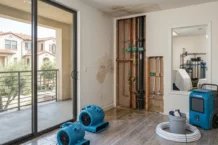
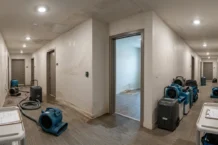
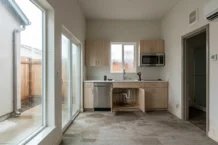
If you own a condo or townhome in a San Diego HOA community and you’ve just discovered a wet ceiling, a soggy carpet near a shared wall, or a slow leak you can’t quite pinpoint, the first question isn’t “how do I dry this out” — it’s “whose problem is this?” That’s a different question from landlord-tenant liability, which we’ve covered elsewhere on this blog. In a common interest development there’s no landlord — there’s an association governed by a board, a set of CC&Rs, a master insurance policy, and your own ownership interest, and all four can point different directions once water starts moving between units.
We restore water damage in condo and townhome communities throughout Mira Mesa, University City, Scripps Ranch, and Carmel Valley regularly, and the liability question comes up almost every time — usually while the homeowner is standing in a wet hallway waiting for the board to call back. Here’s how California law and typical HOA insurance actually sort it out, and what that means for the first hour after you find the damage.
California’s Davis-Stirling Act: The Default Rules
Condos, townhomes, and other common interest developments in California are governed by the Davis-Stirling Common Interest Development Act, a section of the California Civil Code that sets the baseline rules for how associations and owners share responsibility for the property. The most relevant section for water damage is Civil Code §4775, which lays out a default division: the association is responsible for repairing, replacing, and maintaining the common area, and each owner is responsible for repairing, replacing, and maintaining their own separate interest — meaning the inside of their unit.
What the Association Is Typically Responsible For
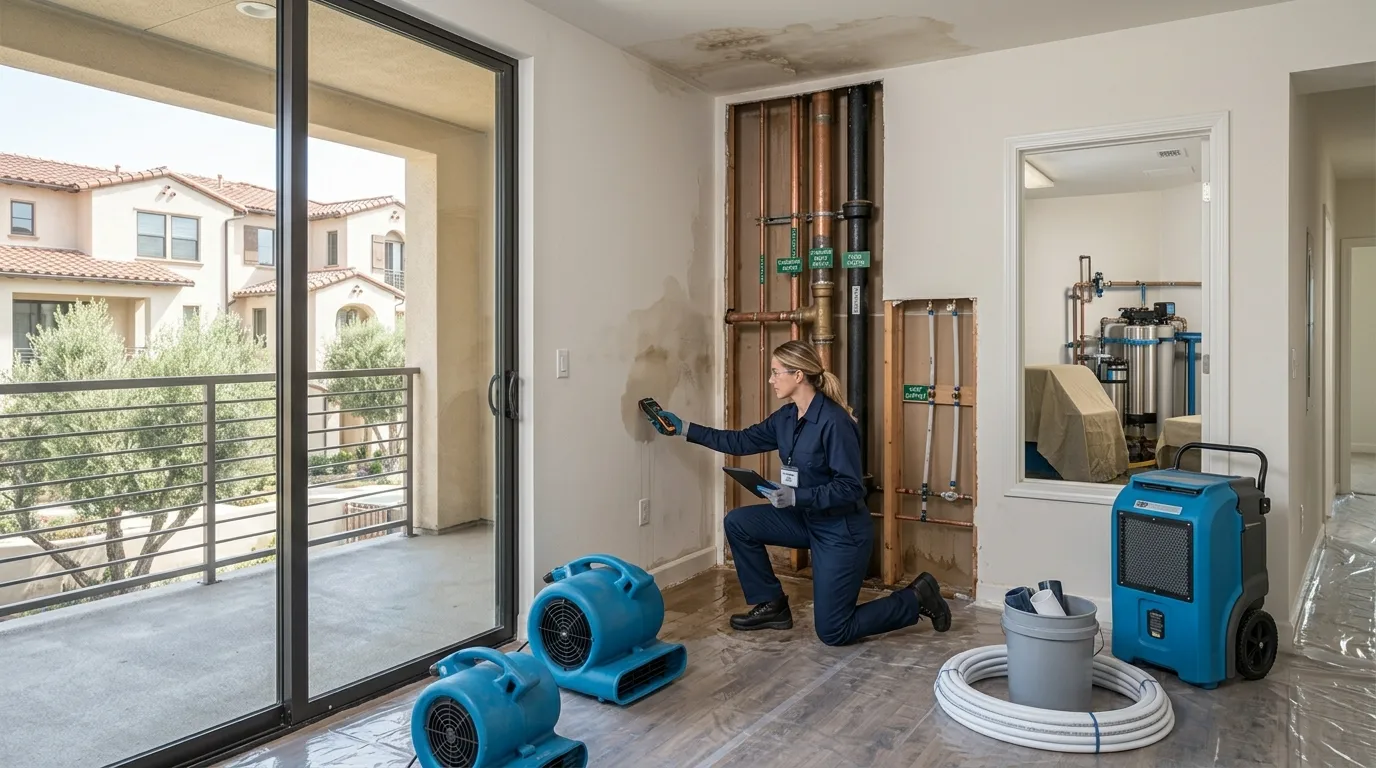
Under the default rule, the HOA generally maintains shared structural and system components: the building’s roof and exterior envelope, main plumbing risers and shared supply lines that serve more than one unit, common hallways and stairwells, and shared mechanical systems. Section 4775 also specifically addresses interrupted utility service — including water — that originates in the common area: the association is responsible for the repair “even if the matter extends into a separate interest,” and as of recent amendments to the statute, the board must begin the repair process within 14 days of learning about the problem.
What the Owner Is Typically Responsible For
Everything inside your own unit — plumbing fixtures, supply and drain lines that exclusively serve your unit, appliances, flooring, drywall, cabinetry — is generally your responsibility to maintain and insure. A failed supply line under your kitchen sink, a cracked toilet tank, or a washing machine hose that lets go is treated as your problem, even though the water can travel into common areas or a neighbor’s unit below.
The Gray Zone: Exclusive Use Common Areas
California law also recognizes “exclusive use common area” — space technically common but reserved for one owner’s use, like a patio, balcony, or the plumbing fixtures serving only one unit within a shared wall. Owners generally handle day-to-day maintenance; the association typically handles major repairs and replacement. This is one of the most disputed categories in condo water claims, since whether a pipe counts as exclusive use, common area, or part of the unit depends on how the condo plan and CC&Rs define it.
CC&Rs Can Override the Default
None of the above is absolute. Davis-Stirling notes its default allocations apply “unless otherwise provided in the declaration” — your community’s CC&Rs can shift responsibility either direction. Some declarations make owners responsible for all plumbing within their unit’s walls regardless of who it serves; others put more in-wall plumbing on the association. The single most useful document in a condo water dispute is rarely the statute itself — it’s your community’s recorded CC&Rs.
HOA Master Policy vs. Your HO-6 Policy
Maintenance responsibility under Davis-Stirling is one layer of this question. Insurance is the other, and the two don’t always line up the way you’d expect — the association can be responsible for repairing a pipe without its insurance paying for the water damage that pipe caused inside your unit.
What the HOA’s Master Policy Usually Covers
Most California HOA master policies cover the building structure and common areas: roof, exterior walls, foundation, shared systems, plus the association’s general liability. Many master policies (sometimes called “bare walls” or “single entity” policies) stop at the unfinished interior surfaces of each unit — drywall, flooring, cabinetry, and fixtures inside your unit may not be covered at all, even if the association must maintain the pipe that failed.
What Your HO-6 Policy Usually Covers
An HO-6 policy is designed to fill that gap: interior finishes and improvements inside your unit’s walls, personal belongings, additional living expenses if the unit becomes temporarily unlivable, and personal liability — including, often, damage your unit accidentally causes to a neighbor below. If your CC&Rs require HO-6 coverage and you don’t carry it, you can end up personally exposed even when the leak wasn’t your fault.
Loss Assessment Coverage
One HO-6 add-on worth knowing about is loss assessment coverage. When a major loss — a common-area pipe burst, a fire, storm damage — exceeds the master policy’s limits or deductible, the association can levy a special assessment against every owner to cover the shortfall. Loss assessment coverage on your HO-6 policy reimburses you for your share of that assessment, up to the policy limit, so a shared building-wide loss doesn’t turn into a large unplanned bill mailed to your unit.
Common Scenarios in Condo & Townhome Communities
Local condo and townhome complexes in Mira Mesa, University City, Scripps Ranch, and Carmel Valley range from 1980s-era stucco buildings to newer multi-story developments, and the plumbing layouts vary a lot — which is exactly why the “who’s responsible” answer changes case by case. A few scenarios come up repeatedly:
A Leak From the Unit Above
If a neighbor’s washing machine overflows or a supply line fails inside their unit and water comes through your ceiling, the source is generally the upstairs owner’s responsibility to fix and, if their conduct was negligent (an old hose they never replaced, a known leak they ignored), potentially their liability for your damage as well. In practice, the upstairs owner’s HO-6 liability coverage or your own HO-6 policy often ends up paying for your interior repairs, rather than the HOA.
A Common-Area Pipe or Slab Leak
When the source is a shared riser, a main line in a common wall, or a leak under a shared slab, the association typically repairs the pipe itself. Whether the master policy also pays for the resulting drywall, flooring, and paint damage inside units depends on the policy’s terms and CC&Rs — a common point of friction between owners and boards, especially in older Scripps Ranch and University City buildings where original plumbing has been in the ground or walls for 30-plus years.
Mold Following an HOA-Covered Leak
San Diego’s coastal humidity means mold can start colonizing wet drywall and framing within 24 to 48 hours of a leak, regardless of whose pipe caused it. Even when the association acknowledges the leak was a common-area problem, mold remediation inside your unit is frequently treated as a separate cost question from the plumbing repair itself — another reason to document damage and start drying and remediation quickly rather than waiting for a liability determination.
Who’s Typically Responsible? A Quick Reference
| Component / Area | Who Usually Repairs the Source | Whose Insurance Usually Pays Interior Damage |
|---|---|---|
| Main plumbing risers / shared supply lines | Association (HOA) | Often HOA master policy, but check CC&Rs and policy exclusions |
| Fixtures/lines serving only your unit (even if inside a shared wall) | Owner (often, per CC&Rs — confirm locally) | Owner’s HO-6 policy |
| Shared/party wall structure | Association, for major repair/replacement | HOA master policy for structure; HO-6 for each owner’s interior finishes |
| Balcony or patio (exclusive use common area) | Owner for upkeep; HOA for major repair/replacement | Varies by CC&Rs — request the governing documents |
| Roof and exterior building envelope | Association (HOA) | HOA master policy for structure; leak-caused interior damage often HO-6 |
| Leak from the unit above (neighbor’s fixture) | Upstairs unit owner | Upstairs owner’s HO-6 liability, or your own HO-6 |
| Your unit’s interior finishes, flooring, belongings | Owner | Owner’s HO-6 policy |
What You Can Do Yourself vs. When to Call a Professional
What a Homeowner Can Handle Right Away
- Shut off water at the fixture or unit valve if the source is inside your unit, or contact the HOA’s emergency line if it looks like a common-area line.
- Photograph and video the damage as soon as it’s safe — stains, standing water, and the apparent source — before anything is moved or dried.
- Notify your HOA management company (in writing) and your own insurer, even before you know who’s responsible; most policies have notice deadlines.
- Pull your CC&Rs and any recent board minutes about plumbing — many associations post these in an owner portal.
- Move belongings out of standing water and run fans or a dehumidifier if you have one, to slow damage while you wait on a professional.
When to Call Gold Coast Flood Restorations
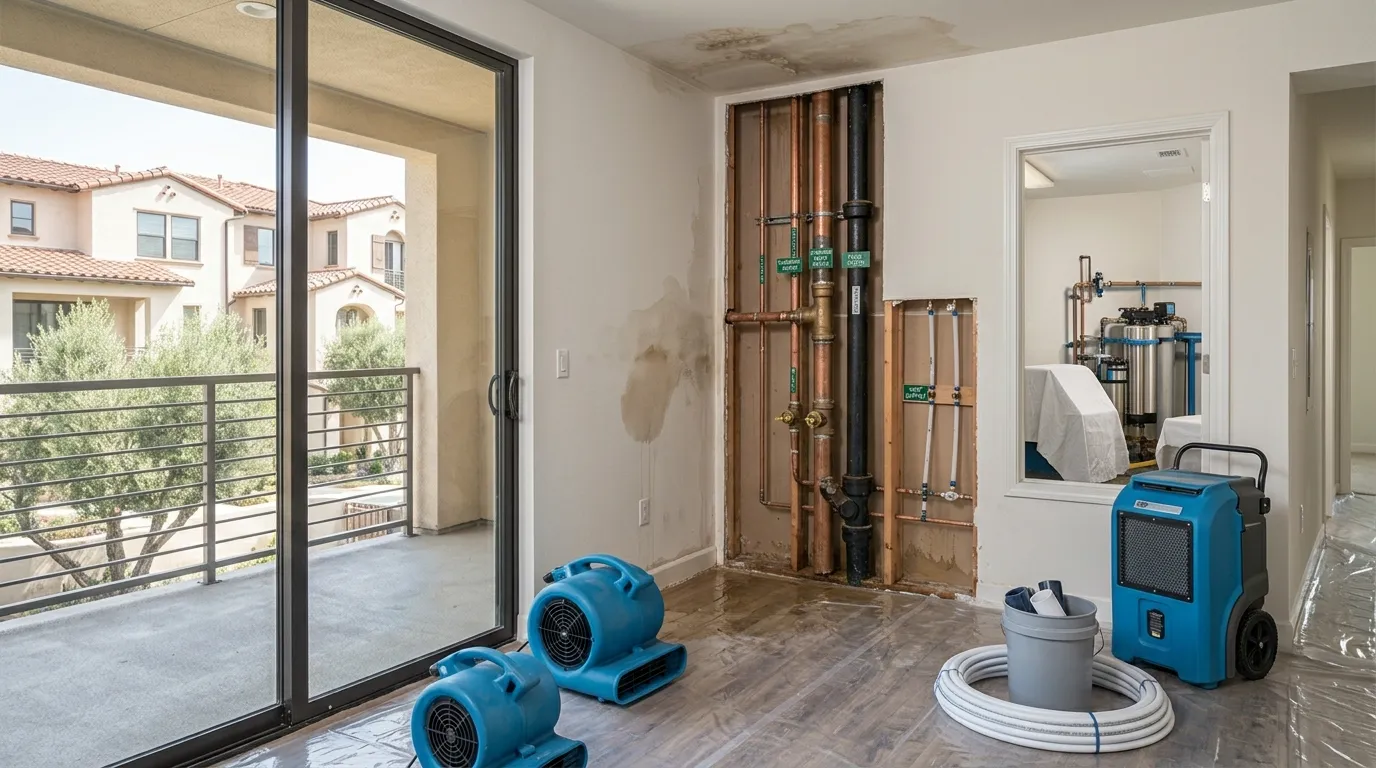
Liability determinations can take days or weeks to sort out between owners, boards, and insurance adjusters — but water and the mold that follows it don’t wait for that paperwork. Call a restoration professional as soon as you find active water intrusion, a ceiling or wall that’s staying wet, any musty odor, or if the leak has been running for more than a few hours undetected. We provide the kind of independent moisture readings, photo documentation, and written assessment that both HOA boards and insurance adjusters rely on to determine scope and cause — which speeds up, rather than complicates, the liability conversation.
Frequently Asked Questions
Does the HOA have to pay for damage inside my unit if a common-area pipe caused it?
Not automatically. The association generally must repair the pipe itself if it’s a common-area component, but whether the master policy also covers the resulting interior damage depends on the policy’s terms, your CC&Rs, and sometimes negligence — the leak’s location alone doesn’t decide the payout.
What if the leak comes from the unit above mine — is my neighbor automatically responsible?
Usually the upstairs owner must fix the source, and if negligence caused it (an ignored slow leak, an old failed hose), their HO-6 liability coverage often covers your damage. If it was a sudden, non-negligent failure, your own HO-6 policy may need to cover your interior repairs instead.
I already pay HOA dues that fund a master policy — do I still need an HO-6 policy?
Almost always, yes. Most master policies don’t cover interior finishes, belongings, or liability inside your unit, and many CC&Rs actually require owners to carry HO-6 coverage for that reason.
What is loss assessment coverage, and do I need it?
An HO-6 add-on that reimburses your share of a special assessment when a major loss exceeds the master policy’s limits or deductible. It’s inexpensive relative to the protection and worth asking your agent about, especially in older buildings with aging shared plumbing.
Can our CC&Rs make owners responsible for things Davis-Stirling normally assigns to the HOA?
Yes. The Act’s default allocation applies “unless otherwise provided in the declaration,” so your CC&Rs can shift responsibility for certain plumbing or systems either direction. Check your actual governing documents rather than assuming the statutory default applies.
Who pays for mold remediation after an HOA-covered leak?
Often negotiated separately from the plumbing repair. Some policies and CC&Rs treat mold remediation inside a unit as the association’s cost when tied to a common-area leak; others push it to the owner’s HO-6 policy. A documented professional assessment quickly helps establish cause and timeline either way.
Why Gold Coast Flood Restorations
We’ve restored water and mold damage throughout San Diego County for more than 35 years, and condo and HOA communities in Mira Mesa, University City, Scripps Ranch, and Carmel Valley are a large part of that work — we understand how these liability conversations play out between owners, boards, and adjusters because we’ve documented hundreds of them. We’re the only water damage and mold remediation contractor in San Diego certified by ToFixIt, and as a Christian-owned company we operate on one rule: give an honest assessment of what’s actually happening, never inflate scope, and never fabricate problems — a reputation that’s gotten us featured on Channel 10 News. We’re available 24/7, and we offer a $50 discount on your first service call.
If water is moving through your condo or townhome right now, don’t wait on a liability decision to start protecting your home — call Gold Coast Flood Restorations 24/7 for an honest, documented assessment.