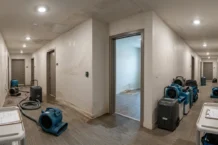
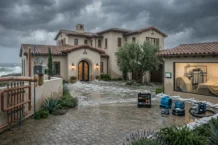
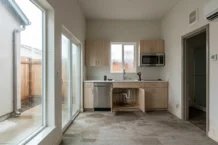
If you live on or near the water in La Jolla, Del Mar, Solana Beach, or Encinitas, you’ve likely seen it: water sheeting over a seawall, pooling across Camino Del Mar or Neptune Avenue, or seeping into a ground-floor patio with nothing but sunshine in the forecast. No storm, no rain for a week — yet there’s saltwater in the house. That’s not a plumbing failure or runoff problem; it’s a tide problem, driven by the moon’s orbit and ocean swell rather than local rainfall. Understanding the mechanism, and why the cleanup differs from a typical water damage job, helps coastal homeowners know what’s happening and when to call for specialized help.
What Exactly Is a “King Tide”?
“King tide” isn’t an official scientific term — NOAA describes it as informal shorthand for what oceanographers call a perigean spring tide. A “spring tide” is the extra-high tide following a new or full moon, when the sun and moon line up and their gravitational pull on the ocean adds together. “Perigee” is the point in the moon’s orbit when it’s closest to Earth, strengthening that pull further. When a spring tide coincides with lunar perigee, San Diego gets a king tide — a tide noticeably higher than the normal daily high. According to California Sea Grant, this alignment happens only about three or four times a year.
These aren’t small swings. In a recent winter king tide season, predicted highs at the Scripps Institution of Oceanography pier in La Jolla ran 6.8 to 7.2 feet, against lows near -1.8 feet — roughly an 8- to 9-foot difference within a single tide cycle. King tides can occur in any season (San Diego’s Stormwater Department deployed sandbags for one in July 2026, well outside rainy season), but the ones that do real property damage cluster from around November through February, when the Pacific’s winter storm swell also reaches Southern California beaches.
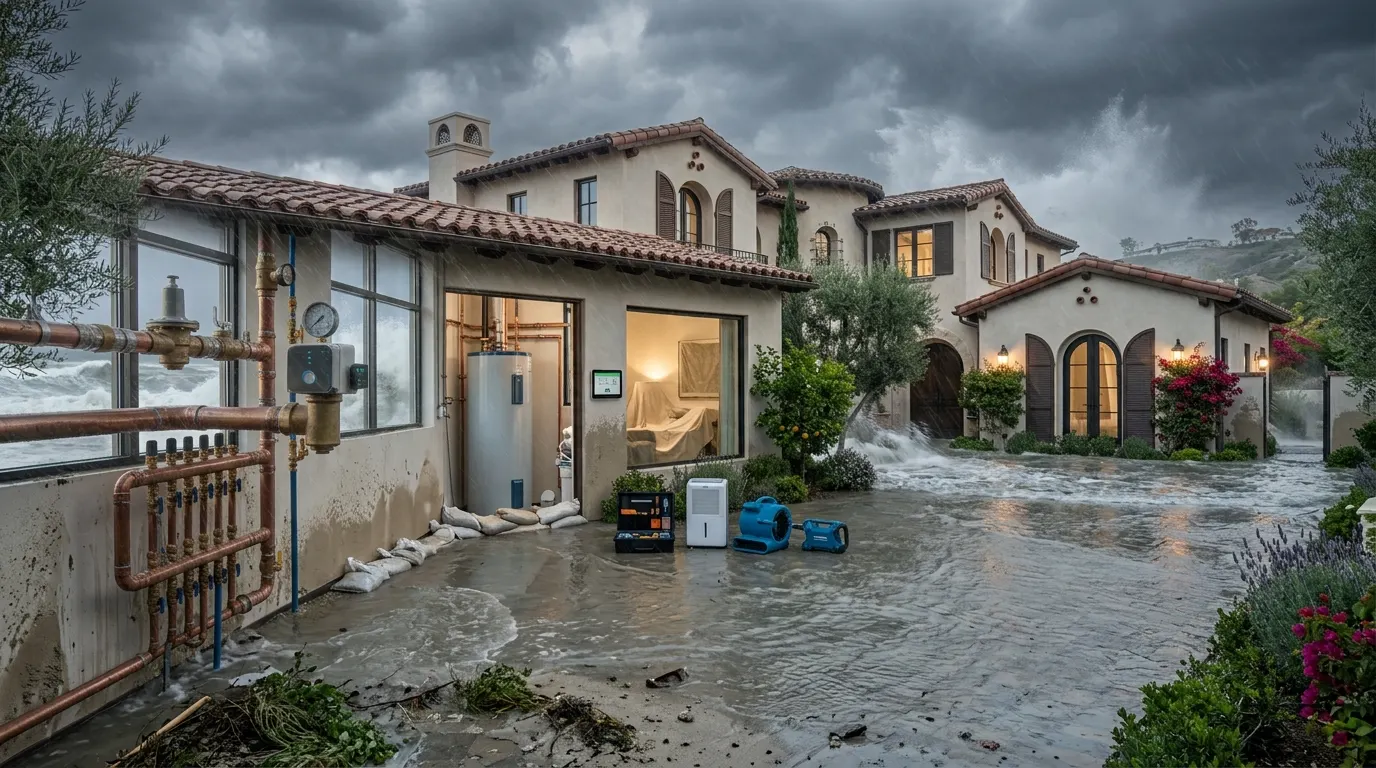
How King Tides Combine With Winter Swell to Flood Coastal Homes
A king tide by itself is predictable years in advance and, on a calm day, mostly a curiosity — people show up at La Jolla Cove just to watch the water reach unusually high. Property damage starts when a king tide overlaps with storm surge or elevated wave energy and the two stack on top of each other. NOAA defines storm surge as the rise in seawater caused solely by a storm — mainly wind pushing water toward shore — and storm tide as the total water level you get when that surge rides on top of the existing astronomical tide. When a winter Pacific storm sends a groundswell toward San Diego during a king tide window, wave run-up launches from an already-elevated baseline, reaching farther up the beach and higher against seawalls, bluffs, and oceanfront structures than either factor would alone.
This combination has repeatedly overwhelmed Southern California beachfront properties: reporting on king tide events elsewhere in the region has described seawalls disappearing beneath surging water, waves slamming directly into decks and foundations, and beaches already stripped of protective sand becoming even more exposed. San Diego’s coastal cities prepare for the tide-alone risk even without a storm attached — during the July 2026 king tide, the Stormwater Department staffed extra sandbag stations from Mission Beach to La Jolla Cove purely because of tide height. Add a winter storm swell to that same window and the water pushes higher still.
Within Gold Coast’s coastal service area, the most exposed features are the ones you’d expect: seawall-fronted lots near La Jolla Cove and the Shores; Del Mar homes along Camino Del Mar and near the Los Peñasquitos Lagoon mouth; Solana Beach’s bluff-top and San Elijo Lagoon-adjacent properties; and the Cardiff-by-the-Sea strip in Encinitas, where Highway 101 sits a short distance from the high-tide line.
Why This Isn’t the Same as Rainy-Season Flooding
It’s worth being precise about the mechanism, because it’s genuinely different from the flooding most San Diego homeowners think about first. Rain-driven flooding happens when storm drains, canyons, and creeks can’t move runoff fast enough — how bad it gets depends on how much rain falls that season. King tide and storm surge flooding is ocean-driven, running on a fixed lunar schedule calculable years in advance regardless of whether San Diego is having a wet winter or a dry one. A coastal home can flood from the ocean side during a drought year, or even in July, with zero rain involved.
The two mechanisms can also compound each other. During a wet winter, lagoon and creek mouths along the coast are already working harder to move inland runoff out to sea — if a king tide is elevating ocean levels at the same time, that outflow has less room to drain, and low-lying streets near lagoon inlets can back up faster than either factor alone. Either way, “it hasn’t rained” is not a reliable sign that a coastal home is safe from flooding.
Sea-Level Rise Is Raising the Baseline Every Year
Scripps Institution of Oceanography, whose pier sits in La Jolla, tracks this closely because San Diego’s coast is one of its home laboratories. Its research shows California’s sea level has risen roughly six inches over the past century, and the rate has accelerated — satellite data show it has more than doubled since 1993. Scripps projects another 0.5 to 1.2 feet of rise above year-2000 levels by 2050.
The effect on flood frequency matters most: Scripps specifically cites La Jolla, noting that mild coastal flooding occurring once or twice a year today is projected to occur nearly 50 times a year with about one foot of additional sea-level rise — a threshold California could reach well before 2050. Every king tide now rides on a slightly higher baseline than the one before it, so events that used to lap at the base of a seawall are starting to reach patios and thresholds that stayed dry a decade ago.
Why Saltwater Flooding Needs a Different Restoration Approach
Once seawater is inside a home, cleanup diverges from a typical freshwater loss, and treating it like an ordinary rain leak tends to leave hidden problems behind.
- Corrosion is fast and aggressive. Salt increases water’s conductivity, accelerating corrosion in anything metal — outlets, panels, HVAC components, fixtures, fasteners, appliances. Industry sources note metals can show significant corrosion in less than a week after saltwater exposure, far faster than after a freshwater intrusion.
- Porous materials break down faster too. Salt dissolves and weakens wood, plaster, and drywall — sometimes within just a few days — and can compromise concrete and cinder block within a few weeks, shortening the window in which “dry it out and reuse it” is a safe option.
- Drying takes longer, not less time. Salt is hygroscopic — it pulls moisture from the air — so salt-contaminated framing can stay damp longer, and can reabsorb moisture even after reading “dry” on a meter if the salt wasn’t fully rinsed out.
- It’s classified as contaminated water, not clean water. Under the IICRC S500 standard, seawater and storm surge flooding fall automatically into Category 3 — the same “grossly contaminated” tier as sewage backups — because ocean water routinely carries sand, marine debris, bacteria, and runoff contaminants. That changes required PPE, disposal, and how conservatively porous materials get treated.
- The mold-resistance myth is backwards. Homeowners often assume saltwater is less likely to grow mold. In practice the opposite tends to be true — salt keeps materials damp longer, which can promote mold rather than suppress it.
| Factor | Saltwater / Storm Surge Flooding | Freshwater Flooding (rain intrusion, pipe leak) |
|---|---|---|
| IICRC water category | Category 3 (grossly contaminated) — automatic per IICRC S500 | Usually Category 1 or 2, depending on the source |
| Metal & electrical corrosion | Rapid — visible corrosion possible within days | Slower; standard corrosion timelines apply |
| Drying time | Extended; salt is hygroscopic and re-attracts moisture | Shorter, more predictable with standard dehumidification |
| Drywall / insulation / baseboards | Often needs removal and replacement, not just drying | Frequently salvageable if dried within 24–48 hours |
| Wood flooring & cabinetry | Higher replacement likelihood; salt embeds in the material | Better salvage odds with prompt extraction and drying |
| Electrical safety during cleanup | Elevated shock risk from saltwater’s conductivity | Standard electrical safety precautions apply |
| After surfaces look dry | Salt residue can remain and keep corroding/re-absorbing moisture until rinsed and treated | Minimal residue once materials are dry |
What You Can Do Right Away vs. When to Call a Professional
If seawater is entering your home
- Avoid contact with floodwater — it’s contaminated and, if it reached outlets or panels, may carry live current.
- If safe to do so without stepping in standing water, shut off electrical breakers serving the flooded area.
- Move valuables, electronics, and rugs above the waterline if there’s time.
- Photograph and video the flooding for insurance documentation.
- Once water recedes, rinse hard, non-porous surfaces (sealed tile, concrete, some metal) with fresh water to cut down on salt residue — this helps but isn’t a substitute for professional extraction and drying.
- Ventilate the space rather than sealing it up — trapped humidity accelerates corrosion and mold.
When to call a professional
Because coastal saltwater intrusion is classified as contaminated water and salt hides inside wall cavities long after a room looks dry, call a professional any time seawater has touched electrical outlets, panels, or appliances; reached drywall, insulation, baseboards, or carpet padding; soaked into subflooring or cabinetry; or mixed with storm drain overflow. A professional crew uses moisture meters and thermal imaging to find salt-retained dampness deep in framing that isn’t visible on the surface — the exact hidden-corrosion scenario that turns a one-time flood into a recurring problem months later if missed.
Cost and Timeline Expectations
Cost and timeline are driven by how far water traveled into wall cavities and subflooring, whether electrical or HVAC components were contacted, and how much porous material needs replacing rather than drying. Because Category 3 protocols call for more aggressive material removal and longer moisture monitoring than a typical freshwater job, saltwater restoration generally takes longer and involves more replacement than a comparable freshwater loss.
Frequently Asked Questions
What’s the difference between a king tide and a regular high tide?
A regular high tide happens twice a day. A king tide is one of just three or four times a year, per California Sea Grant, when a new or full moon lines up with the moon’s closest approach to Earth (perigee), producing a noticeably higher-than-normal high tide.
When do king tides happen in San Diego?
King tides can occur in any season — San Diego prepared for one in July 2026 — but the highest flood risk clusters from around November through February, when winter storm swell also hits Southern California beaches.
Can my home really flood from the ocean if it isn’t raining at all?
Yes. King tide and storm surge flooding is driven by the moon’s orbit and ocean swell, not local rainfall, so it can flood a beachfront or lagoon-adjacent home on a completely dry, sunny day.
Is saltwater flood damage covered by homeowners insurance?
Standard homeowners policies typically exclude flooding from rising ocean water or storm surge, which usually falls under separate flood insurance (NFIP or private) rather than a standard policy. Check your policy language and document damage thoroughly.
How long does it take to dry out a home after saltwater flooding?
Longer than a comparable freshwater loss. Salt pulls moisture from the air, so affected materials stay damp longer and need repeated rinsing and dehumidification, with monitoring continuing until readings are consistently normal — not just until surfaces look dry.
Can flooded drywall just be dried out instead of replaced?
Usually not. Salt embeds in porous materials like drywall and insulation and keeps drawing moisture and corroding nearby fasteners even after the material appears dry, which is why Category 3 intrusions typically call for removing saturated porous materials rather than drying them in place.
Why Gold Coast Flood Restorations
Gold Coast Flood Restorations has responded to San Diego County water emergencies for more than 35 years, including the coastal king tide and storm surge events inland-focused companies rarely see enough of to handle correctly. We’re the only water damage restoration and mold remediation contractor in San Diego certified by ToFixIt, and as a Christian-owned company we operate on honest assessments — telling you what actually needs replacing because of saltwater corrosion, not what pads an invoice. Our work has been featured on Channel 10 News, and we’re available 24/7, because a king tide can peak at 2 a.m. as easily as 2 p.m.
If seawater has reached your La Jolla, Del Mar, Solana Beach, or Encinitas home, call Gold Coast Flood Restorations 24/7 for an honest assessment and a $50 discount on your first service call.