San Diego’s weather runs a confidence game. Two hundred and ninety days of sunshine lull the county into forgetting what water can do — and then an atmospheric river parks offshore and delivers a season’s rain in thirty-six hours, at wind, sideways, onto a housing stock that hasn’t been rain-tested since last winter. When it happens, storm damage rarely arrives through one door: the roof gives at a flashing while the hillside sends sheet flow at the sliders, the street drain backs up at the driveway, and the garage floods from two directions at once. Storm losses are multi-front losses, and cleaning them up is a different job than chasing a single failed pipe. Gold Coast Flood Restorations has worked every major storm event in San Diego County for more than 35 years — crews running around the clock when the weather hits, IICRC-certified drying behind them, and a general contractor’s license to put the house back together when the sky closes.
During the Event: Triage While It’s Still Raining
Storm losses are managed in real time, and the priorities sort cleanly:
- People away from the hazards. Standing water near outlets or appliances means breakers off (from a dry position) before anyone wades in; sagging, water-loaded ceilings mean the room below is cleared. Nothing in a flooded room is worth an energized misstep.
- Contain what can be contained. Buckets and sheeting under active ceiling drips; a controlled screwdriver hole at the low point of any ceiling bulge, bucket beneath; towels and rolled rugs at door thresholds losing the argument with sheet flow; valuables and electronics up off floors in the water’s path.
- Interrupt what can be interrupted. Clear the area drain or window well that’s ponding against the door if it can be reached safely; redirect the downspout discharging at the foundation. Small interventions mid-storm regularly save rooms.
- Call while it’s happening. Storm response is precisely what 24/7 means — mitigation and extraction don’t wait for the weather to finish, and during major events, the earliest calls get the earliest crews.
- Document in real time. Timestamped photos and video of water actively entering — the roof drip, the flow at the slider, the rising garage — are the most valuable insurance evidence a storm loss produces, tying every bit of damage to the event itself.
The Many Doors a Storm Uses
Three decades of San Diego storm seasons produce a reliable map of how the water gets in:
Through the roof. The county’s number-one storm entry: flashings, aged tile underlayment, skylights, and debris-clogged valleys — all invisible failures until wind-driven rain tests them. The roof’s failure modes and the attic-to-ceiling loss they produce have a full page of their own: roof leak water damage repair. On a storm loss, that’s one front of several.
Over the ground. Hillside and canyon-adjacent lots — the slopes of Mount Helix, Del Cerro, Poway, Alpine, and the coastal bluffs — meet sheet flow first: water moving downslope across yards and hardscape, into garages, through slider tracks and thresholds, and into any below-grade space in its path. Clogged area drains and gutters convert designed defenses into funnels, and the region’s clay soils, sealed hard by the dry months, shed the first storm’s water almost entirely sideways.
Through the openings. Wind-driven rain defeats assemblies that handle vertical rain fine — forcing past window tracks and weep systems, under doors, through vents and gable louvers, and into wall cavities via cracked stucco that never mattered until the rain came horizontal. Stucco-wall intrusion is a San Diego specialty: water enters high, travels the cavity, and announces itself as a stain rooms away from any visible breach.
Backward through the drains. Overwhelmed municipal storm systems and sewer surcharges send water up through the lowest drains in the house during peak events — a contamination event, not just a water event.
Via the trees. Wind takes limbs, limbs take roof sections and windows, and a puncture mid-storm turns a weather event into an open-building event that needs emergency covering before anything else.
Storm Water Is Dirty Water — The Rule That Sets the Cleanup
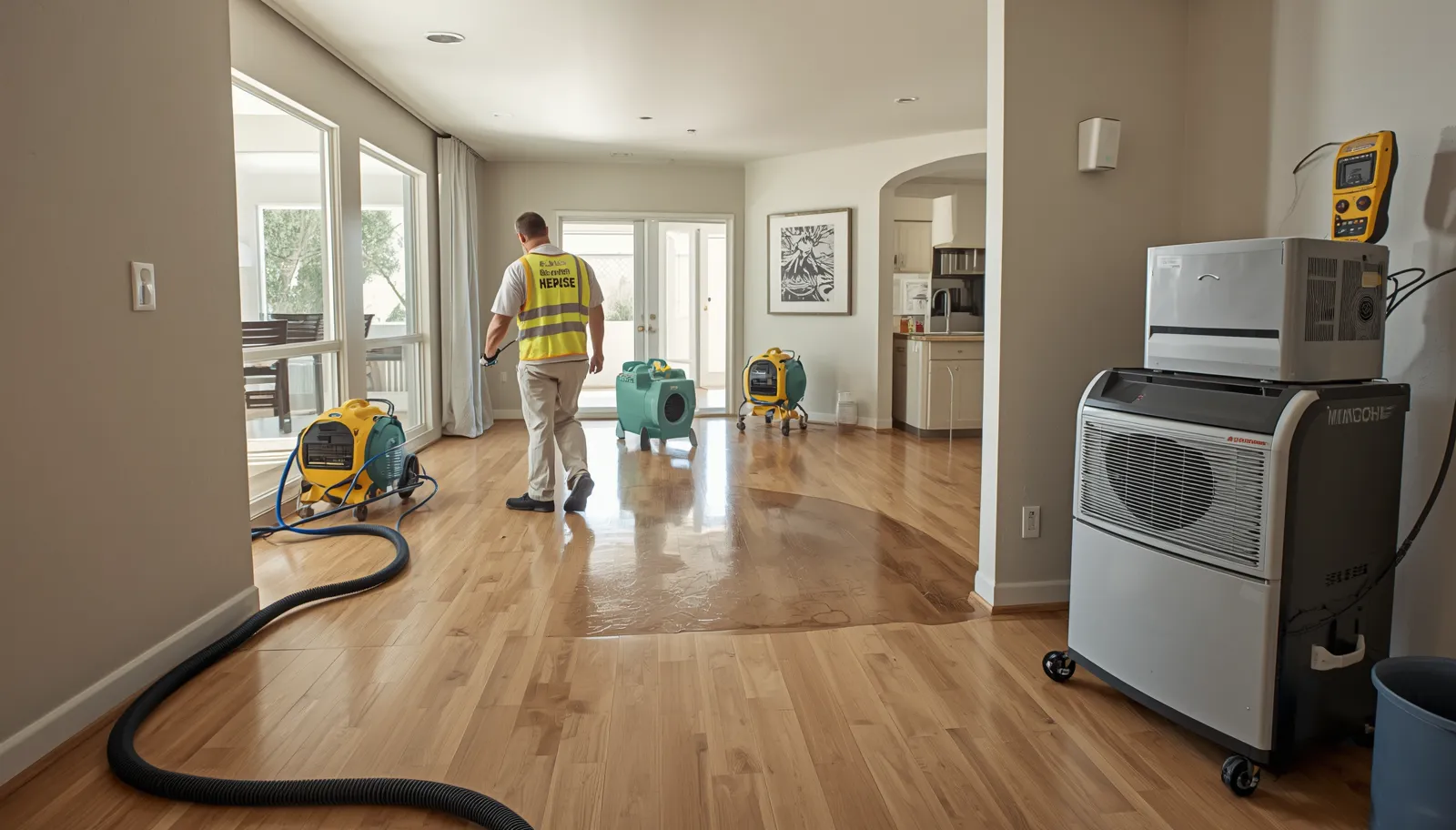
Here is the classification fact that governs storm losses: water that enters from outside at ground level is Category 3 — black water — regardless of how clear it looks. Runoff has crossed streets, yards, and soil, collecting what they carry; drain backflow needs no explanation. Clarity is not cleanliness, and the cleanup protocols follow the category: porous materials the water contacted — carpet, pad, cardboard, upholstered contents — are removed rather than negotiated with, affected surfaces are cleaned and sanitized, and the work is done under the contamination controls the category demands. Roof water, by contrast, generally enters cleaner and permits the fuller saves the readings support. A storm loss routinely contains both categories in the same house — which is exactly why the assessment maps and classifies every front before the scope is set, and why, per the company’s standing philosophy, the category and the meters make the case in both directions: nothing condemned that can honestly be saved, nothing “saved” that the category forbids.
How Gold Coast Works a Storm Loss
Stabilize every front. Emergency roof covering coordinated so the next rain band doesn’t repeat the loss; water stopped or diverted where it’s still entering; power hazards cleared; the building made safe to work.
Extract fast, everywhere at once. Pumping and extraction across all affected areas — living space, garage, below-grade rooms — with contaminated water handled and disposed of properly under the company’s registered waste hauler permit.
Map, classify, and scope honestly. Instruments trace every front’s true footprint — including the stucco-cavity and attic paths storms favor — each area classified by its entry route, and the scope built accordingly: Category 3 removals under containment on the ground-water fronts, drying-in-place where clean-water readings support it.
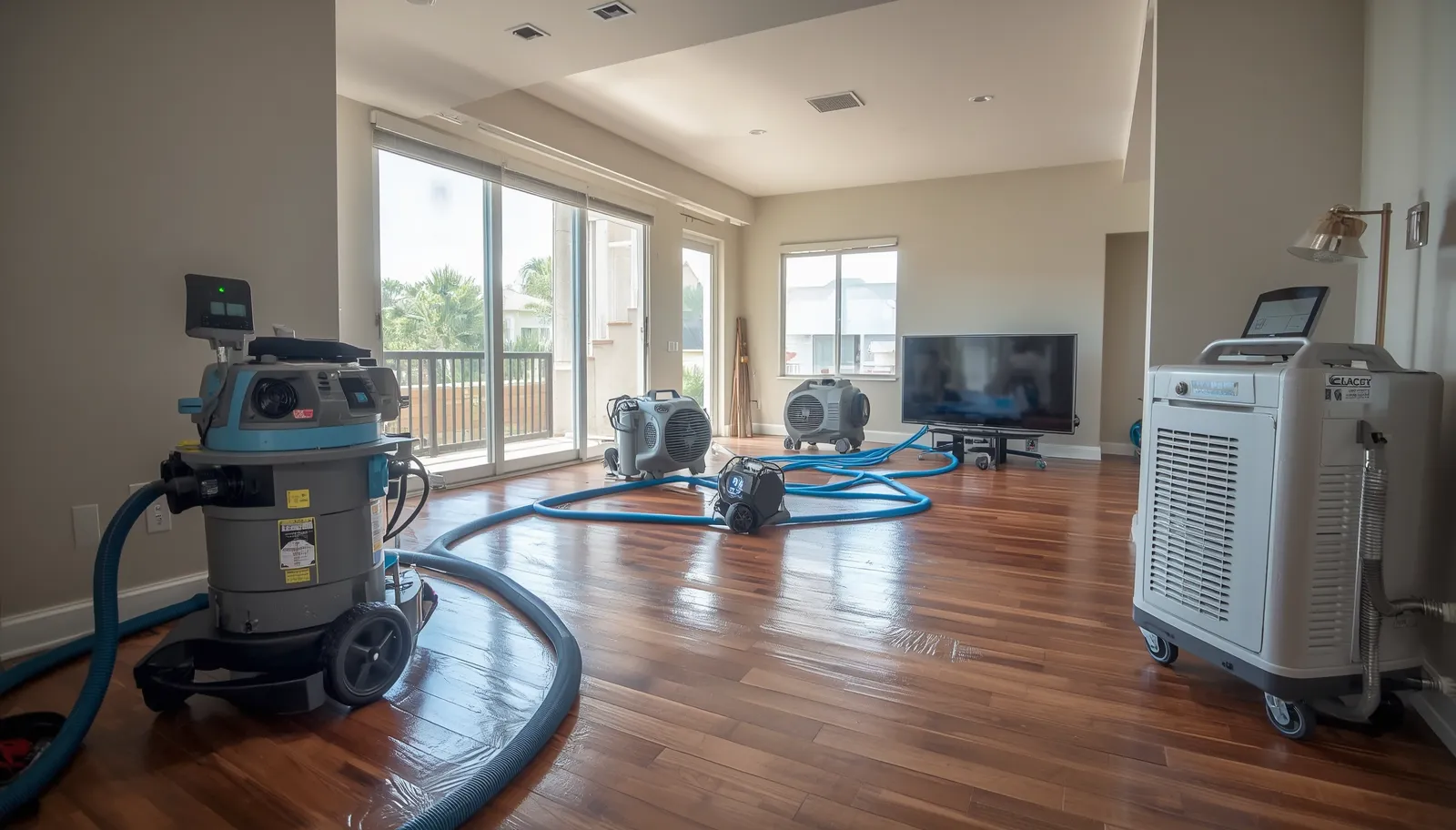
Dry the whole structure to standard. The full structural drying discipline — extraction, directed airflow, commercial dehumidification, daily monitored readings to documented dry standard — applied across every affected assembly, in a race the 24–48 hour mold window makes non-optional. Storm losses in marine-layer humidity dry against a stacked deck; the equipment and the monitoring are how the deck gets unstacked.
Remediate, verify, rebuild. Growth that established gets containment, remediation, and independent third-party verification; then reconstruction under the general contractor license (CA #838802) — drywall, flooring, paint, and coordination with the roofer whose repair closes the loss’s origin. One company from the mid-storm phone call to the final coat.
The Insurance Reality: One Storm, Several Different Claims
No loss type scrambles coverage like a storm, because a single event produces damage under several different rules. Wind and storm-created openings — and the rain that entered through them — are commonly covered perils under homeowners policies. Rising water from outside — sheet flow, street flooding, ground seepage — is the standard flood exclusion; that’s flood insurance’s territory (a separate policy, NFIP or private), which most county homeowners don’t carry and hillside/low-lot owners should genuinely price. Drain and sewer backup is commonly covered only where the optional water backup endorsement was purchased. The same storm can put all three in one house, which makes early, precise source documentation — the timestamped mid-storm evidence above, plus the professional mapping of each front — the claim’s entire foundation. No outcome can honestly be promised by anyone; what’s provided is the multi-front file, built the way San Diego adjusters have received it from this company through every storm season for three decades.
Frequently Asked Questions
Question: The storm’s still going and water is coming in. Can anyone actually come now?
Answer: Yes — that’s the job. Mitigation, extraction, and emergency covering run during events, not after them, and during major storms the crews work around the clock. The earlier the call, the earlier the response slot.
Question: Water came under the door from the yard but it looks clean. Is it really contaminated?
Answer: By classification, yes — ground-entry water is Category 3 regardless of appearance, because contamination is about what the water crossed, not what the eye sees. The protocols exist for what’s in it. Roof-entry water is a different story, and both get assessed on their own terms.
Question: Our street floods every big storm and it reached the garage this time. Whose problem is that?
Answer: The municipal drainage is the city’s; the water in your garage is, practically speaking, yours to mitigate — and standard homeowners policies exclude it as rising water. It’s the clearest case there is for pricing flood insurance, and for the site-drainage conversation (grading, area drains, thresholds) that closes the pathway before next season.
Question: A tree limb opened the roof mid-storm. What’s the order of operations?
Answer: Safety, covering, then everything else: the room below cleared, emergency tarping or board-up coordinated so the open section stops feeding the loss, and interior mitigation running in parallel. The permanent roof repair follows with the roofer; the interior restoration doesn’t wait for it.
Question: Do you handle the mud and debris the water left behind?
Answer: Yes — storm cleanup includes what the water carried in: silt and mud extraction, debris removal, and the cleaning and sanitization the Category 3 classification requires, with disposal handled properly under permit.
Question: The house dried out on its own after the storm — are we in the clear?
Answer: Surfaces drying and structures drying are different events. Storm water that reached wall cavities, stucco assemblies, insulation, or slab has not left on the surface’s schedule, and post-storm “all clear” is exactly the moisture-mapping visit that costs little and prevents the springtime mold discovery. After any significant intrusion, verify — don’t assume.
The Storm Picks Its Doors — The Cleanup Has to Find Them All
Roof, hillside, threshold, drain: a storm loss is every entry point at once, and the restoration is only as good as its least-mapped front. One call puts crews on all of them.
Service Area & Contact
Gold Coast Flood Restorations Serving San Diego and all of San Diego County
24/7 Emergency Line: (858) 495-9133 Book online: goldcoastflood.com/appointment-form
Certifications: IICRC Certified | Licensed General Contractor #838802 | A+ BBB Rated | Serving San Diego County for 35+ Years | 24/7 Emergency Response
Service areas include: San Diego, Santee, El Cajon, La Mesa, Alpine, Lakeside, Spring Valley, Poway, Scripps Ranch, Rancho Bernardo, Rancho Penasquitos, Rancho Santa Fe, Del Mar, Solana Beach, Encinitas, Carlsbad, La Jolla, Carmel Valley, Mira Mesa, Sorrento Valley, University City, Tierrasanta, and throughout San Diego County.
Not Sure What You Need?
Call us at (619) 449-9611 — we’ll help identify the damage and recommend the right restoration service. No pressure, just honest advice from local water damage and mold specialists who know San Diego, CA.
📞 Call Now