When water gets loose in a home, the loss is measured in materials. When it gets loose in a business, the meter runs on something more expensive: time. Every hour a dining room is closed, a sales floor is roped off, a medical suite can’t see patients, or a tenant can’t occupy their unit costs more than the drywall ever will.
Commercial water damage restoration is therefore a different discipline than its residential cousin — same science, different clock, and a different definition of success: not just a dry building, but a business that lost as few operating hours as the physics allowed.
Gold Coast Flood Restorations has been working both sides of that discipline across San Diego County for more than 35 years: 24/7 response, IICRC-certified structural drying, a registered waste hauler permit for what commercial losses generate, and a general contractor’s license (CA #838802) to carry commercial spaces through reconstruction.
The Commercial Loss Landscape
Offices and retail. Supply line and restroom failures over occupied floors, roof leaks onto sales floors and server rooms, and the after-hours discovery — the Monday-morning flood that ran all weekend, which is the commercial version of the unattended-hours problem and the argument for the fastest possible response once found.
Restaurants and food service. The most water-intensive tenancies on any block: dish lines, ice machines, grease-adjacent drainage, and health-department stakes that turn any Category 2 or 3 event into a compliance matter as much as a cleanup. Speed here isn’t convenience; it’s the difference between a closed night and a closed week.
Multi-family, condominiums, and HOAs. The stacked-unit problem: one unit’s water heater or supply line failure becomes three units’ ceilings, with an HOA board, a property manager, multiple owners, and competing insurance policies all attached to one loss. These projects are as much coordination and documentation as they are drying — and they’re a large share of what three decades of commercial work looks like in this county.
Medical, dental, and professional suites. Fixture-dense spaces where contamination protocols, patient scheduling, and equipment protection all constrain how and when the work happens.
Warehouses and light industrial. Big-volume events — roof drainage failures, sprinkler discharges, fire-line breaks — across large slabs, where inventory triage and racking access shape the extraction plan.
Commercial-specific water sources round out the picture: automatic sprinkler systems (a single fused head discharges serious volume before shutoff), roof drain and scupper failures on the flat roofs commercial San Diego is built with, aging risers and larger-bore supply lines, and the shared-wall, shared-ceiling pathways that let one tenant’s failure become the neighbor’s loss.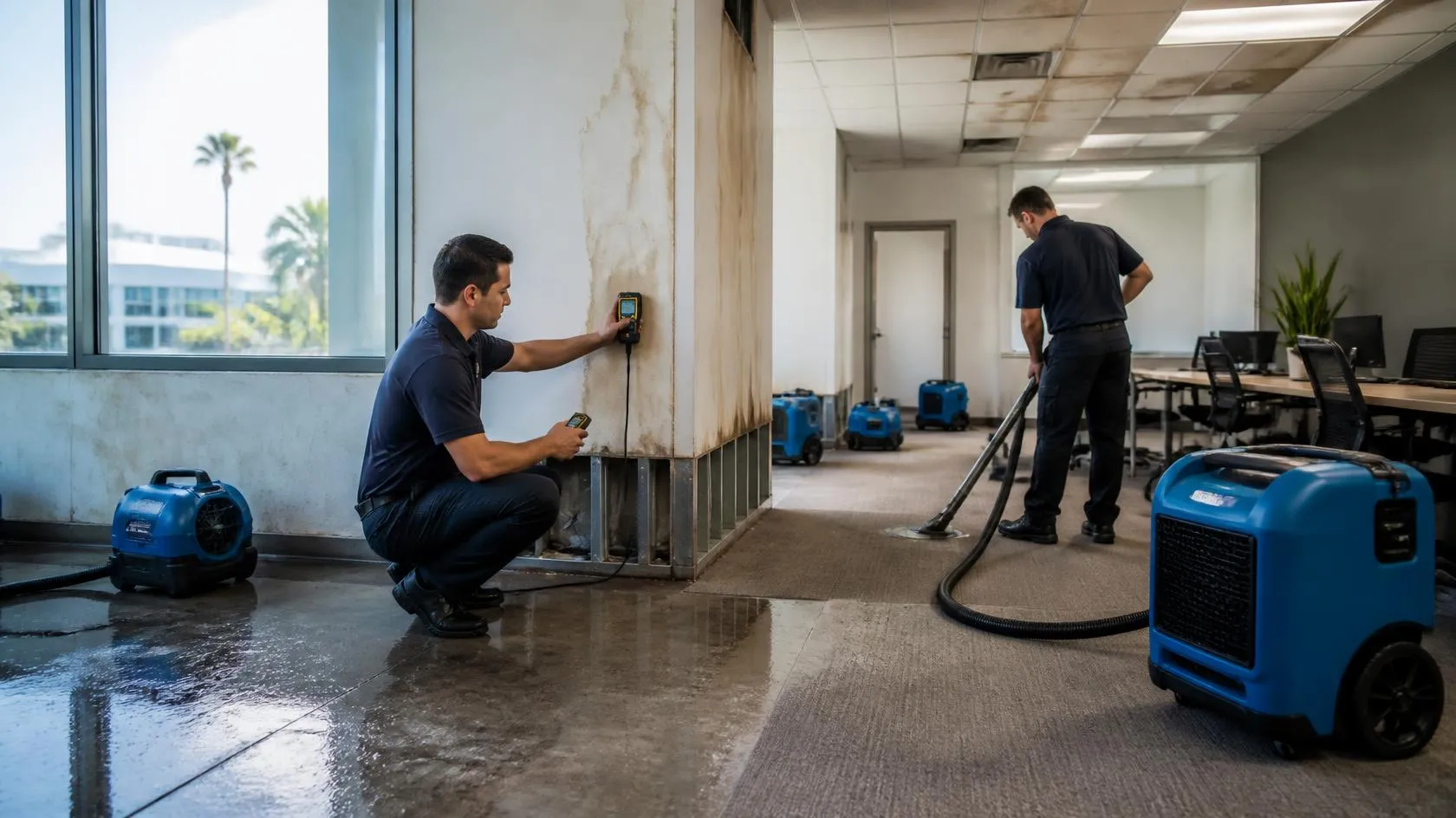
What Changes When the Building Has to Keep Working
Phased work instead of full possession. Residential crews get the house; commercial crews get what the business can spare. Restoration is planned in zones — containment isolating the affected area while the rest operates, equipment staged and cabled out of customer paths, noisy phases scheduled to closed hours where the business’s rhythm allows. A retail floor dries behind clean containment walls customers barely register; a restaurant’s dining room comes back in sections.
After-hours and overnight execution. The 24/7 capability that answers emergencies also schedules: demolition, loud drying phases, and odor treatments run overnight and on dark days so operating hours stay operating. Ozone treatment in particular — inherently an unoccupied-space process — slots naturally into a commercial building’s closed hours.
The stack of stakeholders. A commercial loss answers to more people than a homeowner: the owner, the property manager, the affected tenants, the board, the adjusters — often several of each. The service that matters as much as the drying is communication built for that stack: a single point of contact, written scopes, daily progress documentation, photographs from spaces decision-makers won’t personally enter, and the paper trail that lets a property manager forward one email instead of translating twelve phone calls.
Business-grade documentation. Commercial claims and commercial landlords both run on records, and every Gold Coast commercial loss produces them as standard practice: cause and category determination, moisture maps, daily drying logs to documented standard, contents and inventory records where stock was involved, disposal records under the waste hauler permit, and the reconstruction scope — assembled the way San Diego’s commercial adjusters and management companies have received them for three decades.
The Process, at Commercial Scale
The science doesn’t change with square footage — extraction before evaporation, category-honest protocols, drying to instrumented standard — but the execution scales:
Response and stabilization sized to commercial volume: high-capacity extraction across large slabs, sprinkler and riser shutoffs coordinated with building systems, emergency containment protecting inventory, equipment, and records, and — where storm damage opened the envelope — emergency covering coordinated so the building stops taking water.
Honest classification, applied without flinching. Restroom and sewer-side events, ground-entry storm water, and long-dwelling losses get the full Category 2 and 3 protocols — contaminated porous materials removed under containment, surfaces cleaned and sanitized, disposal handled under permit — because a business’s exposure to a shortcut is larger than a homeowner’s, not smaller. And per the company’s standing philosophy, the same honesty runs the other way: clean-water losses caught fast get the fullest saves the readings support, and nobody scopes a bigger closure than the meters justify.
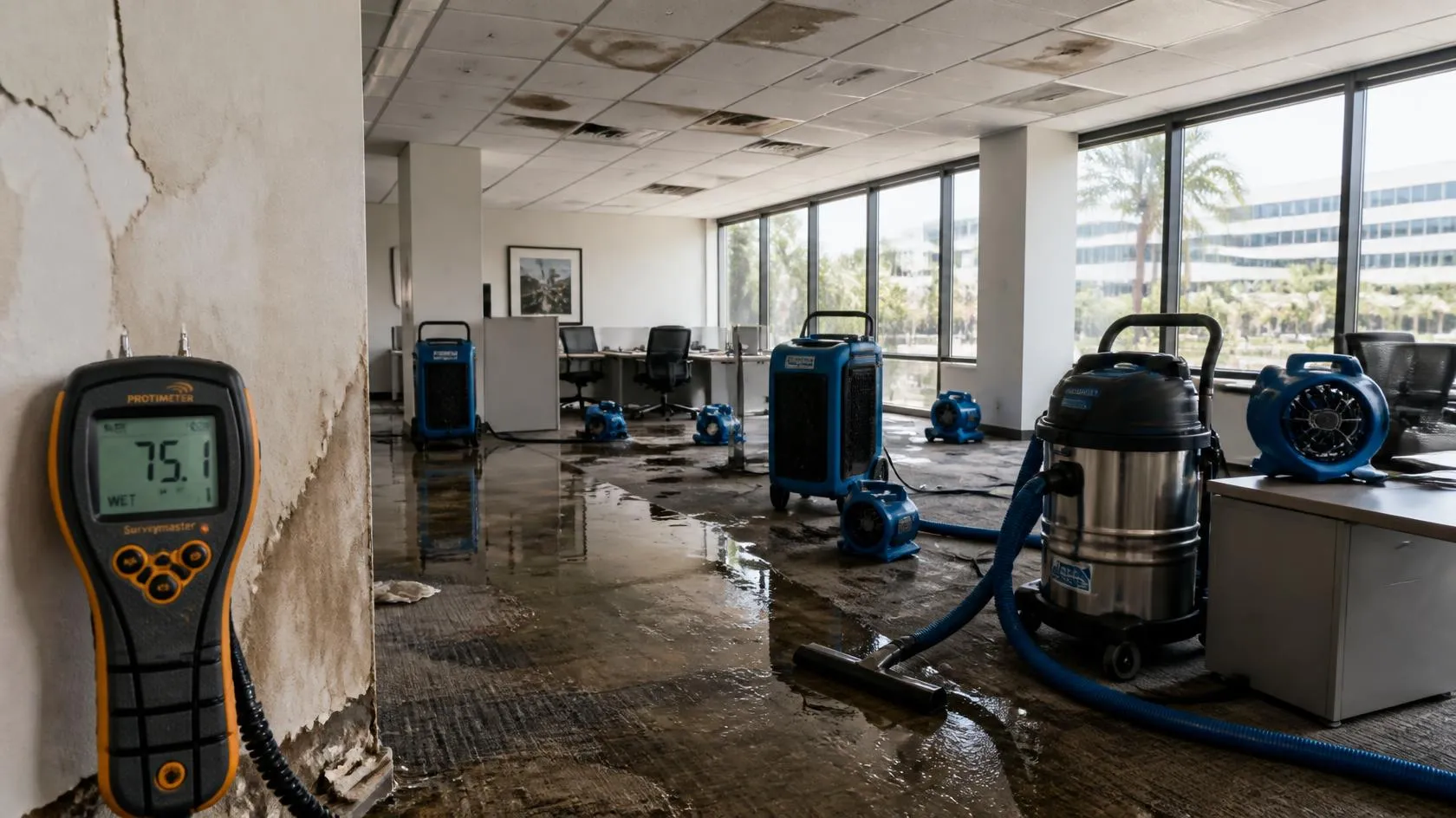
Drying at scale, verified. Commercial dehumidification and airflow matched to the space’s real load, monitored daily to documented dry standard under the firm’s IICRC Applied Structural Drying certification — with the drying log doubling as the business-interruption claim’s timeline evidence.
Mold response where the timeline demands it, under containment, with independent third-party verification — the clearance a landlord can hand a returning tenant, or a board can file, from a tester with no stake in the result.
Reconstruction under one license. Demising walls, ceilings and grid, flooring, finishes — the general contractor license carries commercial spaces from dry to occupancy-ready, coordinated with building management and, where the loss triggered improvements, scoped as the tenant-improvement-grade work commercial rebuilds often become.
The Insurance Note — Commercial Edition
Commercial losses run through commercial policies, and the landscape differs from the homeowner version in ways worth naming plainly. Commercial property policies carry their own water provisions and exclusions; business interruption coverage — where carried — turns on documentation of the closure’s cause, duration, and mitigation, which makes the restoration timeline itself claim evidence; multi-tenant losses routinely involve several policies (building, tenant, association) apportioning one event; and sprinkler discharges, sewer backups, and flood each meet their own policy treatment. No restoration company can honestly promise what any policy will pay, and this one won’t. What it provides is what commercial claims run on: the cause determination made early, the mitigation clock documented from the first hour, and the complete file — built for the adjuster stack a commercial loss actually has.
Frequently Asked Questions
Question: Can we stay open during the restoration?
Answer: That’s the planning target, and it’s achievable more often than owners expect: containment isolating the work zone, phased scheduling around operating hours, and overnight execution of the disruptive stages. Full closures happen — whole-space contamination, essential-area losses — but partial operation is the norm, and the plan is built around your hours from day one.
Question: A pipe failed upstairs and three of our units are wet. Who handles what?
Answer: That’s the stacked-unit loss, and the working answer is: one restoration company across all affected units, one documentation set, and the coverage apportionment worked out between the policies involved — association, owners, tenants — using that shared record. Fragmenting the mitigation across multiple contractors fragments the evidence too; the single-file approach serves every party’s claim.
Question: A sprinkler head discharged over our stockroom. How bad is this?
Answer: Volume-wise, serious — a fused head flows fast until the system’s shut down — but sprinkler water is typically a clean-side event, which means aggressive extraction, inventory triage, and drying offer real saves. The inventory documentation runs parallel to the structural work, because the stock loss is usually the bigger claim line.
Question: How fast can you actually get to a commercial loss?
Answer: The 24/7 line is answered around the clock, and commercial emergencies — where every hour is operating cost — are triaged accordingly. During county-wide storm events crews run continuously; the earlier the call, the earlier the slot, and stabilization starts on arrival, not after estimates.
Question: Our property manager needs everything in writing for the board. Is that a problem?
Answer: It’s the standard product: written scope, daily logs, photo documentation, and a file organized for forwarding. Three decades of HOA and management-company work have shaped exactly what that paperwork needs to look like, and it arrives without being chased.
Question: Do you handle the rebuild too, or just the drying?
Answer: Both, under one license — CA General Contractor #838802 — from demolition through occupancy-ready finishes, coordinated with building management and scoped to tenant-improvement grade where the rebuild warrants it. One accountable company from the emergency call to the reopening.
Every Closed Hour Has a Price — The Response Sets It
Commercial water losses are won in the first day and finished in the file: fast stabilization, honest classification, phased work around your operation, and documentation built for everyone who’ll ask. One call starts all of it.
Gold Coast Flood Restorations Serving San Diego and all of San Diego County
24/7 Emergency Line: (858) 495-9133 Book online: goldcoastflood.com/appointment-form
IICRC Certified | Licensed General Contractor #838802 | A+ BBB Rated | Serving San Diego County for 35+ Years | 24/7 Emergency Response
Service areas include: San Diego, Santee, El Cajon, La Mesa, Alpine, Lakeside, Spring Valley, Poway, Scripps Ranch, Rancho Bernardo, Rancho Penasquitos, Rancho Santa Fe, Del Mar, Solana Beach, Encinitas, Carlsbad, La Jolla, Carmel Valley, Mira Mesa, Sorrento Valley, University City, Tierrasanta, and throughout San Diego County