San Diego’s climate keeps a peculiar secret from its homeowners: it hides bad roofs. For eight or nine rain-free months a year, a failed flashing, a slipped tile, a cracked skylight seal, or a clogged valley costs nothing and announces nothing. Then the first real storm of the season arrives — increasingly, an atmospheric river dropping an inch or more in a day — and every deferred weakness on the roof cashes in at once. The result is a very San Diego pattern: roof leak damage arrives in clusters, all over the county, in the same 48 hours. When it arrives at your ceiling, Gold Coast Flood Restorations has been handling the interior side of that story for more than 35 years — 24/7 storm response, IICRC-certified drying, and a contractor’s license to rebuild what the rain reached.
During the Storm: What to Do While It’s Still Raining
A roof leak mid-storm can’t be fixed from inside, but the damage below it can be managed:
- Contain the water. Buckets under drips, towels at spreading edges, plastic sheeting or trash bags over furniture and electronics that can’t be moved.
- Relieve any ceiling bulge. A sagging pocket of ceiling is water accumulating above the drywall. One small screwdriver hole at the bulge’s low point, bucket underneath, drains it on your terms instead of letting the ceiling choose its moment.
- De-energize wet fixtures. If water is coming through or near can lights, fans, or fixtures, switch off those breakers. Water and ceiling electrical share the same cavity.
- Move what matters. Anything under the leak’s path — and remember water travels along framing, so the path is wider than the drip.
- Call Gold Coast — storms are exactly what 24/7 means. Interior mitigation doesn’t wait for the rain to stop; extraction and drying can begin while the roof waits for weather.
- Photograph everything, timestamped. The active leak, the storm, the spread — this documentation ties the damage to the event, which matters enormously for the insurance conversation.
Once the weather allows, the roof itself needs temporary protection — tarping or patching — so the next band of rain doesn’t repeat the loss. Gold Coast coordinates that step with roofing contractors as part of stabilizing the loss.
Two Trades, One Loss
A roof leak is really two projects wearing one name, and homeowners get the best outcome when both are understood.
The roof is the roofer’s job. Finding and repairing the failure point — flashing, underlayment, tile, penetrations — is roofing work, and it must happen or the restoration below is just rehearsal for the next storm. Gold Coast works alongside the homeowner’s roofer routinely and sequences the interior work with the roof repair.
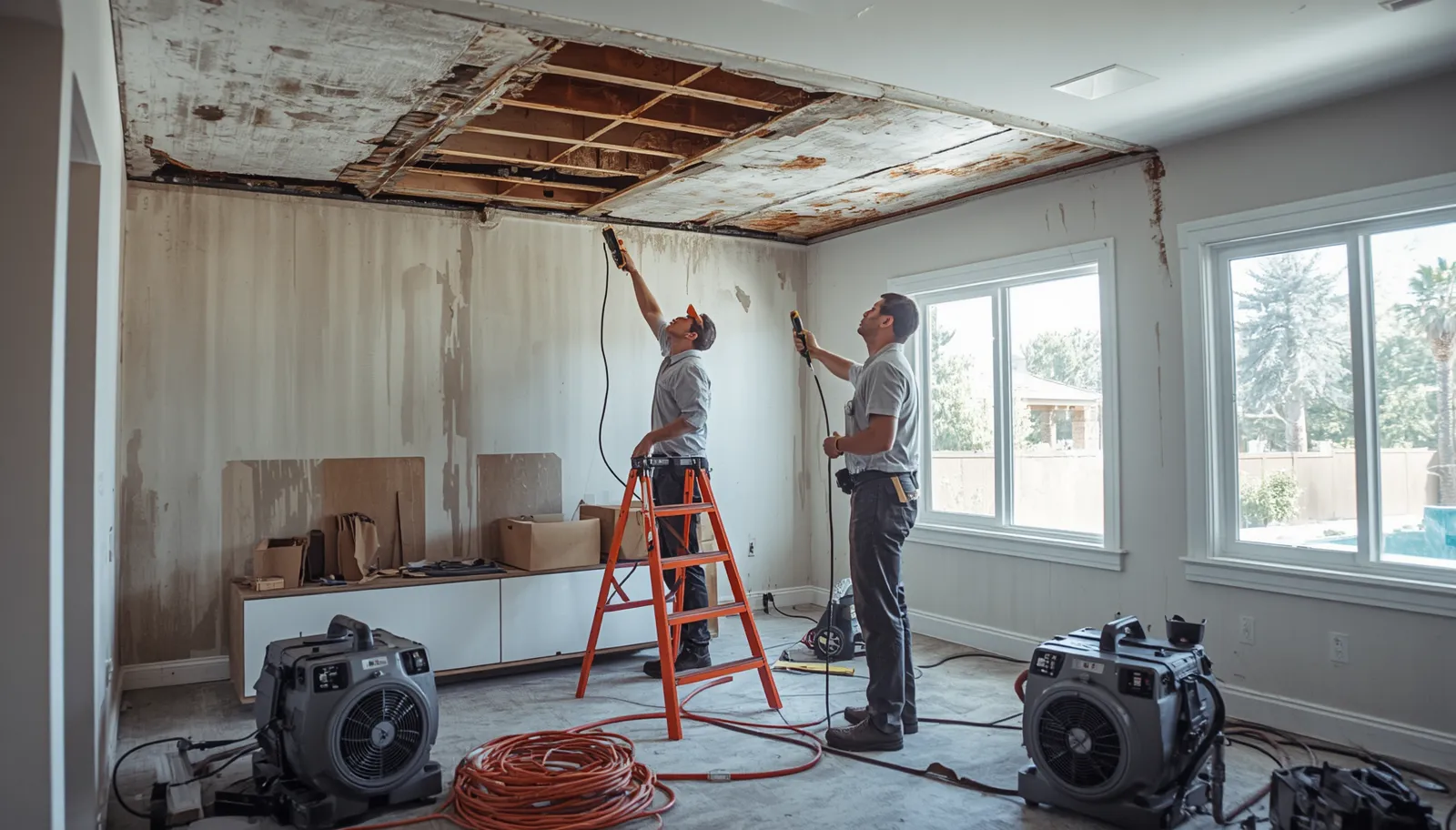
Everything below the roof deck is the restoration job — and it’s usually the bigger scope. By the time a drip reaches a ceiling, the water has already passed through the attic: soaking insulation (which holds water against framing and drywall like a sponge), wetting rafters and joists, tracking along framing to emerge rooms away from the actual roof failure, and loading the back of the ceiling drywall. The interior loss is an assembly problem, not a stain problem — which is why the response starts with instruments, not paint.
Where San Diego Roofs Let Go
Three decades of storm seasons produce a reliable map of the county’s roof failures:
Flashing and penetrations. The metal transitions at chimneys, vents, skylights, and wall intersections are the leading leak source on otherwise sound roofs — sealants age out in the UV of the long dry season and fail unnoticed until tested by rain.
Tile roof underlayment. The concrete and clay tile that defines so many local neighborhoods sheds most water, but the felt or synthetic underlayment beneath does the real waterproofing — and underlayment has a lifespan the tiles above conceal. An aging tile roof can look perfect from the curb and leak like a colander in a driving rain.
Skylights. Seals and curb flashings fail with age, and a skylight leak delivers water directly into living space with no attic buffer.
Valleys, crickets, and debris. Leaves and jacaranda litter accumulate through the dry months precisely where roof geometry concentrates water; the first storm turns clogged valleys into overflowing ones, driving water under the roofing.
Low-slope and flat sections. Room additions, patio conversions, and the flat-roof sections common on mid-century homes pond water and stress their membranes — a disproportionate share of chronic leaks live on these sections.
Wind-driven rain. The county’s stronger storm systems push rain sideways into vents, under ridge caps, and past defenses that handle vertical rain fine — producing leaks in roofs with nothing technically broken.
What the Water Does Between Roof and Ceiling
The attic is where roof leak losses grow silently. Saturated insulation loses its value and holds moisture against wood framing for days; wet attic dust and cellulose become a growth medium; and the enclosed, unconditioned space dries poorly on its own — conditions that put attic assemblies squarely inside the 24–48 hour window in which mold can establish on damp materials. Meanwhile the ceiling drywall wicks from the back face, stains keep spreading after the rain stops, and water that found the wall tops continues down into wall cavities. A one-hour leak routinely produces a one-week drying map — which is only discoverable with moisture meters and thermal imaging, and only fixable with the assembly actually opened where the readings require and dried where they allow.
How Gold Coast Restores Roof Leak Damage
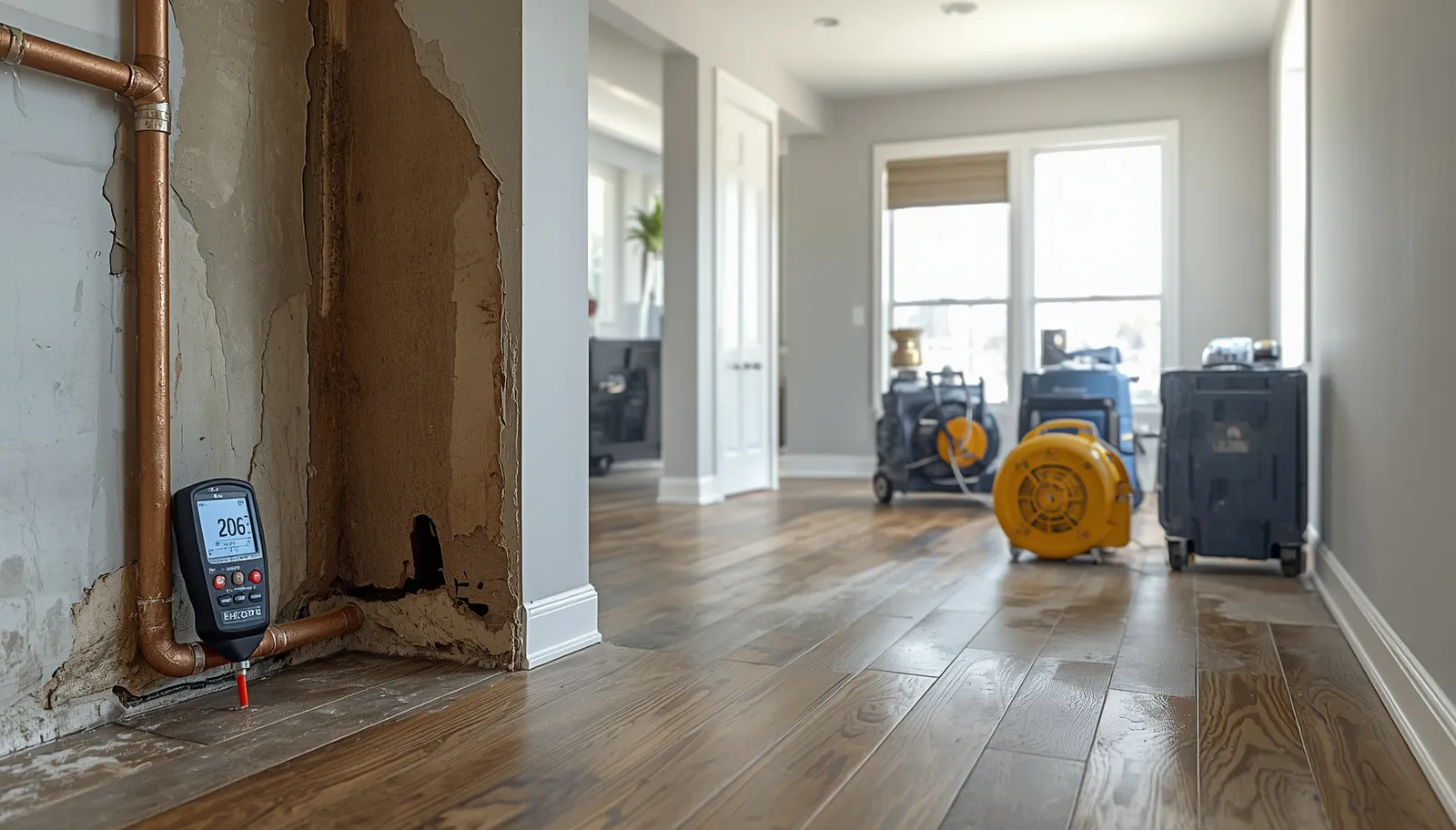
Stabilize and map. With the roof tarped or repaired and the source verified, the crew maps the full wet footprint — attic insulation, framing, ceiling and wall drywall, and flooring the drips reached — with instruments, before any material decisions are made.
Remove what’s ruined, dry what isn’t. Saturated insulation comes out (wet insulation neither insulates nor dries in place); ceiling drywall is removed where readings condemn it and dried where they don’t. Older homes get the protections their materials require: pre-1980s acoustic ceiling texture is tested before disturbance for asbestos, and pre-1978 painted surfaces are handled under lead-safe practice — Gold Coast is a U.S. EPA Lead-Safe Certified Firm and Certified Renovator, so the legal way is the standard way.
Dry the assembly to standard. Air movers and commercial dehumidifiers configured for attic and cavity drying, monitored daily until the framing and remaining materials reach documented dry standard — the applied discipline behind the firm’s IICRC Applied Structural Drying certification.
Address mold where the timeline created it. Chronic leaks — the ones that stained a little more each storm for two winters — frequently arrive with established attic or cavity mold. Where found, it’s contained and remediated, with independent third-party testing verifying the result.
Rebuild to finished. New insulation, drywall, texture matched, paint — under the same general contractor license (CA #838802) that’s been rebuilding San Diego interiors for decades. One company from tarp to texture; the roof repair itself stays with the roofer, sequenced so neither trade waits on the other.
The Insurance Reality for Roof Leaks
Roof leak claims turn on one question: what caused the opening? Sudden storm damage — wind lifting tiles, a branch puncture, storm-created openings — commonly triggers coverage for the resulting interior damage. Wear and tear — the aged-out underlayment, the long-failed flashing — commonly doesn’t, and the interior damage from a maintenance-condition leak is frequently contested on the same grounds. It’s the least predictable category of water loss coverage, policies differ, and no restoration company can promise an outcome. What demonstrably helps: documentation tying damage to the storm event (dated photos, weather records, the mitigation timeline) and a clean written scope of the interior loss — exactly the file Gold Coast has been building for San Diego adjusters through every storm season for 35 years. Report promptly, photograph the roof damage before repairs erase the evidence, and keep the claim’s story anchored to the event.
Frequently Asked Questions
Question: The stain showed up during the storm but stopped growing. Is it dry up there now?
Answer: Almost certainly not. The insulation and framing above a stain hold moisture long after the drip stops, and stains that “stopped” routinely sit under attics that are still wet — inside the mold window. A moisture map answers it in an hour; assuming answers it in a remediation.
Question: Should I call a roofer or Gold Coast first?
Answer: Call Gold Coast during the event — interior mitigation can’t wait for weather, and the loss needs stabilizing and documenting immediately. The roof repair gets coordinated in parallel; both trades end up on site in the right order.
Question: My roof leaked in last winter’s storms and I just painted over the stain. Problem solved?
Answer: Only if three things were true first: the roof failure was actually repaired, the attic assembly was verified dry, and no growth had established in the interim. Paint over an unverified assembly hides the evidence without changing it — and the next storm reports back.
Question: Does insurance cover roof leaks?
Answer: It depends on cause more than any other water loss: storm-created damage commonly yes, wear-and-tear commonly no, and the line between them is where claims are argued. Dated documentation of the storm, the damage, and the mitigation is the strongest card a homeowner holds. No one can honestly guarantee the outcome.
Question: The leak came through a can light. Is that dangerous?
Answer: Treat it as live until proven otherwise — switch off that circuit and leave the fixture alone. Water in ceiling electrical is an electrician’s checkpoint during the restoration, and fixtures that took water get evaluated before re-energizing.
Question: Do you repair the roof too?
Answer: The roof stays with a roofing contractor — it’s a distinct trade and the honest division of labor. Gold Coast stabilizes the loss, coordinates the tarping and repair sequence, and owns everything from the roof deck down: attic, ceilings, walls, floors, and the rebuild.
When the Storm Finds the Roof, Don’t Let It Keep the House
The rain picked the weakness; what happens next is chosen. Contain it, call it in, and get the attic-to-floor loss mapped, dried, and rebuilt right.
Gold Coast Flood Restorations Serving San Diego and all of San Diego County
24/7 Emergency Line: (858) 495-9133 Book online: goldcoastflood.com/appointment-form
IICRC Certified | Licensed General Contractor #838802 | A+ BBB Rated | Serving San Diego County for 35+ Years | 24/7 Emergency Response
Service areas include: San Diego, Santee, El Cajon, La Mesa, Alpine, Lakeside, Spring Valley, Poway, Scripps Ranch, Rancho Bernardo, Rancho Penasquitos, Rancho Santa Fe, Del Mar, Solana Beach, Encinitas, Carlsbad, La Jolla, Carmel Valley, Mira Mesa, Sorrento Valley, University City, Tierrasanta, and throughout San Diego County