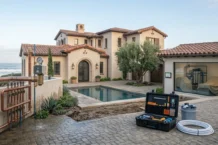
San Diego County has one of the highest concentrations of backyard pools in the country, and the larger, sloped lots common in Poway, Rancho Bernardo, Rancho Santa Fe, and Alpine mean a lot of that equipment sits close to a wall of the house or an attached casita or garage. Homeowners check their kitchen and bathrooms for leaks almost by habit. Almost nobody walks out to the pool equipment pad daily. That gap is exactly why pool and spa equipment leaks quietly become some of the more expensive water damage claims we see in San Diego County — not because the leak itself is dramatic, but because it runs unnoticed against a foundation wall far longer than an indoor leak ever could.
Why Pool Equipment Leaks Go Unnoticed Longer Than Indoor Leaks
An indoor leak under a sink or behind a washing machine usually announces itself fairly quickly — a damp cabinet floor, a musty smell, a spike in the water bill a homeowner connects almost immediately to something inside the house. A pool equipment leak doesn’t get that same daily scrutiny. The pump, filter, heater, and plumbing are usually tucked behind a side-yard gate, often screened by landscaping so guests don’t have to look at them. Many homeowners only visit that pad when something obviously stops working — the pump won’t prime, the heater won’t fire — not on a routine basis.
Autofill (or auto-leveler) lines make this worse. They run under constant pressure to top off water lost to evaporation, so a small crack or loose fitting can leak continuously, day and night, without ever creating a puddle a homeowner would notice. The water simply disappears into the soil around the pad. A pool that’s topping itself off normally masks the leak completely — the water level looks fine because the autofill is quietly replacing what’s escaping underground.
Common Failure Points in a Pool or Spa Equipment Room
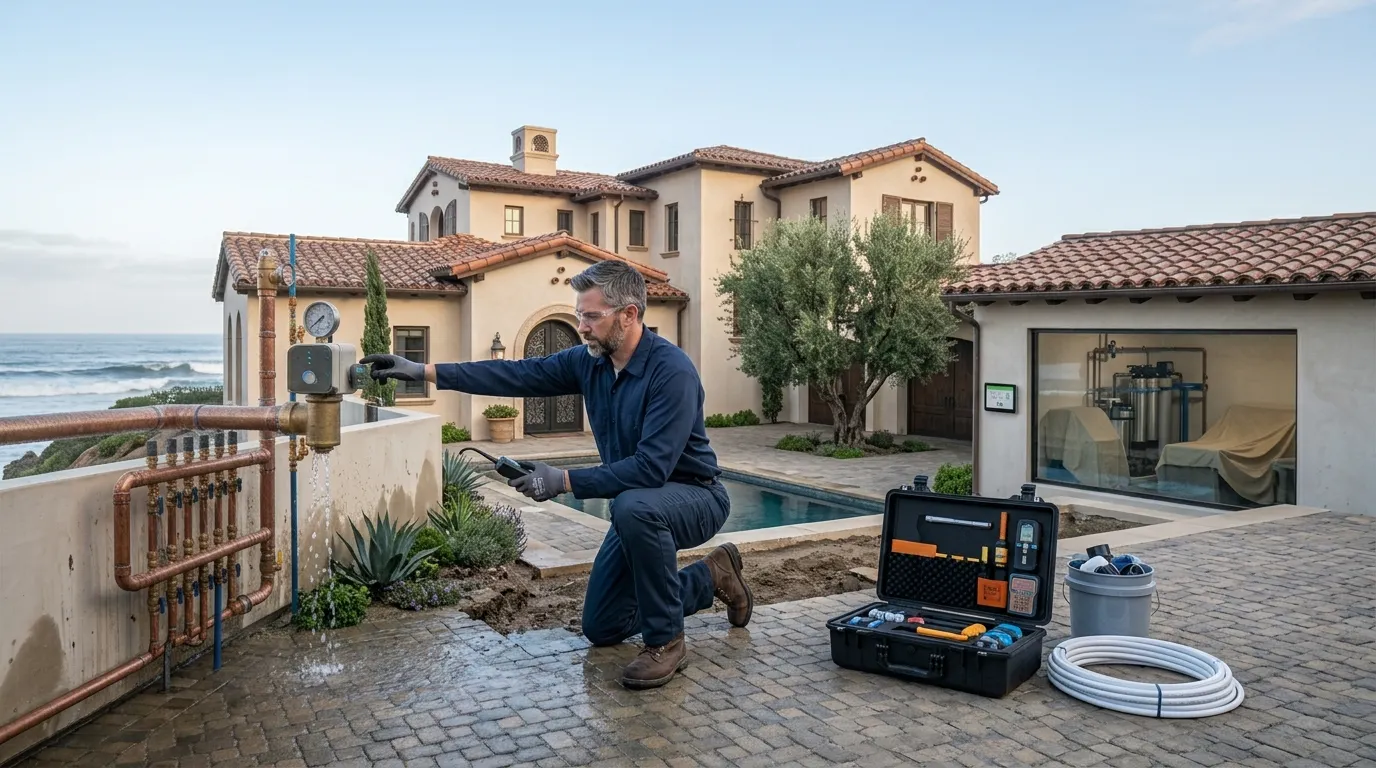
Most equipment-pad leaks trace back to a small number of predictable failure points. Knowing where to look shortens the time between “something seems off” and an actual repair.
Cracked Pump and Filter Housings
Pump housings, strainer lids, and filter tanks are typically PVC or reinforced plastic, and they age. UV exposure, San Diego’s wide day-to-night temperature swings, and years of motor vibration make the plastic brittle over time. Cracks commonly start at the strainer lid, the seal plate behind the impeller, or the unions where PVC pipe threads into the housing. On the suction side, a crack usually shows up first as air bubbles in the strainer basket rather than dripping water, since that side runs under negative pressure. On the discharge side, after the water has been pressurized, the same kind of crack sprays or drips visibly — usually what finally gets a homeowner’s attention.
Heater Leaks
Pool and spa heaters leak most often at the header/manifold, the pressure switch fitting, or where copper heat-exchanger tubing meets the header. Corrosion from chemically imbalanced water — chlorine and pH outside the recommended range — is a common culprit. A heater leak can be almost invisible at first, since heaters are often bolted to a concrete pad with limited clearance underneath, letting water wick sideways into the pad and surrounding soil rather than pooling somewhere obvious.
Valve and Plumbing Failures
Every equipment pad has several PVC valves — for the pump, heater bypass, and often a solar or spa valve — plus buried plumbing connecting the pool shell to the pad. Valve handles and O-rings degrade with age and sun exposure, and buried joints can separate from ground movement or simple settling over years. Because much of this plumbing is underground, a break there can leak for a long time with no visible sign at the surface except gradually damp or spongy soil.
Autofill / Water-Leveler Malfunctions
The autofill valve and its float mechanism are among the most common sources of slow, sustained water loss. A stuck float, worn valve seat, or cracked fill line lets water trickle continuously. Because the system is designed to run unattended, a malfunction here can go undetected for days or weeks, showing up first as an unexplained jump in the water bill rather than anything visible at the pool itself.
| Failure Point | What Typically Fails | Early Warning Sign |
|---|---|---|
| Pump / filter housing | Cracked lid, seal plate, or union fitting | Air bubbles in strainer basket; drips or puddling under the pump |
| Spa or pool heater | Corroded header, manifold, or pressure-switch fitting | Damp concrete under the heater; mineral staining on the pad |
| Valves & buried plumbing | Worn O-rings, cracked PVC, separated underground joints | Spongy or unusually green/soggy soil near the pad |
| Autofill / water leveler | Stuck float, worn valve seat, cracked fill line | Rising water bill with no visible leak; pool that never seems to need manual topping off |
| Adjacent slab & stucco | Saturated soil causing differential settlement | Hairline stucco cracks, efflorescence (white chalky residue), doors/windows near the pad sticking |
How a Hidden Equipment Leak Reaches Your Foundation, Slab, and Walls
The mechanism is straightforward once you see it laid out. San Diego County soils, especially inland and in the foothill communities, hold a mix of clay content that expands when saturated and contracts when it dries. A pool equipment leak introduces a steady, concentrated source of water into the soil at one specific spot — often just a few feet from the house, since equipment pads are typically built close to the structure for plumbing efficiency. Over days or weeks, that soil becomes saturated well beyond what normal irrigation or rainfall would produce.
Saturated soil loses bearing capacity and can shift or settle unevenly under a nearby footing or slab edge. Because the leak saturates one side of the foundation perimeter more than the rest, the settlement is almost always uneven, and the foundation can crack as it conforms to the newly uneven ground beneath it. Once a crack forms, water finds it, and hydrostatic pressure from the saturated soil pushes moisture through that crack and into the slab or foundation wall — how a leak that starts entirely outside the house ends up producing water stains, cracked drywall, or a musty smell on an interior wall sharing a foundation line with the equipment pad.
Stucco is often the first visible casualty, since it sits directly on the exterior wall closest to the saturated soil. Hairline cracks, bubbling paint, or a chalky white mineral deposit called efflorescence (water wicking through masonry or stucco and evaporating, leaving mineral residue behind) are common early indicators. Left unaddressed, the same moisture pathway staining the stucco is also feeding wood framing, insulation, and drywall on the interior side of that wall — exactly the conditions mold needs, often before any interior sign is visible at all.
What You Can Check Yourself vs. When to Call a Professional
What a Homeowner Can Check
- Walk the equipment pad monthly and check for damp concrete, puddling, or soggy soil around the pump, filter, heater, and valves.
- Watch your water bill. An unexplained increase, especially when nothing inside the house has changed, is one of the most reliable early indicators of a leak.
- Do a bucket test: fill a bucket to the pool’s water level, set it on a step, mark both lines, and compare the drop after 24 hours with the pump off. Pool loss significantly greater than bucket loss (normal evaporation) points to a leak.
- Look at the stucco and foundation line within 10-15 feet of the pad for new hairline cracks, staining, or chalky white residue.
- Check that doors or windows near the pad still open and close smoothly — sticking can signal early foundation movement.
When to Call a Professional
- Damp soil, staining, or standing water at the equipment pad with no obvious explanation (recent hose use, rain).
- A rising water bill that a bucket test or visual inspection can’t explain.
- Visible cracking in stucco, slab, or interior drywall near the equipment area, especially if new or growing.
- Musty odor, soft drywall, or visible mold on an interior wall near the equipment pad.
- After a pool professional repairs the equipment-side leak, have a water damage and mold remediation contractor assess how far moisture already traveled into the slab, wall cavity, and framing — fixing the leak doesn’t undo damage already done.
A Bigger Concern on Poway, Rancho Bernardo, Rancho Santa Fe, and Alpine Lots
This issue shows up especially often on the larger, custom-built lots typical of Poway, Rancho Bernardo, Rancho Santa Fe, and Alpine. These properties tend to have older, established pools with equipment in service well over a decade, sloped or terraced yards that route water toward the house rather than away from it, and equipment pads positioned near a casita, garage, or bedroom wing rather than out in the open. Rancho Santa Fe and Alpine in particular often have larger setbacks and heavier landscaping around the pad, which makes a slow leak even easier to hide from view. On sloped lots, saturated soil can also migrate downhill toward a footing lower in elevation than the equipment itself, so damage sometimes shows up on a side of the house nowhere near the pad. If your property fits this description, treat the equipment pad walk-through as seriously as checking under the kitchen sink.
Frequently Asked Questions
Is a leaking pool pump covered by homeowners insurance?
It depends on the policy and the cause. Sudden, accidental leaks are more likely to be covered, while damage from a leak that ran for weeks due to lack of maintenance is often excluded as a “gradual” or “wear and tear” loss. Document the leak and damage as soon as you find it, and confirm your policy language before assuming either way.
How much water loss from a pool is normal vs. a sign of a leak?
Normal evaporation in San Diego’s climate is typically a quarter-inch to half an inch of water level drop per day, more in hot, dry, or windy conditions. If your pool is losing noticeably more than that, or the autofill runs far more than it used to, a bucket test can confirm whether it’s evaporation or an actual leak.
Can a spa or hot tub connected to the pool equipment also cause foundation damage?
Yes. A spa sharing plumbing, a heater, or a pump with the main pool has the same failure points — cracked fittings, corroded heater connections, and valve failures — and since spas are often built directly against a patio slab or house wall, a leak there can saturate soil even closer to the foundation.
How long does it take for a pool equipment leak to cause visible foundation or stucco damage?
It varies with soil type, leak volume, and proximity to the house, but because these leaks often run continuously and unnoticed, visible cracking or staining can appear within weeks rather than months — especially on the clay-heavy soils common in San Diego County’s foothill communities.
Should I turn off the pool equipment if I suspect a leak?
If you see active water loss or standing water at the pad, shutting off the pump and closing isolation valves (if you know how) can limit further loss until a pool technician arrives. Leave diagnosis and repair to a professional, since misdiagnosing suction-side versus discharge-side leaks is common.
Do I need a mold inspection if I find water damage near my pool equipment room?
If moisture has been present near a wall or slab for more than 24-48 hours, a mold inspection is a reasonable precaution, particularly for a leak that ran unnoticed for a while, which is common with pool equipment. A restoration contractor can assess both the water damage and mold risk in one visit.
Why Gold Coast Flood Restorations
Gold Coast Flood Restorations has served San Diego County homeowners for more than 35 years, and we’ve seen how often water damage that ends up in a foundation or wall cavity started somewhere a homeowner wasn’t looking — including the pool equipment pad. We’re the only water damage restoration and mold remediation contractor in San Diego certified by ToFixIt, and as a Christian-owned company, we built our reputation on honest assessments: we tell you what’s actually happening to your home, not what generates the biggest invoice. Featured on Channel 10 News for that same straightforward approach, we’re available 24/7 for the moment a hidden leak finally becomes visible.
If you’ve spotted damp soil, stucco cracking, or interior staining near your pool or spa equipment in Poway, Rancho Bernardo, Rancho Santa Fe, Alpine, or anywhere in San Diego County, call Gold Coast Flood Restorations today — and ask about our $50 discount on your first service call.