The most expensive water losses in San Diego homes rarely come from the plumbing hidden in walls. They come from the machines everyone can see — the washer, the dishwasher, the refrigerator — connected to the water supply by small hoses and fittings that hold back full house pressure every hour of every day. When one of those connections fails, it picks its moment badly by definition: the burst washer hose flows unattended at hundreds of gallons per hour while the family is at work; the dishwasher leaks only mid-cycle, always after everyone’s gone to bed; the fridge’s ice maker line weeps invisibly behind the cabinet for a year before the hardwood tells on it. Gold Coast Flood Restorations has spent more than 35 years cleaning up exactly these losses across San Diego County — 24/7, IICRC-certified, and licensed to rebuild what the machine ruined.
The Three Machines, Three Different Losses
The washing machine: the catastrophic one. A washer’s supply hoses are the single most notorious failure point in residential water damage nationally — rubber hoses that age, bulge, and finally burst at full supply pressure with nobody standing there. The flow doesn’t stop until someone comes home and finds it, which is why washer-hose losses so often involve multiple rooms, soaked flooring throughout, and — in the two-story homes with upstairs laundry that are common in newer San Diego neighborhoods — a ceiling collapse below. The washer’s other failure, the drain overflow (a clogged standpipe or a failed pump mid-cycle), delivers less volume but delivers it as sudsy gray water, which changes the cleanup.
The dishwasher: the intermittent one. Dishwashers leak from door gaskets, failed pumps, cracked tubs, and supply or drain connections under the adjacent sink — and they leak only when running, which makes the source maddening to confirm. The water exits low and travels under the machine, beneath the cabinet toe-kicks, and under the kitchen flooring, where it can work on the subfloor for weeks between visible puddles. Many “sudden” kitchen floor failures are dishwasher leaks that were never sudden at all.
The refrigerator: the patient one. The ice maker and water dispenser line — often a thin plastic tube run behind cabinets — is the classic slow leak. It doesn’t flood; it moistens, steadily, in a spot nobody looks at. Discovery usually comes as cupped hardwood spreading out from the fridge, a warped toe-kick, a musty smell, or mold found when the appliance is finally pulled out. By then the subfloor has been wet for months, and the loss is bigger than any puddle ever suggested.
Add the honorable mentions — washer door boot seals on front-loaders, under-sink reverse osmosis and filter connections, wine fridges and standalone ice makers — and the pattern is consistent: small connection, big consequence, and a loss whose size depends almost entirely on how long it ran before discovery.
First Response, by Scenario
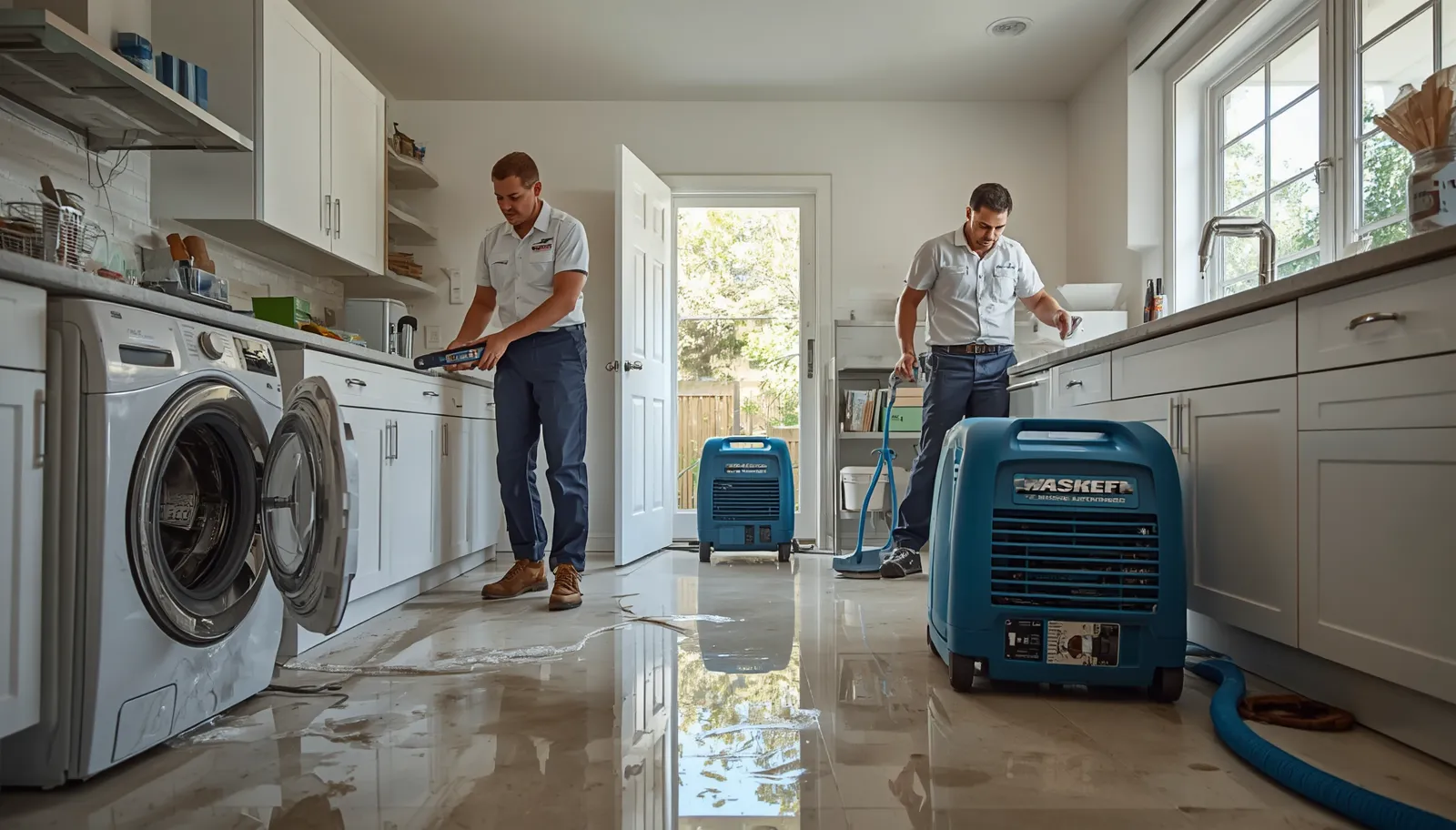
Active flood (burst hose, mid-cycle failure): Close the appliance’s shutoff valves — washer valves are in the wall box behind the machine — or the home’s main if they’re seized or unreachable. Kill power to the area at the breaker if water is near outlets or the machine’s plug. Then call, move belongings up and out of the water’s path, and photograph everything before cleanup begins.
Discovered slow leak (warped floor, musty cabinet, mold behind the fridge): Shut the small valve feeding the appliance line, resist the urge to fan-and-forget, and get the area moisture-mapped. Weeks-old moisture has already spread beyond what’s visible and has likely opened the mold question — the map answers how far, honestly.
Either way, fast matters. Mold can establish on damp materials within 24–48 hours of wetting, and appliance losses are frequently discovered with that window already open. Same-day extraction and drying is the entire strategy.
What Appliance Water Is — and Isn’t
Restoration classifies water honestly, and appliance losses span the scale. A burst supply hose delivers Category 1 clean water — degrading as it dwells. A washer or dishwasher discharge overflow is Category 2 gray water: detergents, soils, and food residues that call for cleaning and sanitization along with drying, though nothing like a sewage loss. And any clean-water leak that has soaked materials for weeks has degraded by dwell time alone. The category assessment isn’t pedantry — it sets the cleaning protocols, what’s salvageable, and how the loss is documented for the insurance file.
How Gold Coast Handles an Appliance Loss
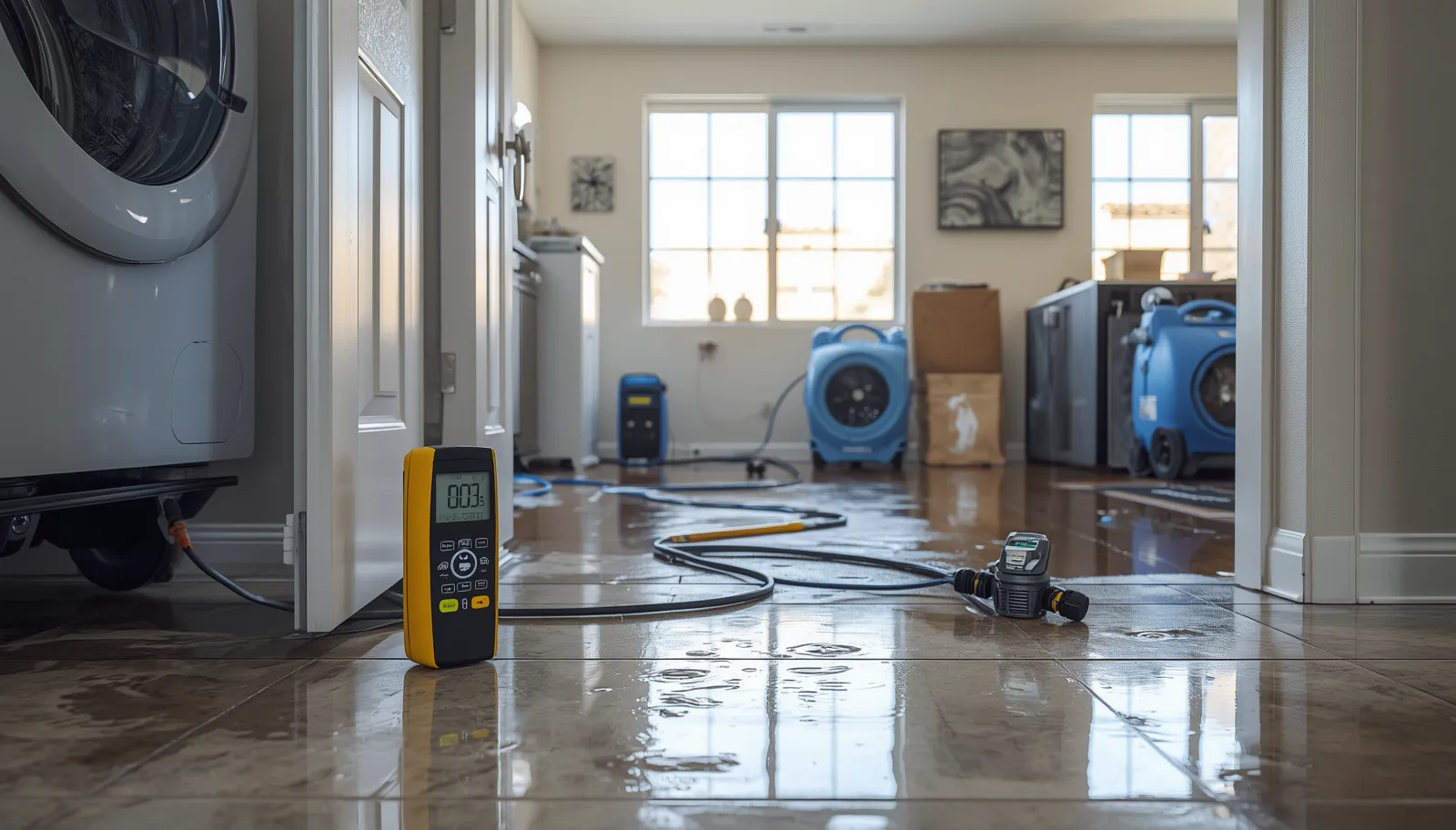
Mapping before anything. Appliance water travels low and hides — under machines, beneath cabinets, inside toe-kick voids, under flooring, and down into ceiling assemblies from upstairs laundries. Moisture meters and thermal imaging trace the true footprint before a single decision is made, because the visible wet is reliably the smallest part of these losses.
Extraction and honest material calls. Standing water and saturated pad are extracted immediately. Flooring, cabinetry, and drywall are evaluated by the readings: what can be dried in place is dried — including cabinet drying with directed airflow rather than reflexive demolition — and what can’t is removed cleanly. Per the company’s standing philosophy, the meters make the case, not the invoice.
Structural drying to a measured standard. Air movers and commercial dehumidifiers configured to the actual assembly — kitchen subfloors, laundry alcoves, wall cavities, ceilings below — monitored daily until instruments confirm the dry standard is met. This is the working discipline behind the firm’s IICRC Applied Structural Drying certification, and it’s what separates a restored kitchen floor from one that fails again in a year.
Mold remediation where the timeline earned it. The slow-leak versions of these losses — the fridge line, the hidden dishwasher drip — frequently arrive with mold established behind cabinets and under flooring. Where found, it’s contained and remediated, then verified by independent third-party testing rather than self-graded.
Rebuild under one license. Subfloor, flooring, toe-kicks, drywall, baseboards, paint — as a licensed general contractor (CA License #838802), Gold Coast carries the loss through reconstruction. Appliance repair or replacement itself belongs to the appliance tech or plumber; Gold Coast coordinates timing so the new machine lands on a dry, rebuilt floor.
The Insurance Angle — Including the Question Adjusters Ask
Appliance failures produce both of insurance’s favorite categories at once. The sudden burst hose is the classic covered loss — sudden and accidental discharge — with resulting damage commonly covered while the hose and machine are not. The months-long fridge line leak is the classic contested one, running into gradual-seepage and maintenance exclusions. Same machine wall, opposite outcomes, and no restoration company can promise which way a given policy lands. What Gold Coast contributes is the documentation that claims actually turn on — moisture maps, photos, drying logs, and a clear written account of the loss — built the way San Diego adjusters have received it from this company for three decades. Practical notes: report promptly, keep the failed hose or fitting for the adjuster, and let the mitigation record speak.
An Ounce of Prevention, Honestly Offered
Restoration companies profit from failed hoses, which makes this advice worth more, not less: replace rubber washer hoses with braided stainless on a five-to-seven-year cycle, close washer valves when leaving town, pull the fridge and eyeball its line once a year, and consider leak-sensor pucks behind each machine — or an automatic shutoff system for upstairs laundries over finished space. Gold Coast would rather meet a homeowner at a small loss than a big one; it says so on its own site, and the advice above is the proof.
Frequently Asked Questions
Question: The washer hose burst while we were at work and multiple rooms are wet. Where do we even start?
Answer: Valves off, breaker off if water reached outlets, one call to Gold Coast, and photos as you go. Multi-room hose losses are precisely what 24/7 extraction crews exist for — the spread stops the hour the equipment arrives.
Question: My kitchen floor is buckling near the dishwasher but I’ve never seen a leak. Is the dishwasher really the cause?
Answer: Very possibly — dishwashers leak only mid-cycle and drain the evidence away with them. A moisture map of the floor and cabinet bases, plus a look while the machine runs, usually settles it. The buckling means the subfloor is involved either way, and that needs drying regardless of which appliance confesses.
Question: We pulled the fridge out and found mold. How bad is this?
Answer: It means the leak has been running long enough to establish growth — typically months — so the inspection goes wider than the visible patch: under flooring, into the cabinet sides and wall base. Containment and remediation handle what’s found, and independent third-party testing verifies the result before rebuild.
Question: Is the sudsy water from a washer overflow a health issue?
Answer: It’s Category 2 gray water — detergents and soils, not sewage. It calls for proper cleaning and sanitization along with drying, and porous materials it soaked get honest evaluation. Unpleasant, manageable, and routine for a certified crew.
Question: Our laundry is upstairs. Does that change the response?
Answer: It doubles it: the laundry room, and the ceiling assembly below. Upstairs appliance losses load insulation and ceiling drywall on the way down, so both levels get mapped and dried — even when the downstairs shows only a stain.
Question: Will insurance cover appliance leak damage?
Answer: Sudden failures commonly yes (minus the appliance itself); long-running slow leaks often meet exclusions. Every policy differs — report early, keep the failed part, document everything. Gold Coast supplies the mitigation records; no honest company guarantees the outcome.
Small Hose. Big Mess. One Call.
Whether the machine flooded three rooms this morning or leaked quietly for a year, the path is the same: map it, extract it, dry it to standard, verify it, rebuild it.
Gold Coast Flood Restorations Serving San Diego and all of San Diego County
24/7 Emergency Line: (858) 495-9133 Book online: goldcoastflood.com/appointment-form
IICRC Certified | Licensed General Contractor #838802 | A+ BBB Rated | Serving San Diego County for 35+ Years | 24/7 Emergency Response
Service areas include: San Diego, Santee, El Cajon, La Mesa, Alpine, Lakeside, Spring Valley, Poway, Scripps Ranch, Rancho Bernardo, Rancho Penasquitos, Rancho Santa Fe, Del Mar, Solana Beach, Encinitas, Carlsbad, La Jolla, Carmel Valley, Mira Mesa, Sorrento Valley, University City, Tierrasanta, and throughout San Diego County