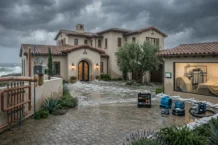
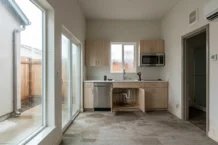
In almost every case, no. A standard homeowners insurance policy does not cover flood damage, meaning water that enters your home from outside — rising creeks, an overflowing storm drain, runoff from a hillside, or a street that floods during heavy rain. That kind of damage is only covered if you carry a separate flood insurance policy, typically through the National Flood Insurance Program (NFIP) or a private flood carrier. What your homeowners’ policy does usually cover is water damage from a sudden, accidental source inside your home, like a burst pipe or a failed water heater. The difference between those two categories determines whether your claim gets paid or denied.
Why “Flood” and “Water Damage” Aren’t the Same Thing to Your Insurer
This is the single most misunderstood part of a homeowner’s policy, and it catches people off guard every time San Diego County gets hit with a serious storm. Insurance companies define a flood very specifically: water from outside a structure that affects two or more properties or two or more acres, usually caused by heavy rain, overflowing rivers or creeks, mudflows, or storm surge. If water comes in that way, your homeowners’ policy almost certainly excludes it, no matter how minor or major the damage is.
What your homeowners policy generally does cover is what insurers call water damage — a pipe that bursts inside a wall, a washing machine hose that fails, a water heater that ruptures, or a roof leak from storm damage to the structure itself (as opposed to floodwater coming through the door). These are treated as sudden and accidental events that occur inside the home, and most standard policies cover the resulting cleanup and repair, sometimes without a deductible.
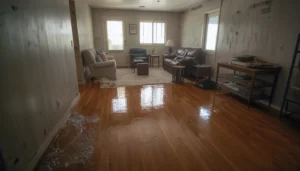
So the question isn’t really “does insurance cover water damage” — it’s “where did the water come from, and how did it get into my home?” That distinction is exactly what claims adjusters are trained to look for first.
What San Diego Homeowners Have Actually Experienced
This isn’t theoretical. San Diego County has had several serious flood events in recent years, including widespread flooding in January 2026 when the San Diego River overflowed its banks near Mission Valley, swamping roads around Fashion Valley, Hotel Circle, and Qualcomm Way, and trapping drivers who needed swift-water rescue. Neighborhoods like Southcrest and Mountain View — areas that flooded in 2023 — saw stormwater back up into homes again, with residents working together to keep rising water away from their front doors. Mission Hills also reported several feet of standing water on local streets during the same storm system.
In nearly all of these cases, homeowners without a separate flood policy were left paying out of pocket. That’s not a hypothetical worst-case — it’s been reported directly by residents affected by Chollas Creek overflowing into homes near South 42nd Street, where a homeowner described being on the phone with her insurance carrier in knee-deep water, only to be told that flood damage wasn’t covered at all.
Who’s Actually Required to Carry Flood Insurance
The Federal Emergency Management Agency (FEMA) maintains Flood Insurance Rate Maps that identify Special Flood Hazard Areas throughout San Diego County. If your home sits in one of these high-risk zones and you have a mortgage from a federally regulated lender, flood insurance isn’t optional — it’s required as a condition of the loan. FEMA updated several of these maps along San Diego’s coastal zones, including South Mission Beach, North Mission Beach, Pacific Beach, and Bird Rock up through La Jolla Shores, shifting those areas from low/moderate risk to high risk and triggering new mandatory coverage requirements for many homeowners there.
But here’s the part that surprises a lot of people: you don’t have to live in a mapped flood zone to flood. More than 20% of flood insurance claims nationally come from properties outside high-risk zones, often from flash flooding, poor drainage, or a storm drain that simply can’t keep up. San Diego’s terrain — canyons, dry creek beds, and steep hillsides that funnel water quickly toward low-lying neighborhoods — makes flash flooding a real risk even for homes nowhere near a river or the coast.
Getting Flood Coverage Before You Need It
Flood insurance is purchased separately from your homeowners policy, either through the NFIP or a private carrier, and there’s a catch that trips people up every storm season: most NFIP policies have a 30-day waiting period before coverage takes effect. You can’t watch a storm forming on the radar and buy a policy that afternoon — by the time rain is in the forecast, it’s already too late to get covered for that event.
The City of San Diego participates in FEMA’s Community Rating System (CRS), which has earned thousands of local property owners and renters a 15% discount on flood insurance premiums because of the city’s floodplain management efforts. San Diego County’s Department of Public Works also maintains an extensive flood warning network — more than 120 ALERT flood monitoring stations, including stream gauges, rainfall sensors, and reservoir level sensors — feeding real-time data that can give residents advance notice when water levels start climbing.
What to Do the Moment Water Gets Into Your Home
Regardless of whether the water came from a flood or an internal failure, your first moves should be the same:
- Get everyone to safety first. Never walk or drive through standing water; even six inches of fast-moving water can knock a person down.
- Stop the source if it’s safe to do so. Shut off the water supply to address an internal leak, or move valuables above the waterline if floodwater outside is rising.
- Document everything before cleanup starts. Photos and video of the water level, affected rooms, and damaged belongings are critical for any claim, flood or otherwise.
- Call your insurance company and ask direct questions. Don’t accept a vague “that’s not covered” — ask specifically whether the claim is being denied because it’s classified as flood versus water damage, and get that reasoning in writing.
- Call a restoration company immediately, even before your claim is settled. Most policies, and certainly the standard policyholder’s bill of rights followed across the restoration industry, entitle you to take reasonable emergency steps to prevent further damage — and you may actually be obligated to do so for any claim to hold up.
Why Acting Fast Still Matters, Insurance or Not
Whether or not your policy ends up paying for the loss, mold doesn’t wait around for a claims decision. According to the U.S. Environmental Protection Agency (EPA), mold can begin growing on wet materials within 24 to 48 hours, and once it does, you’re often looking at a second remediation cost stacked on top of the original flood damage. A fast response from an IICRC-certified restoration company limits how far the damage spreads and gives you the strongest possible documentation if you do end up disputing a claim or filing through a separate flood policy.
Frequently Asked Questions
Does homeowners’ insurance cover a flooded basement or garage? Only if the water came from an internal source, like a burst pipe or sewer backup, covered under your policy’s water damage provisions. If the flooding came from outside — rainwater pooling against the foundation and seeping in, or floodwater entering through a garage door — that’s typically excluded and only covered by a separate flood insurance policy.
What’s the difference between flood insurance and water backup coverage? Flood insurance covers damage from external flooding events, such as overflowing rivers or storm surge. Water backup coverage is a separate, often optional endorsement on your homeowners policy that covers sewer or drain backups, which is a different cause than flooding and is sold separately from both your base homeowners policy and flood insurance.
Can I buy flood insurance if my home has flooded before? Yes. You can purchase flood insurance even if your property has a history of flooding, though pricing may be higher in designated high-risk areas. The NFIP doesn’t deny coverage based on prior flood claims, as some private insurers might.
Is there a waiting period before flood insurance coverage starts? Yes, NFIP policies typically have a 30-day waiting period before coverage becomes effective, with limited exceptions for new mortgage closings or recent flood map changes. This is exactly why insurance agents recommend buying flood coverage well before storm season rather than waiting for a forecast.
Will my insurance cover mold that grows after a flood? It depends on the policy and the cause of the original water intrusion. Some homeowners’ policies require a separate mold remediation endorsement, and flood policies may have their own limits on mold coverage. This is worth confirming with your carrier in advance, since mold exclusions are common and vary significantly between policies.
If my neighborhood floods every few years, am I stuck without options? No. You can still purchase flood insurance, and your community’s participation in FEMA’s floodplain management program may even reduce your premium. Property protection measures such as elevation or improved drainage can also help, and some of these qualify for FEMA hazard mitigation grants administered by the state or county.
Get Help Fast, Whatever Caused the Water
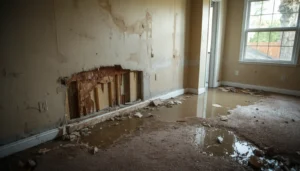
Sorting out what your policy covers can wait a few hours. Standing water in your home cannot. Gold Coast Flood Restorations has served homeowners throughout San Diego County for more than 35 years, with IICRC-certified technicians available 24/7 to extract water, begin structural drying, and document the damage properly — whether you’re dealing with a flooded street in Mission Valley, a backed-up storm drain near Southcrest, or a burst pipe that has nothing to do with the weather at all. The company is BBB-accredited with an A+ rating and works directly with insurance companies to help homeowners get the claims process started correctly from day one.
If water has entered your home anywhere in San Diego County, call Gold Coast Flood Restorations now at (619) 449-9611 for emergency extraction and a damage assessment before the situation worsens.