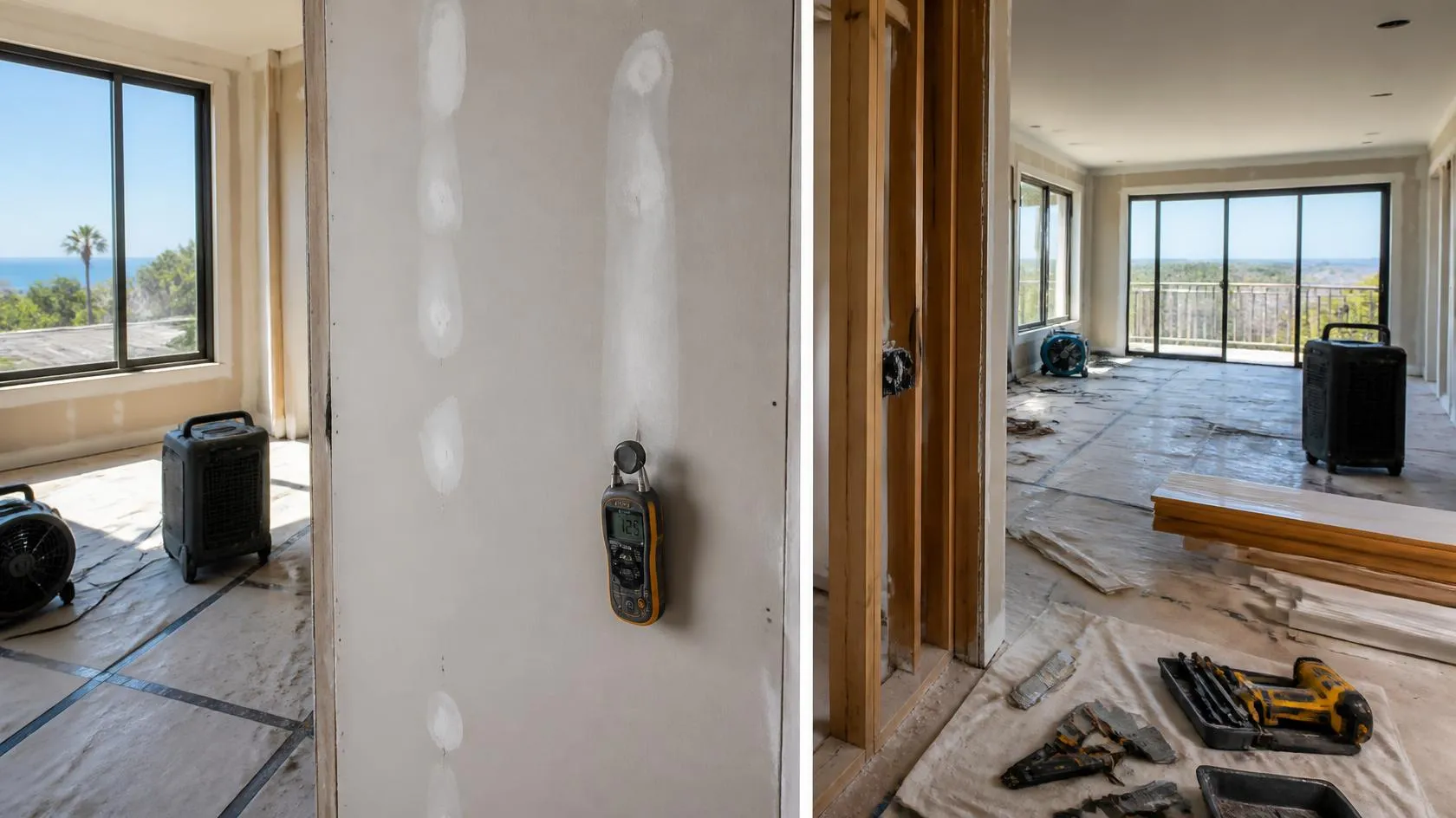
There’s a moment in many water losses that homeowners don’t see coming: the day the drying company declares victory and leaves. The structure is dry, the equipment is gone — and the house is still opened up. Flood-cut walls, missing baseboards, bare subfloor, a ceiling with a hole where the leak came through. “Dry” turned out to be the halfway point, and the second half needs a contractor who, it turns out, isn’t returning calls about a job this size.
That gap — between mitigation and a finished home — is exactly what Gold Coast Flood Restorations was built to close. As both an IICRC-certified restoration company and a licensed California general contractor (License #838802), it carries losses through the half most restoration outfits can’t touch: the reconstruction. One company, one accountable license, from the emergency call to the final coat of paint.
Why the Gap Exists — and What It Costs
The restoration industry splits at the drywall. Mitigation companies dry structures but many hold no contractor’s license, so their work legally and practically ends where rebuilding begins. General contractors hold the license but often decline water-loss repairs — the jobs are irregular, insurance-entangled, and small by remodel standards. The homeowner inherits the seam: a second round of bids mid-crisis, a schedule reset to zero, a new company re-learning the loss, and an insurance scope negotiated by someone who wasn’t there for the mitigation.
The seam costs more than patience. Scope details get lost in the handoff — which walls were cut to what height and why, what the moisture map condemned, what the readings cleared. The rebuild estimate and the adjuster’s scope drift apart with no one holding both. And the weeks between “dry” and “started” are weeks a family lives in an opened-up house.
The integrated answer removes the seam entirely: the crew that mapped the moisture and made the cuts is the company that closes them, on one schedule, one file, one accountability.

What Reconstruction Covers
Closing the mitigation’s openings. Flood cuts closed with matched board, insulation replaced where it was removed, access openings in ceilings and walls rebuilt — the direct undoing of what the loss and its cleanup required.
Surfaces back to invisible. Drywall taped and floated flat, texture matched across San Diego’s full catalog of finishes — the craft standard being a repair nobody can find — with primer and paint carried to clean break points so sheen matches too.
Flooring, the full decision tree. Hardwood relaced and refinished after proper acclimation, or replaced where the loss condemned it; new pad and restretch under saved carpet; laminate and vinyl replaced over verified-dry subfloor; tile rebuilt over sound substrate — with the continuous-run matching question laid out honestly, options and prices attached.
The rooms water loves most. Post-loss bathroom and kitchen rebuilds are the deep end of this work: shower enclosures reconstructed with modern waterproofing behind new tile, vanities and cabinet runs repaired or replaced, subfloor and backer renewed — the rebuilds covered in depth on the shower, bathroom, and kitchen pages, all executed under this license.
Structural repairs. Where water had time to work on the bones — rotted subfloor, compromised joists, softened framing, the crawl space’s long-neglect casualties — the repair is structural carpentry, permitted and inspected where the scope requires it, done before any finish hides it.
Trim, doors, and the finish details. Baseboards, casings, swollen doors re-hung or replaced, the hundred small items that separate “repaired” from “restored.”
The Rules the Rebuild Never Breaks
Nothing closes over an unverified assembly. The prime directive, carried from every mitigation page on this site: reconstruction begins only after materials read at documented dry standard — and, where mold was remediated, only after independent third-party testing clears the work. The most expensive drywall in the world is the sheet installed over a wet plate, and this company doesn’t hang it.
Older homes get their protocols, not shortcuts. Pre-1978 painted surfaces under lead-safe practice — Gold Coast is a U.S. EPA Lead-Safe Certified Firm and Certified Renovator — and suspect older materials tested before disturbance. The lawful way is the standard way, especially in the demolition-adjacent work rebuilds involve.
Permits where the work warrants them. Structural repairs, significant reconstruction, and the systems work rebuilds sometimes trigger run through permit and inspection as the license requires — protection that follows the house through its next sale.
Scope honesty, in both directions. Per the company’s standing philosophy: nothing rebuilt bigger than the loss justifies, nothing patched thinner than durability demands. The readings and the documented mitigation scope — not the invoice, not the shortcut — set the rebuild.
The Insurance Side of Rebuilding
Reconstruction is where a water claim’s money mostly lives, and where the integrated file earns its keep. The rebuild estimate is written against the same documentation the mitigation produced — the moisture maps that set the cut lines, the category calls that condemned materials — so the scope the adjuster reviews traces to evidence, line by line. Where the rebuild uncovers what mitigation couldn’t see (the rot behind the enclosure, the framing under the subfloor), supplements are documented the same way: photographed, explained, and submitted properly rather than argued later.
Two honest notes complete the picture. Policies pay to return the home to pre-loss condition — upgrades beyond it are the homeowner’s election, and the rebuild is a genuinely efficient moment to make them (the walls are open; the crew is there), quoted separately and plainly so the claim and the choice never blur. And as everywhere on this site: no company can promise what a policy will pay. What’s provided is the file that gives the scope its best footing, built the way San Diego adjusters have received it for three decades.
One Company, Start to Finish — What It Actually Feels Like
The practical difference shows up in the schedule and the phone. Drying’s final readings and reconstruction’s first day plan against each other instead of across a contractor search. The texture crew knows which walls were cut because their company cut them. Questions have one number, decisions have one point of contact, and the file — mitigation through final walkthrough — lives in one place, ready for the adjuster, the HOA, or the eventual buyer’s inspector. Thirty-five years and an A+ BBB rating built the process; the license makes it complete.
For homeowners whose loss was dried by someone else — the mitigation-only company that left, the DIY dry-down that needs closing — the reconstruction service stands alone as well. It starts the only honest way: verification readings before anything closes, because inheriting an assembly means proving it first.
Frequently Asked Questions
Question: The restoration company dried everything and left. Can you just do the rebuild?
Answer: Yes — reconstruction-only projects are routine, and they begin with verification readings of what’s being closed: the inherited assembly gets proven dry (and clear, where mold was involved) before board goes up. If the readings pass, the rebuild proceeds; if they don’t, you’ve just been saved the second loss.
Question: How long after drying can reconstruction start?
Answer: With one company, essentially immediately — the rebuild is scheduled against the drying’s projected finish, and work begins once the final readings clear. The multi-week contractor-search gap is the seam this model exists to remove.
Question: Will the repairs match the rest of the house?
Answer: That’s the standard: matched texture, matched trim profiles, paint to clean break points, flooring options laid out where matching gets genuinely hard (discontinued materials, aged finishes) with honest choices priced — weave-in, refinish-the-run, or replace-the-run. The repair is done when it’s invisible.
Question: Can we upgrade while everything’s open?
Answer: It’s the efficient moment for it, and many homeowners do — better tile, an upgraded vanity, the flooring they always wanted. The honest mechanics: insurance pays toward pre-loss condition, upgrades are quoted separately as your election, and the two never blur in the paperwork.
Question: Do you handle the insurance scope for the rebuild?
Answer: The estimate is written against the documented mitigation — cut lines to moisture maps, removals to category calls — and supplements for uncovered conditions are documented and submitted properly. The adjuster relationship stays honest and evidenced; the outcome stays the policy’s to determine, as it always is.
Question: Is the reconstruction warrantied?
Answer: The work is performed under a California general contractor license with the accountability that carries, and workmanship stands behind it — specific warranty terms are laid out in writing at contract, where they belong. What’s promised on this page is the part that matters most: nothing closed over an unverified assembly, ever.
Dry Is Halftime — Finished Is the Win
The loss ends when the house looks like it never happened: verified, rebuilt, matched, and done under one license by the company that was there from the first hour.
Gold Coast Flood Restorations Serving San Diego and all of San Diego County
24/7 Emergency Line: (858) 495-9133 Book online: goldcoastflood.com/appointment-form
IICRC Certified | Licensed General Contractor #838802 | A+ BBB Rated | Serving San Diego County for 35+ Years | 24/7 Emergency Response
Service areas include: San Diego, Santee, El Cajon, La Mesa, Alpine, Lakeside, Spring Valley, Poway, Scripps Ranch, Rancho Bernardo, Rancho Penasquitos, Rancho Santa Fe, Del Mar, Solana Beach, Encinitas, Carlsbad, La Jolla, Carmel Valley, Mira Mesa, Sorrento Valley, University City, Tierrasanta, and throughout San Diego County