Wood remembers water. Long after a spill is mopped or a leak is fixed, a hardwood floor keeps a running record of what happened to it — edges lifting into cupped rows, boards crowning in the middle, finish clouding white, planks darkening at the seams, and in the worst tellings, whole sections buckling up off the subfloor like a ramp. What most homeowners don’t know is that a meaningful share of that record can be erased — if the response starts fast enough and dries the wood rather than replacing it by reflex. Specialty drying can rescue floors that look doomed; delay guarantees floors that aren’t. Gold Coast Flood Restorations has been making that save across San Diego County for more than 35 years, with IICRC Applied Structural Drying certification, 24/7 response, and a general contractor’s license to refinish or rebuild whatever the water actually took.
Reading the Floor: What Each Symptom Means
A wet hardwood floor announces its condition in a specific vocabulary, and reading it correctly is the first diagnostic act:
Cupping — board edges raised, centers low, in washboard rows — means the undersides are wetter than the faces. The water is below: in the subfloor, the slab, or the cavity beneath. Cupping is the most common symptom, the most misread (the source is almost never on top of the floor), and the most rescuable: cupped wood that is dried properly, from the correct side, frequently flattens as its moisture equalizes.
Crowning — centers raised, edges low — usually tells a second-chapter story: a floor that cupped, then had its face dried or sanded while the underside stayed wet, leaving the profile inverted. It’s why sanding a cupped floor too early is the classic well-meaning mistake.
Buckling — boards lifting entirely off the subfloor — is saturation’s endgame: wood that expanded until it ran out of room and released its fastening or its glue. Buckled sections are rarely savable, though the boards around them often are.
Dark staining at seams and nail holes signals water that dwelt long enough to penetrate the finish and react with the wood — often accompanied by the beginnings of growth beneath.
White or cloudy finish is the mildest entry: moisture trapped in the finish layer itself, frequently correctable with far less than a refinish.
The pattern also points to the source: cupping along a single line suggests a slab leak tracing a pipe run below; damage radiating from the fridge or dishwasher points to an appliance line; a doorway gradient points to the adjacent room’s loss migrating in. Whatever the source page it routes to, the floor’s rescue runs on this page.
The Clock That Decides Everything
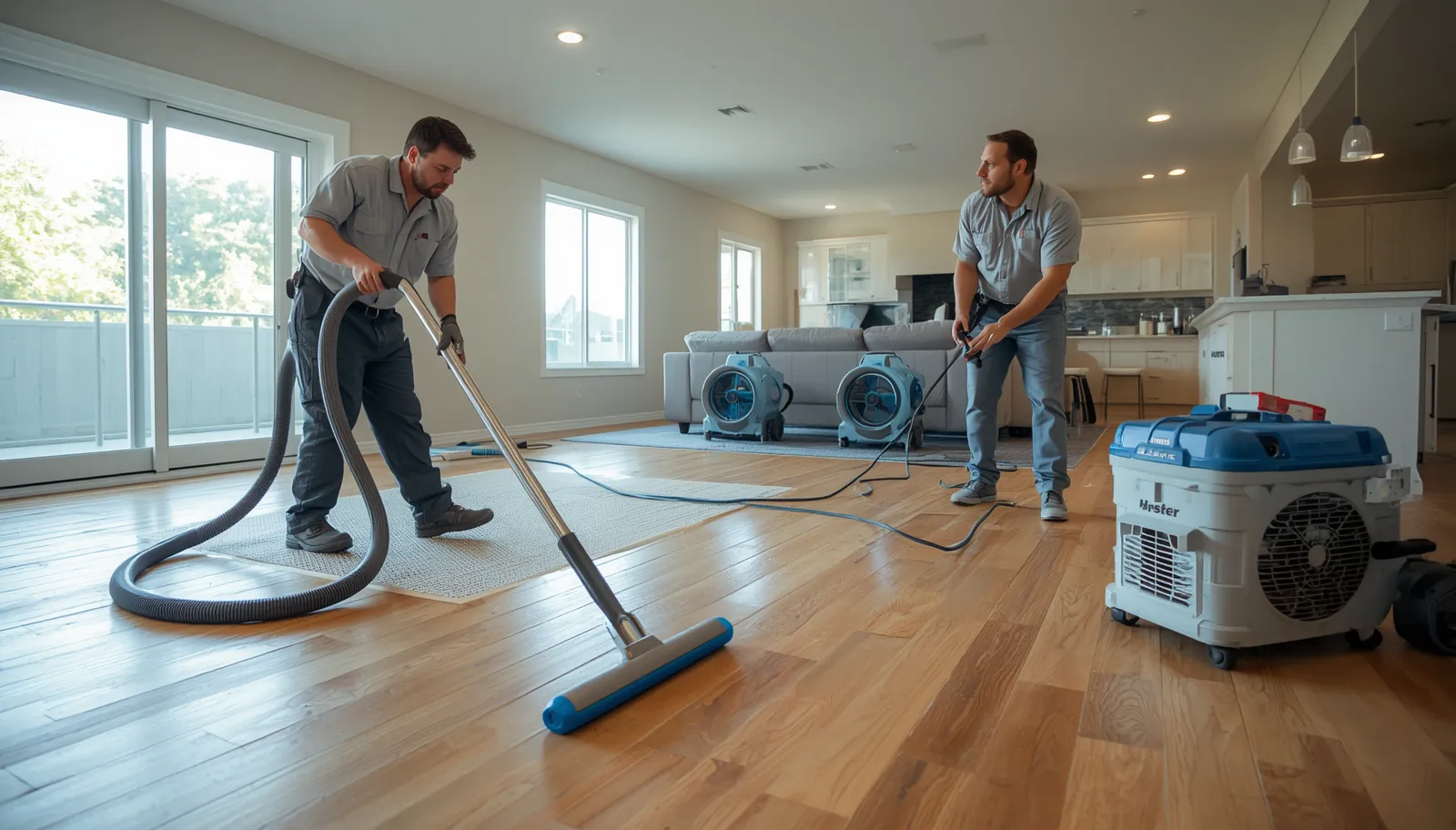
No material on this site rewards speed like hardwood. Wood absorbs moisture progressively — first the faces and finish, then the board bodies, then full saturation — and each stage closes options the previous one left open. In the first hours, extraction and surface drying can hold a floor at the cosmetic stage. In the first days, specialty drying can pull absorbed moisture back out before the wood deforms permanently. Past that, deformation sets, adhesives release, and the conversation shifts from rescue to replacement — with the 24–48 hour mold window running underneath the whole timeline, because the dark, damp space under a wet floor is exactly where growth starts.
The practical translation: a hardwood floor with standing water on it, or cupping already visible, is a same-day call. Waiting to “see if it settles” is choosing replacement and paying for the delay.
How Wood Floors Are Actually Dried
Rescuing hardwood is a specialty inside structural drying, and it’s where the discipline behind Gold Coast’s IICRC Applied Structural Drying certification does its most visible work.
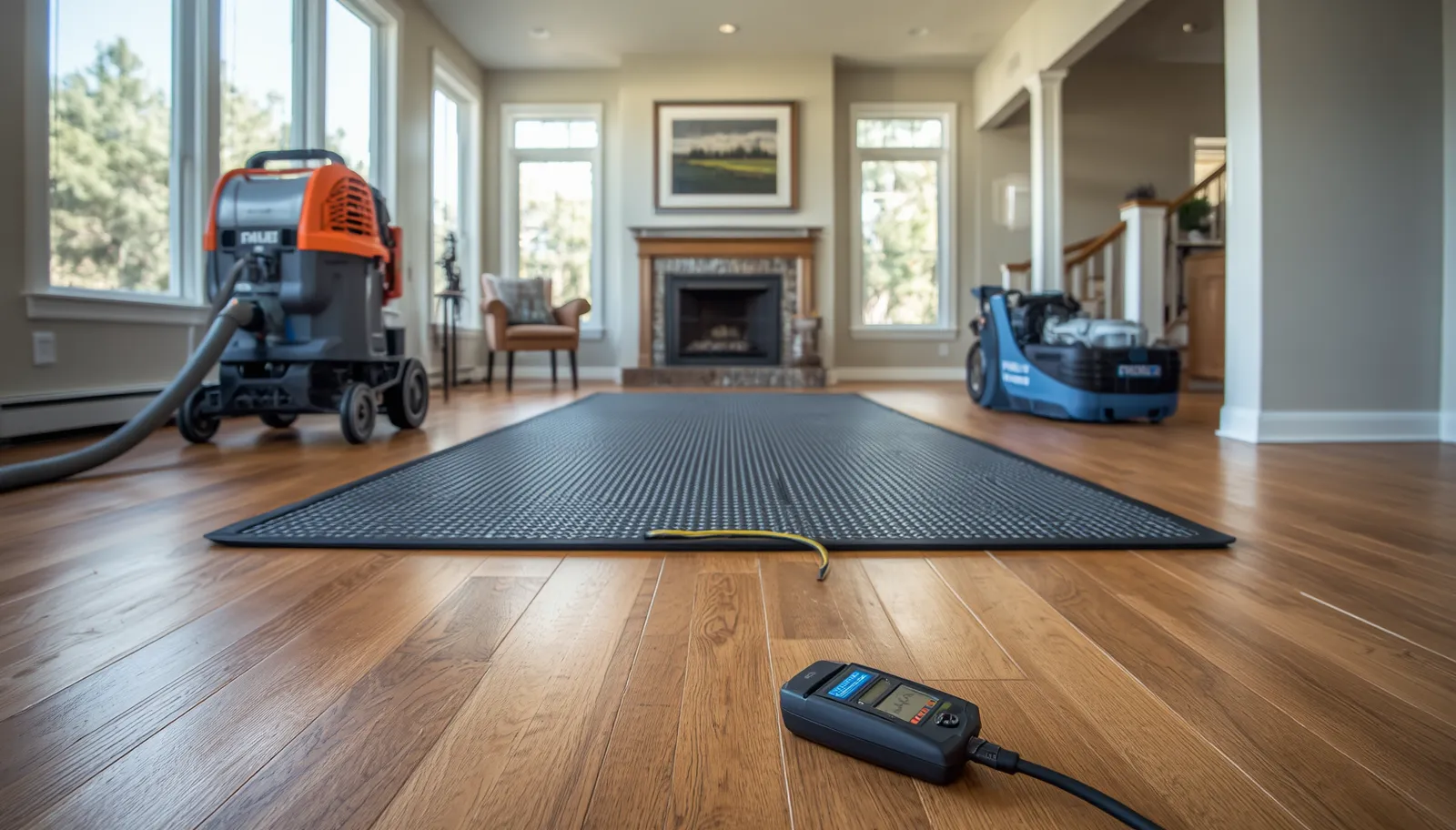
Moisture mapping first — the floor and what’s under it. Meters read the boards and, critically, the subfloor or slab beneath, because drying the wrong side of the assembly is how cupped floors become crowned ones. Thermal imaging traces the wet footprint across the room and under cabinets and walls the water reached.
Extraction before evaporation. Standing water off the surface immediately; every gallon physically removed never has to be pulled through the wood.
Directed drying systems. Depending on the assembly, the tools include specialty floor-drying mat systems that draw moisture up through the boards under controlled vacuum, directed airflow into the cavity below where one exists, and commercial dehumidification holding the room’s air hungry enough to keep pulling. Over San Diego’s slab-on-grade construction — where most local hardwood is glued down and there is no cavity to dry from below — the approach shifts accordingly, and the slab’s own moisture is measured and dried as part of the assembly, since wood flooring over a wet slab fails no matter how dry the boards test.
Controlled pace, daily monitoring. Wood dried too fast checks and splits; dried too slow, it molds. The equipment runs to a measured schedule with daily readings, and the job is done when the wood and its substrate reach documented dry standard — not when the surface feels dry, which it will days before it is.
The honest verdict, board by board. What flattens and dries stays; what deformed past recovery, delaminated, or buckled comes out. Per the company’s standing philosophy, the meters make the case — a floor that can be saved is saved, and a floor that can’t is said plainly, before anyone spends money pretending otherwise.
Solid, Engineered, Laminate: Three Materials, Three Fates
The word “hardwood” covers materials with very different relationships to water, and the honest prognosis depends on which one is wet.
Solid hardwood is the best rescue candidate: thick, refinishable, and tolerant of the drying process. A solid floor caught early can often be dried flat, then screened or refinished where the finish suffered — at a fraction of replacement.
Engineered wood — the dominant choice over San Diego slabs — is a real wood wear layer over a plywood core, and its fate depends on that core: quality engineered products with intact cores frequently survive proper drying; delaminated cores don’t, and thin wear layers limit refinishing options afterward.
Laminate is photographed paper over fiberboard, and fiberboard’s response to water is swelling that never reverses. Saturated laminate is honestly unsalvageable, and the useful work is drying the subfloor correctly so the replacement floor lands on a sound base. Anyone promising to dry and save soaked laminate is selling the impossible.
After the Drying: Refinish, Repair, Rebuild
A dried floor often needs a finished ending, and this is where one license carries the project through. Boards that flattened but show finish damage are screened or sanded and refinished — after the wood has fully acclimated, never before. Sections that came out are replaced with matching material where it exists, and where it doesn’t, the continuous-run matching question (weave in a close match, refinish the whole run to blend, or replace the run) is laid out with real options and real prices. Subfloor that was compromised is replaced, and the assembly — including any mold remediation the timeline made necessary, verified by independent third-party testing — closes up sound. As a licensed general contractor (CA License #838802), Gold Coast takes the floor from wet to finished without a mid-project handoff.
The Insurance Note
Hardwood claims turn on the same sudden-versus-gradual line as every water loss — the burst line that soaked the floor Tuesday is commonly covered; the fridge line that fed it for a year meets exclusions — with one wrinkle specific to flooring: matching. When part of a continuous floor is destroyed, whether the policy pays to patch, to refinish the run, or to replace it for uniformity varies by policy language and state practice, and it is among the most negotiated points in flooring claims. No outcome can honestly be promised; what’s provided is what moves the discussion — moisture maps, drying logs, salvage documentation showing what rescue was attempted and achieved, and a clear reconstruction scope — in the form San Diego adjusters have received from this company for three decades.
Frequently Asked Questions
Question: My floor cupped after a leak. Is it ruined?
Answer: Not necessarily — cupping is the recoverable deformation. Wood dried properly from the correct side, before the distortion sets, frequently flattens as moisture equalizes. The odds are set by speed: days matter, weeks close the window.
Question: Should I run fans on it in the meantime?
Answer: Airflow across the surface helps — with the caveat that surface-only drying on a floor wet from below is how cupping becomes crowning. Fans while help is en route, yes; fans as the whole plan, no. And no heat guns, ever.
Question: When can a water-damaged floor be sanded and refinished?
Answer: Only after the wood has dried to standard and acclimated — sanding a floor whose moisture is still equalizing locks in the wrong profile. It’s the most common irreversible mistake in DIY floor rescue, and patience here is what preserves the refinishing option.
Question: The water came from below — warm boards, cupping in a line. What’s happening?
Answer: That pattern points at the slab: a hot-side slab leak wetting the floor from underneath along the pipe’s run. The floor’s rescue and the leak’s repair run in parallel — the slab leak water damage page covers that loss end to end.
Question: Can laminate be dried and saved like hardwood?
Answer: No — and an honest company says so upfront. Laminate’s fiberboard core swells permanently. The professional work on a laminate loss is drying the subfloor and assembly properly so the new floor succeeds; the old material’s fate was sealed when it saturated.
Question: Will insurance pay to match my flooring if only one area is replaced?
Answer: It’s the most contested question in flooring claims: policies differ on patching versus continuous-run replacement, and outcomes can’t be promised. Thorough documentation of the damage, the salvage effort, and the matching problem gives the claim its best footing — and that documentation is standard practice here.
Wood Remembers Water — Unless the Drying Gets There First
Cupped boards, a spreading stain, standing water on the showpiece floor: the rescue window is open now and closing daily. One call puts certified drying on it today.
Gold Coast Flood Restorations Serving San Diego and all of San Diego County
24/7 Emergency Line: (858) 495-9133 Book online: goldcoastflood.com/appointment-form
IICRC Certified | Licensed General Contractor #838802 | A+ BBB Rated | Serving San Diego County for 35+ Years | 24/7 Emergency Response
Service areas include: San Diego, Santee, El Cajon, La Mesa, Alpine, Lakeside, Spring Valley, Poway, Scripps Ranch, Rancho Bernardo, Rancho Penasquitos, Rancho Santa Fe, Del Mar, Solana Beach, Encinitas, Carlsbad, La Jolla, Carmel Valley, Mira Mesa, Sorrento Valley, University City, Tierrasanta, and throughout San Diego County