Not every wet floor needs a full restoration crew — and the company that’s been drying San Diego for 35 years will tell you so. A modest clean-water spill caught immediately, a contractor drying a small area mid-project, a property manager handling a minor unit event, a capable homeowner who wants real equipment instead of a box-fan vigil: these are rental situations, and renting commercial drying equipment is the honest middle path between under-drying with household fans and over-buying a service the loss doesn’t require. Gold Coast Flood Restorations rents the same commercial-grade air movers and dehumidifiers its own crews run — with the guidance to use them right, and the straight answer when a situation is bigger than a rental should touch.
Why Rental Equipment Beats the Box Fan by a Mile
The gap between household fans and commercial drying gear isn’t marketing — it’s physics, and it’s the difference between moving air around a wet room and actually drying one.
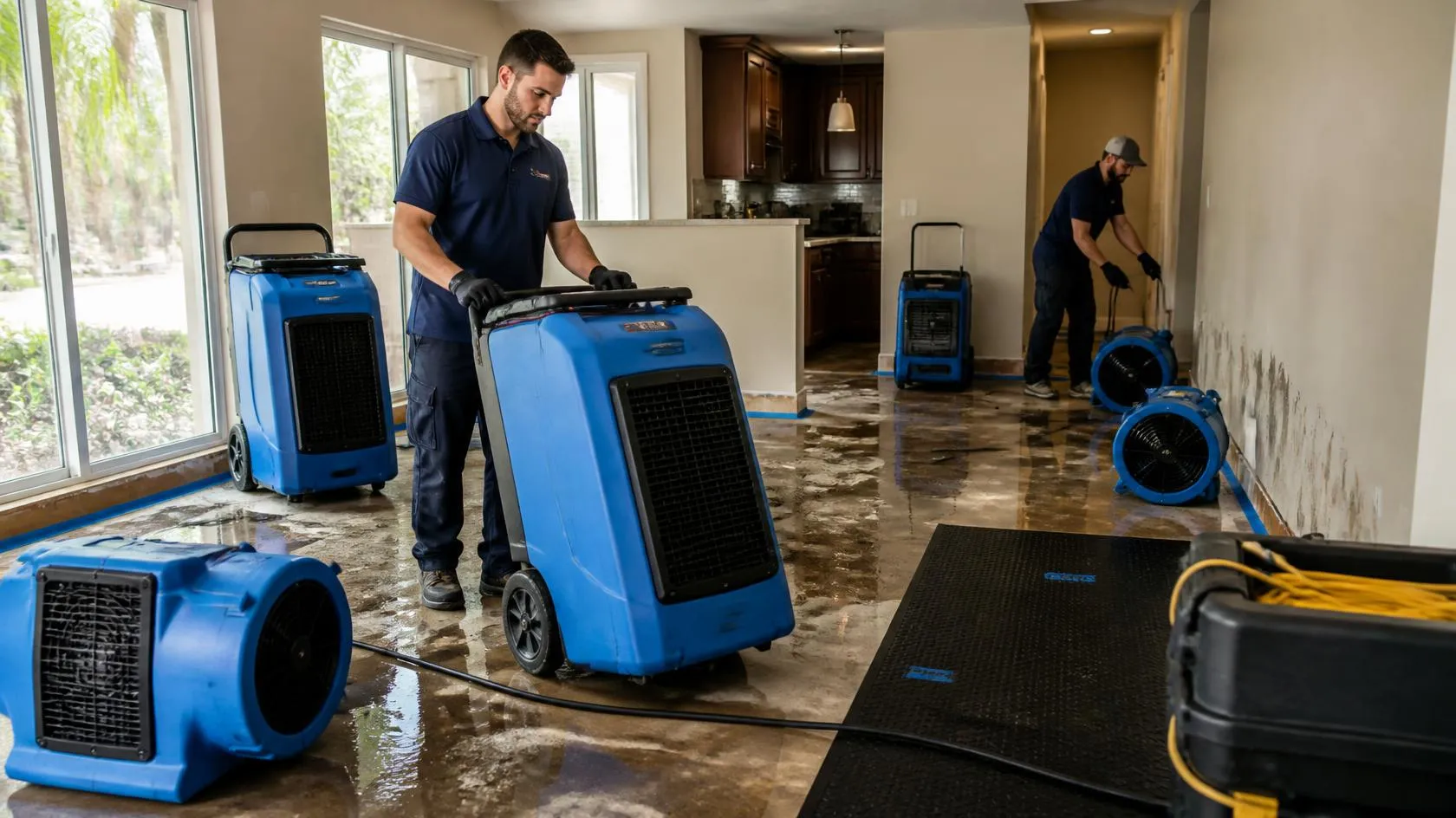
Commercial air movers deliver directed, high-velocity airflow engineered to strip the saturated boundary layer off wet surfaces — the thin blanket of moist air that forms over damp material and stalls evaporation cold. A box fan stirs the room; an air mover works the surface. Positioned correctly, a few air movers accomplish what a houseful of fans never will.
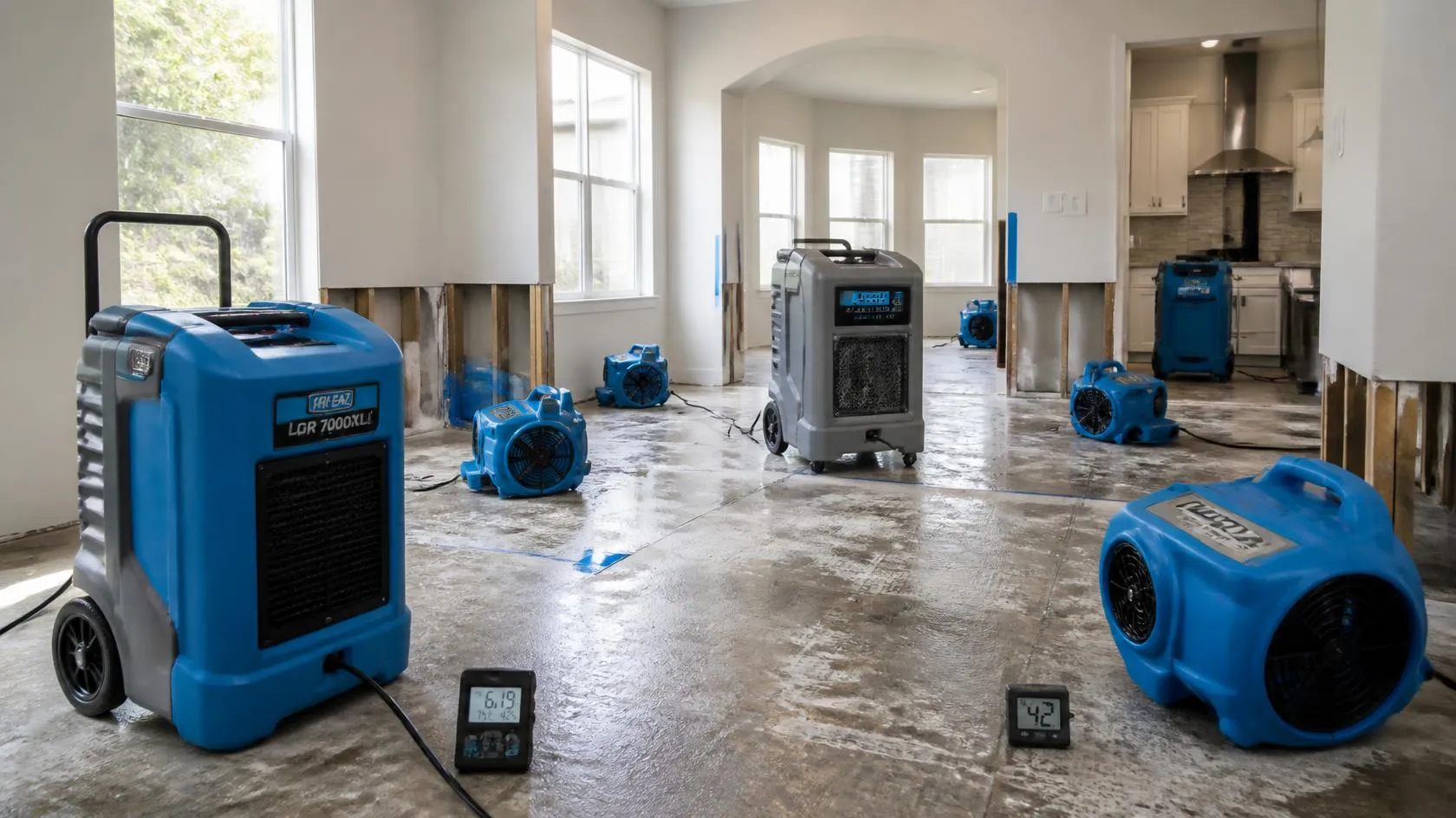
Commercial LGR dehumidifiers are the half of drying that households simply don’t own. Evaporation without dehumidification doesn’t remove water from a home — it relocates it into the air, where it re-condenses into every cool surface and dry material nearby. A low-grain refrigerant dehumidifier pulls moisture out of the air continuously and drains it away, keeping the air hungry so materials keep releasing. The portable dehumidifier from the closet is built for muggy-day comfort, not drying loads; the commercial unit is built for exactly this, and it’s the piece that makes a rental setup a drying system rather than a breeze.
Renting that system for the days a small loss requires costs a fraction of buying it — and a fraction of what under-drying costs when the mold window closes on a floor that “felt dry.”
When Rental Is the Right Call — and When It Isn’t
Honesty about this line is the whole reason to rent from a restoration company instead of a counter. Rental fits when all of the following are true:
- The water was clean — Category 1, from a supply line, a clean overflow, a caught-in-time appliance drip.
- The event is small and fully visible — a room or less, caught fast, with no sign the water reached wall cavities, traveled under flooring, or soaked assemblies you can’t see.
- Someone will actually run the process — equipment positioned right, running continuously (not evenings-only), for the days materials genuinely need.
Rental is the wrong call — and Gold Coast will say so at the counter — when the water was gray or black (contaminated losses are protocol work, never DIY), when the loss has age on it (anything discovered late has already spread and likely opened the mold question), when water plausibly reached cavities, subfloor, or adjacent rooms (the hidden spread is the expensive part, and it’s invisible without instruments), or when the property can’t afford a wrong guess — hardwood, an upstairs unit over finished space, a rental with liability attached. Per the company’s standing philosophy, nobody upsells a rental into a service that isn’t needed — and nobody rents equipment into a situation where the honest product is a crew.
The Hybrid That Makes Rental Actually Safe: Verify It
Here’s the quiet flaw in every equipment rental, from anywhere: the machines dry, but they can’t tell you when you’re done — and “done” is the entire product. The touch test fails days before materials actually reach dry standard, and declaring victory early is how rental savings become remediation invoices.
The fix is the hybrid this company actually recommends: rent the equipment, buy the readings. A professional moisture assessment when the loss happens maps what’s actually wet — including whether the event is genuinely rental-sized — and a verification visit at the end confirms with instruments that materials reached standard before the equipment goes back and the furniture goes down. It’s the smallest professional footprint a water event can carry: the homeowner supplies the labor and the days, the meters supply the certainty, and the documented readings supply something else worth having — a record that the event was handled and verified, which future buyers, insurers, and remodels all have reason to appreciate.
What Renting From Gold Coast Looks Like
The equipment the crews use. Commercial air movers and LGR dehumidifiers from the working fleet — maintained, cleaned between rentals, and actually up to the job.
Sized and planned, not just handed over. The rental starts with the questions that matter — what got wet, when, how much, what’s it sitting on — and ends with a real setup plan: how many movers, where they point, where the dehumidifier sits, how it drains, and how many days the materials involved typically need. Ten minutes of guidance is the difference between running equipment and running a drying system.
The straight answer at the counter. Described a situation that’s bigger than a rental? That’s what you’ll hear — along with what the right response looks like. Described one smaller than any rental? You’ll hear that too. Thirty-five years of A+ BBB standing wasn’t built on renting dehumidifiers into sewage losses.
Terms, availability, and delivery options vary with equipment and season — winter storm weeks run the fleet hard — so call for current specifics: (858) 495-9133.
Frequently Asked Questions
Question: How much equipment do I need for one wet room?
Answer: As a working baseline for a genuinely small clean-water event: several air movers positioned to sweep the wet surfaces from a low angle, plus one properly sized LGR dehumidifier for the space — the dehumidifier being the non-negotiable piece. The real answer follows the specifics, which is what the sizing conversation at pickup is for.
Question: How long will I need it?
Answer: Small clean-water losses typically run two to four days of continuous operation — and continuous is the operative word, because equipment cycled off overnight surrenders its progress to rebounding humidity. Materials like subfloor and plate run longer than surfaces suggest, which is exactly why the verification reading beats the calendar.
Question: Can I rent equipment to dry out a sewage or gray-water mess?
Answer: No — and this is a firm line, not a sales posture. Contaminated losses require removal, sanitization, and protocol work before drying even begins; blowing air across Category 2 or 3 contamination spreads the problem, sometimes literally. Those losses get a crew, full stop.
Question: The carpet feels dry after two days. Can I return everything?
Answer: Feel is the least reliable instrument in this entire field — surfaces dry days before the pad, subfloor, and wall bases beneath them. Return it after a verification reading says standard, or after the full duration the materials involved typically demand. The cheap extra day beats the expensive early victory every time.
Question: Do you rent to contractors and property managers?
Answer: The rental program serves exactly those recurring, right-sized needs — contractors drying small areas mid-project, managers handling minor unit events — with the same sizing guidance and the same honest escalation line when a situation outgrows a rental. Call for current terms and fleet availability.
Question: What if I set it all up and I’m not sure it’s working?
Answer: Call — describing what the meters would ask (what’s still damp, what’s cool to the touch, where the humidity sits) sorts most of it by phone, and a mid-course professional reading is a small spend that redeems the whole rental. Equipment questions are part of the service, not an imposition.
Real Equipment, Real Guidance, Real Limits
The right-sized response to a small clean spill is commercial gear, a good plan, and a verification reading — and the right-sized response to everything bigger is a phone call. Both start at the same number.
Service Area & Contact
Gold Coast Flood Restorations Serving San Diego and all of San Diego County
24/7 Emergency Line: (858) 495-9133 Book online: goldcoastflood.com/appointment-form
Certifications: IICRC Certified | Licensed General Contractor #838802 | A+ BBB Rated | Serving San Diego County for 35+ Years | 24/7 Emergency Response
Service areas include: San Diego, Santee, El Cajon, La Mesa, Alpine, Lakeside, Spring Valley, Poway, Scripps Ranch, Rancho Bernardo, Rancho Penasquitos, Rancho Santa Fe, Del Mar, Solana Beach, Encinitas, Carlsbad, La Jolla, Carmel Valley, Mira Mesa, Sorrento Valley, University City, Tierrasanta, and throughout San Diego County.