A burst pipe is the fastest way a house floods itself. A supply line carries pressurized water around the clock, and when one lets go — in a wall, above a ceiling, under a slab — it doesn’t drip. It pours, at a rate that can put hundreds of gallons into a home’s framing, flooring, and drywall in the first hour alone. What happens in the minutes and days after that determines whether the event ends as a well-managed insurance claim or a months-long reconstruction with a mold problem attached. Gold Coast Flood Restorations has been answering exactly this call across San Diego County for more than 35 years, 24 hours a day, with IICRC-certified technicians who handle everything from emergency extraction through complete structural drying.
The First Ten Minutes: What to Do Right Now
If water is actively flowing, the order of operations matters more than speed of dialing.
- Stop the water. Close the home’s main shutoff valve — typically where the supply line enters the house, near a front hose bib, or at the meter box by the curb. Every minute the main stays open adds gallons to the damage.
- Kill power to affected areas — if it’s safe. If water is near outlets, cords, or appliances, shut off the relevant breakers, provided the panel itself is dry and reachable. When in doubt, leave the power alone and keep people out of standing water.
- Call Gold Coast Flood Restorations. Crews respond around the clock, every day of the year. The sooner extraction begins, the less the water spreads — and spread, not the initial gush, is what makes burst pipes expensive.
- Move what can be moved. Lift furniture onto foil or blocks, pull rugs, get electronics and documents to dry ground.
- Document everything. Photos and video of the water, the source, and every affected room — before cleanup begins. This record does heavy lifting with the insurance claim later.
- Call your insurance company. Sudden pipe failures are the classic covered water loss under most homeowners policies, and early notice keeps the claim clean.
What a homeowner should not do: wait to “see if it dries out.” Water from a burst pipe travels under flooring, wicks up drywall, and soaks insulation invisibly. Surfaces that feel dry by evening are routinely saturated underneath — and the clock on secondary damage is already running.
Why Pipes Burst in San Diego Homes
San Diego doesn’t get the frozen-pipe winters of the Midwest, yet burst pipes are one of the region’s most common water losses. The local causes are different, and worth knowing:
Aging copper under pressure. Much of the county’s housing stock carries copper supply lines that are now forty to sixty years old. Pinhole corrosion thins the pipe wall over decades until pressure finds the weak point — sometimes as a slow leak, sometimes as an outright rupture.
High water pressure and failed regulators. Street pressure in many San Diego neighborhoods runs well above the 80 psi residential code limit, tamed only by a pressure regulator that wears out like any mechanical part. When a regulator fails high, every pipe, joint, and supply hose in the house absorbs the stress — and the weakest one eventually announces it.
Slab-on-grade construction. Most local homes route supply lines under or through the concrete slab. When one of those lines fails, water can flow undetected below the floor, surfacing as warm spots, buckled flooring, or a soaked carpet edge far from the actual break.
Failed fittings and supply connections. Washing machine hoses, angle stops, and flexible connectors fail more often than the pipes themselves — with identical consequences when the failure happens at full pressure in an empty house.
Storm-season stress. Atmospheric river storms saturate and shift the region’s expansive clay soils, stressing buried and slab-embedded lines during exactly the season when everyone’s attention is on the roof.
What Burst Pipe Water Does to a Home — and How Fast
Water from a supply line starts as what the restoration industry classifies as Category 1: clean water from a sanitary source. That’s the good news. The bad news is that Category 1 is a temporary status. As clean water sits — soaking through flooring, migrating through wall cavities, mixing with dust, soil, and building materials — it degrades toward Category 2, and given enough time and contamination, the cleanup requirements escalate with it.
The other clock is biological. Mold can begin growing on damp building materials in as little as 24 to 48 hours after a water intrusion. That’s not a scare line — it’s the documented reality that makes same-day extraction and immediate structural drying the whole strategy. A burst pipe handled inside that window is usually a drying project. The same pipe handled a week later is often a drying project plus a mold remediation.
Along the way, water does its quiet mechanical work: drywall swells and crumbles, baseboards and casings wick moisture upward, hardwood cups and crowns, laminate delaminates, carpet pad holds water like a sponge, and insulation compresses and loses its value. The visible puddle is rarely the real damage; the real damage is in what the puddle touched on its way down and out.
How Gold Coast Handles a Burst Pipe Loss
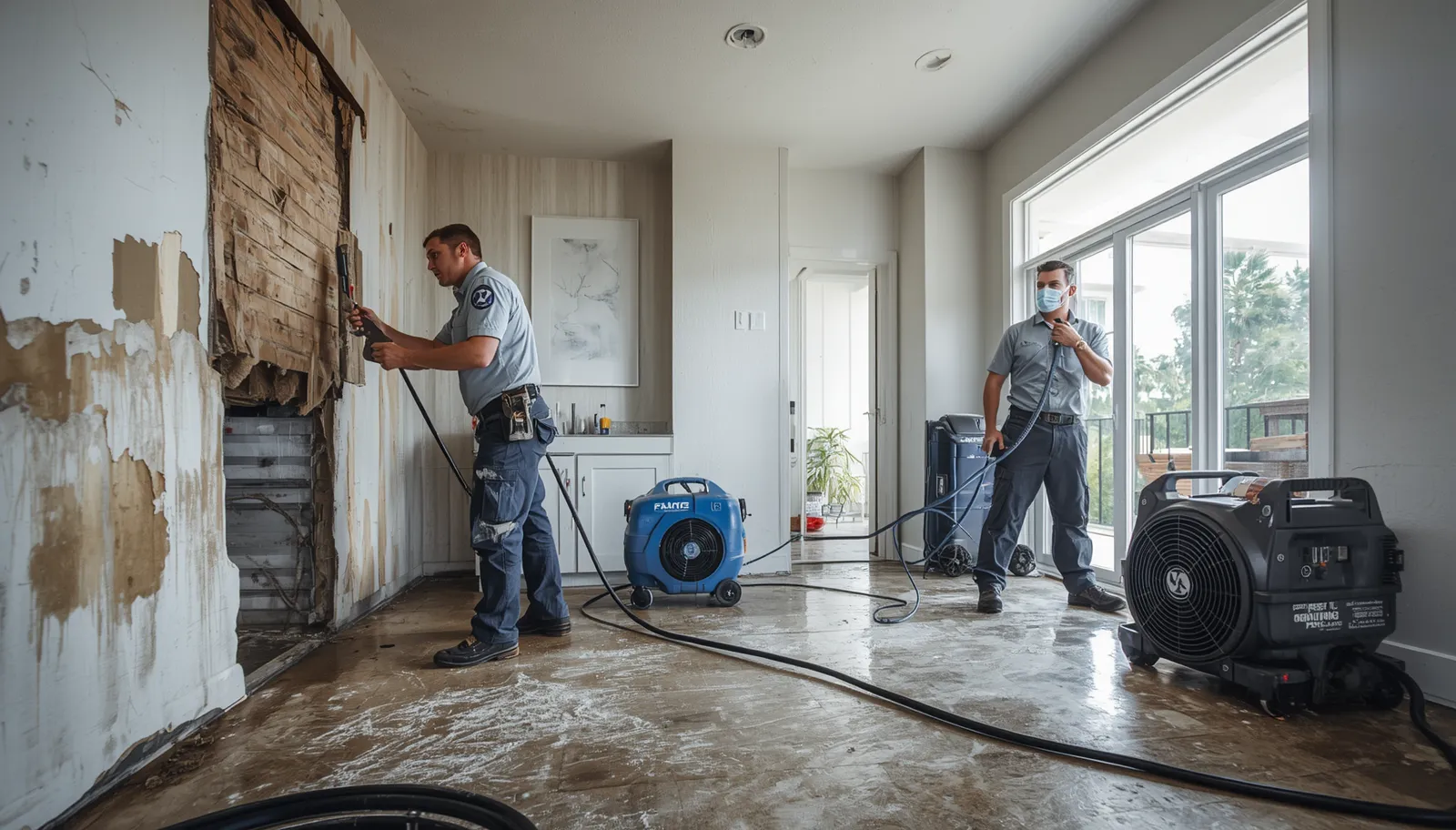
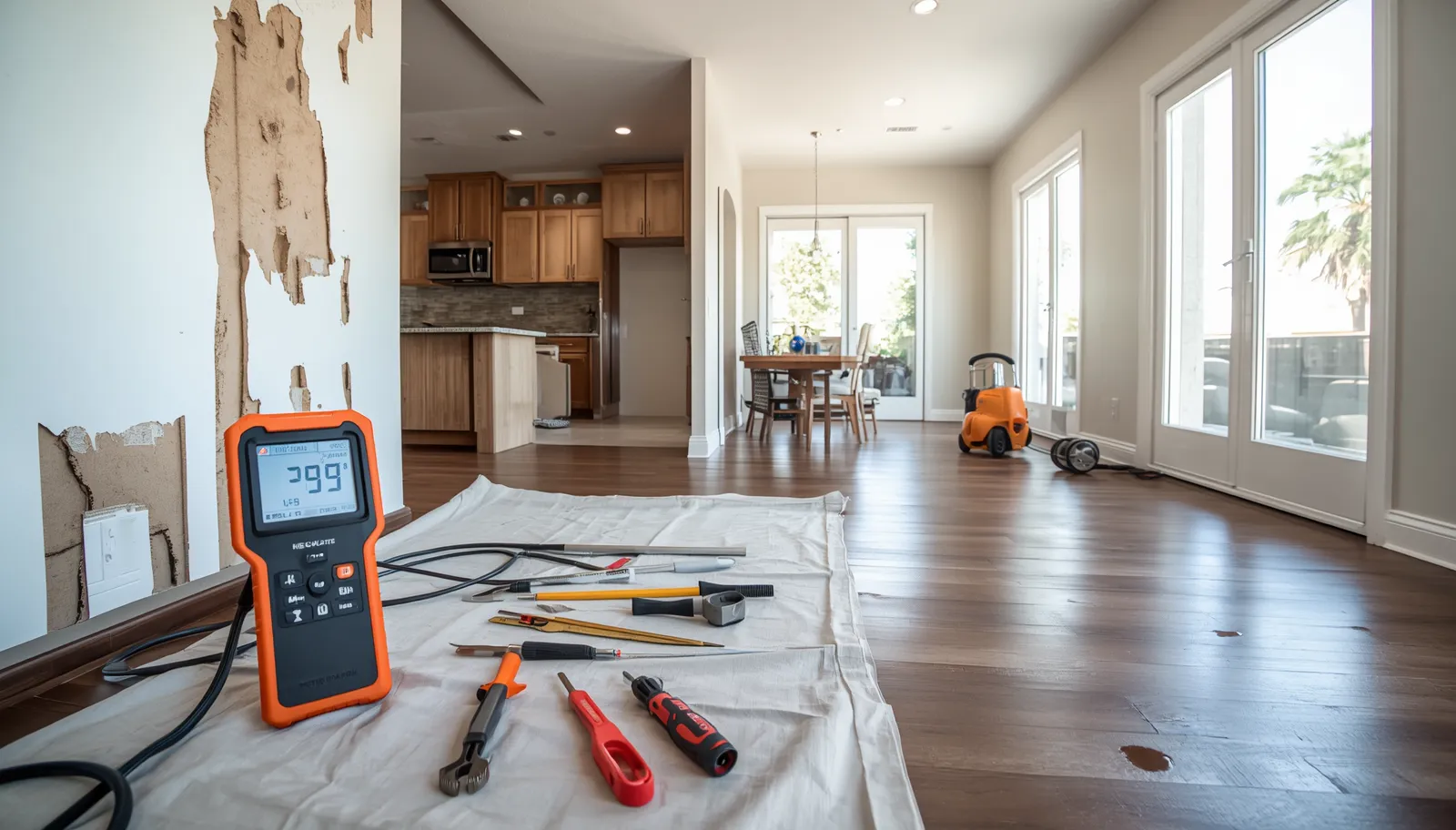
Emergency response and assessment. A crew arrives with extraction and drying equipment on the truck, confirms the source is controlled, and maps the true extent of the moisture — including what’s hidden. Moisture meters and thermal imaging trace where the water actually went, because water follows framing and gravity, not intuition.
Water extraction. Standing water is removed fast with professional extraction equipment — from floors, carpet, and pad, and where necessary from under structures and inside cavities. Extraction is the highest-leverage step in the entire process: every gallon physically removed is a gallon that never has to be evaporated.
Controlled demolition, only where warranted. Saturated pad, ruined drywall, and wet insulation that cannot be dried in place are removed cleanly and contained. The bias is toward drying and saving materials where the science supports it — and toward honesty where it doesn’t. Gold Coast’s approach, stated plainly on its own site, is that if you don’t have a problem, no one is going to invent one.
Structural drying and dehumidification. Air movers and commercial dehumidifiers are placed according to the actual moisture map — this is the discipline behind the firm’s IICRC Applied Structural Drying certification — and the drying system runs until instruments, not appearances, say the structure has reached its dry standard. Technicians monitor daily, adjusting equipment as materials release moisture.
Verification and documentation. Moisture readings, photos, and a documented equipment and drying log — the paper trail that supports the insurance claim and proves the home was returned to a dry, pre-loss condition.
Repairs and reconstruction. As a licensed and insured general contractor (CA License #838802), Gold Coast can carry the project through repairs — drywall, flooring, baseboards, paint — rather than handing the homeowner off mid-crisis to find a second contractor.
The Insurance Question, Answered Honestly
Sudden and accidental discharge of water — the burst pipe — is among the most commonly covered water losses under standard homeowners policies. Coverage typically extends to the resulting damage, while the failed pipe itself and losses attributable to long-term slow leaks are commonly excluded. Every policy differs, and no restoration company can promise what a carrier will pay. What Gold Coast does is what actually moves claims: immediate mitigation (which policies require of the homeowner), thorough documentation of the loss and the drying process, and direct experience working with insurance companies on thousands of San Diego water losses over three decades. Homeowners should report the loss promptly and let the documentation do the talking.
Frequently Asked Questions
Question: My pipe burst and I’ve shut the water off. Is it still an emergency?
Answer: Yes — the flooding has stopped, but the absorption hasn’t. Water is still migrating through materials and the 24–48 hour mold window is open. Same-day extraction and drying is what keeps a plumbing failure from becoming a mold remediation project.
Question: Should the plumber or the restoration company come first?
Answer: Ideally both are in motion. The plumber repairs the pipe; the restoration crew handles the water. Gold Coast coordinates with the homeowner’s plumber and gets extraction started while the repair happens.
Question: Will my homeowners insurance cover this?
Answer: Sudden burst pipe damage is commonly covered, though the pipe repair itself and long-term leak damage often are not. Coverage depends on the policy — report the claim early, document everything, and Gold Coast will provide the mitigation records carriers ask for. No honest company will guarantee a claim outcome.
Question: How long does drying take?
Answer: Typically about three to five days of continuous equipment operation for a routine loss, longer for saturated slabs, hardwood, or extensive wall cavities. The honest answer comes from the moisture meters, which are checked daily — drying ends when the structure reaches its dry standard, not when the schedule says so.
Question: The water looked clean. Do I really need professional drying?
Answer: Clean water doesn’t mean harmless water. Category 1 water degrades as it sits, and it soaks into materials no towel or box fan can dry. Professional extraction and monitored dehumidification exist precisely because “it looks dry” and “it is dry” are routinely two different facts.
Question: Can you repair the walls and floors afterward, or just dry them?
Answer: Both. Gold Coast is a licensed general contractor and can take the project from emergency extraction through finished repairs — one company, one accountable license, start to finish.
One Call, Any Hour
A burst pipe doesn’t wait for business hours, and neither does the response. Get the water out, the structure dried, and the damage documented — starting now.
Gold Coast Flood Restorations Serving San Diego and all of San Diego County
24/7 Emergency Line: (858) 495-9133 Book online: goldcoastflood.com/appointment-form
IICRC Certified | Licensed General Contractor #838802 | A+ BBB Rated | Serving San Diego County for 35+ Years | 24/7 Emergency Response
Service areas include: San Diego, Santee, El Cajon, La Mesa, Alpine, Lakeside, Spring Valley, Poway, Scripps Ranch, Rancho Bernardo, Rancho Penasquitos, Rancho Santa Fe, Del Mar, Solana Beach, Encinitas, Carlsbad, La Jolla, Carmel Valley, Mira Mesa, Sorrento Valley, University City, Tierrasanta, and throughout San Diego County