Black water is the restoration industry’s term for grossly contaminated water — and it’s the one category of water damage where “I’ll just clean it up myself” is genuinely the wrong answer. Sewage backups, toilet overflows from beyond the trap, rising storm floodwater, and even clean water that’s been standing long enough to degrade all fall into this category. Black water can carry bacteria, viruses, and other contaminants, and cleaning it safely requires protective equipment, containment, and disposal protocols that simply don’t exist in a household mop bucket.
Gold Coast Flood Restorations has handled black water cleanup across San Diego County for over 35 years. Based in Santee, available 24/7, and staffed by IICRC-certified technicians working to the industry’s S500 standard, we remove the contamination completely, disinfect properly, dry the structure verifiably — and tell you the truth about the scope from the first walk-through. If you don’t have a problem, we won’t fabricate one. And when you do have one, we won’t minimize it either.
What Counts as Black Water?
The restoration industry (under the IICRC S500 standard) classifies water losses into three categories, and the category determines everything about the cleanup:
- Category 1 — Clean water. From a supply line, a faucet, a water heater. Sanitary at the source.
- Category 2 — Gray water. Significantly contaminated: washing machine discharge, dishwasher overflow, toilet overflow with urine only.
- Category 3 — Black water. Grossly contaminated. This includes sewage backups, toilet backflow originating beyond the trap, rising floodwater from storms and channels, seawater intrusion, and any water carrying soil, debris, or waste. One detail that surprises people: water doesn’t have to start dirty to end up here. Clean water that sits for days — soaking into carpet, wicking through walls, going stagnant — degrades by category as time passes. The washing machine flood you discovered after a weekend away is not the same cleanup job it was on Friday.
Why the category matters: with clean water, most materials can be dried in place. With black water, porous materials that absorbed the contamination — carpet and pad, drywall, insulation, particleboard — generally cannot be sanitized and must be removed and disposed of properly. That’s not upselling; it’s the standard, and it’s the difference between a home that’s actually clean and one that just looks clean.
Where Black Water Comes From in San Diego County
After three and a half decades here, we know this county’s patterns:
- Sewer backups and aging laterals. Much of San Diego’s housing stock dates to the postwar booms, and the private sewer laterals connecting those homes to the main are original — 50 to 70 years old, often clay pipe, and a favorite target of tree roots. When a lateral blocks or collapses, everything that should flow out comes back in, usually through the lowest drain in the house. And in most of the county, that lateral is the homeowner’s responsibility, not the city’s.
- Winter storm flooding. Our rain arrives concentrated between December and March, and when it overwhelms drainage, low-lying areas flood — Mission Valley being the county’s most famous example. Rising floodwater is automatically black water: it’s carried street runoff, soil, and debris with it, no matter how clear it looks.
- Toilet overflows and drain backups. The most common residential black water event — unglamorous, urgent, and hazardous when the source is beyond the trap.
- Storm drain and channel overflow. Properties near creeks, channels, and canyon drainages across Santee, Lakeside, and El Cajon see intrusion during heavy storm years.
How Professional Black Water Cleanup Works
Category 3 cleanup follows a strict sequence — every step exists for a reason:
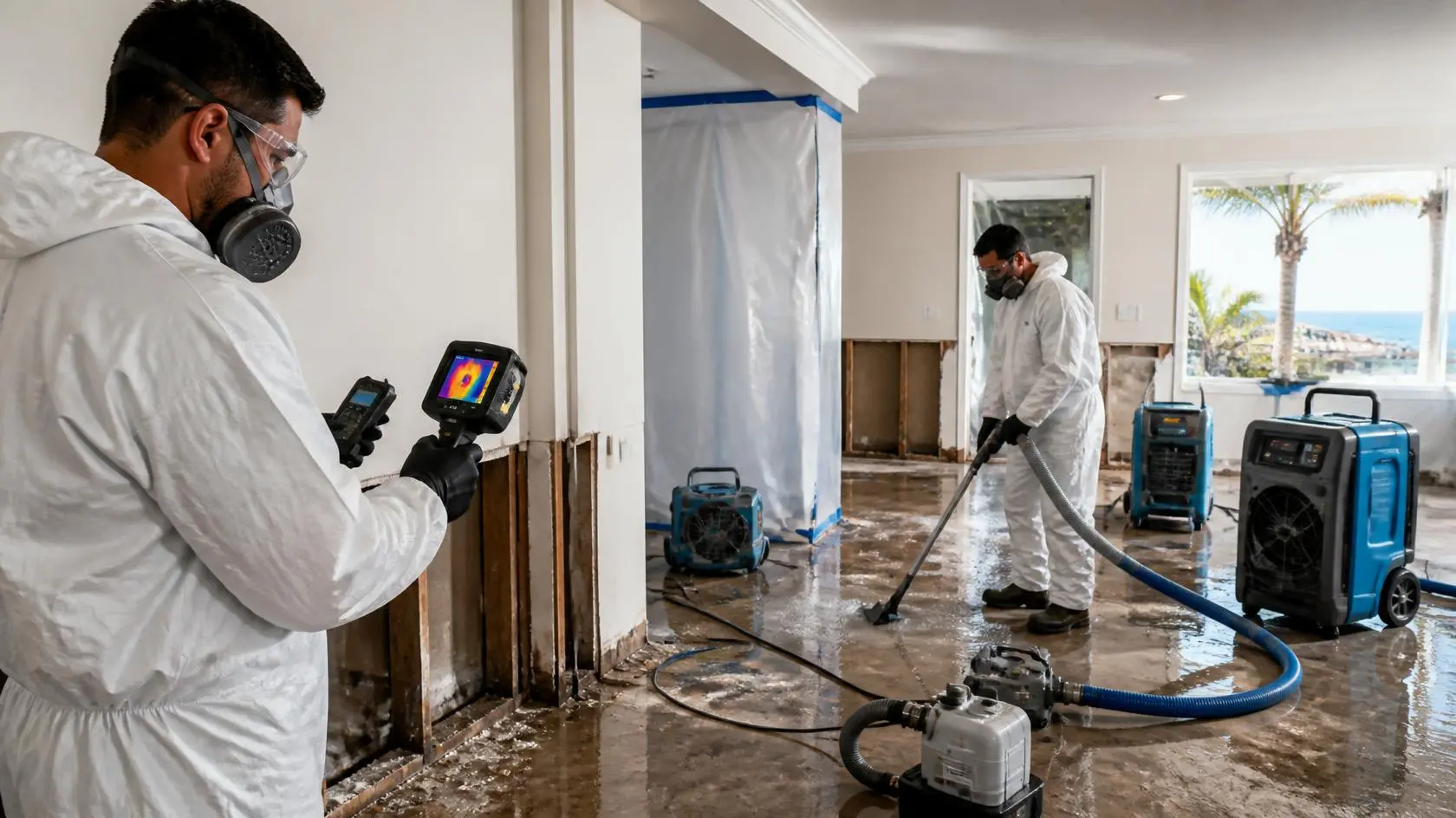
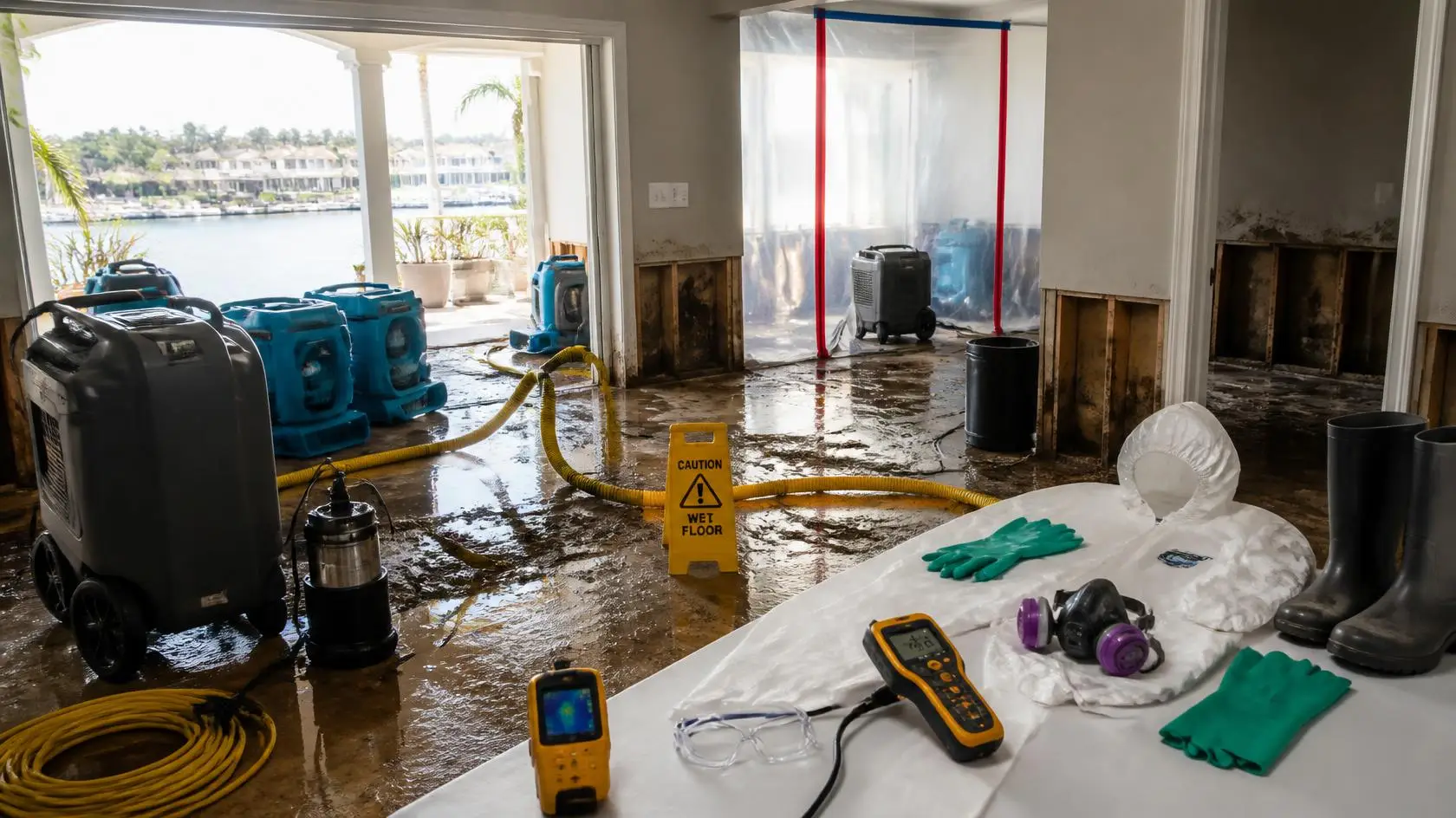
- Safety assessment and containment. Before anything else: electrical hazards checked, the affected area isolated, and cross-contamination into clean areas of the home prevented. Our technicians work in full protective equipment because the water demands it.
- Water extraction. Contaminated water is removed with dedicated extraction equipment — fast, because black water is actively soaking into everything it touches.
- Removal of contaminated materials. Porous materials that absorbed black water — carpet, pad, affected drywall, insulation — are removed and disposed of properly. Non-porous, cleanable surfaces stay.
- Cleaning and disinfection. Every affected surface is cleaned and treated with professional antimicrobial products. This is the step a shop vac and a bottle of bleach cannot replicate — coverage, dwell time, and product selection all matter.
- Structural drying with verification. Air movers and dehumidifiers dry the structure as a closed system, and we verify with moisture meters and daily documented readings — never by touch. Mold growth can begin on wet materials within 24 to 48 hours, and it doesn’t care what category the water was.
- Repairs and reconstruction. Once the structure is verifiably clean and dry, our team rebuilds — drywall, baseboards, flooring — so you’re not hunting for a second contractor to finish the job.
Throughout, we document everything: photos, moisture readings, removed materials, and scope. That documentation supports your insurance claim — and one thing worth knowing before your carrier calls: as the property owner, you have the right to choose your own restoration contractor. You are never required to use your insurer’s preferred vendor. Whether a specific loss is covered depends on your policy and the cause — sewer backup coverage in particular is often a separate endorsement — so confirm details with your carrier.
What to Do Right Now — and What Not to Do
If you have a sewage backup or floodwater in your home:
- Keep people and pets out of the affected area.
- Don’t run water down any drain if the sewer is backing up — every flush and load makes it worse.
- If water is near outlets or appliances and it’s safe to do so, shut off electricity to the area.
- Don’t try to clean it up with household equipment. A shop vac full of sewage contaminates the vac, the process, and often the operator.
- Photograph the damage from a safe distance.
- Call us — any hour, any day. Then call your insurance company.
The honest line we draw: a small, contained clean-water spill is a DIY job, and we’ll tell you so. Black water never is. This is the one category where professional cleanup isn’t a convenience — it’s the difference between a restored home and a contaminated one.
Why San Diego Calls Gold Coast for Black Water Cleanup
We’re Santee-based, not a franchise call center — serving all of San Diego County since the 1980s, featured on Channel 10 News, with IICRC-certified technicians and a track record built one honest job at a time. Our incorporated name is Integrity Flood Response, and on no job does that matter more than this one: black water cleanup done partially or wrong doesn’t announce itself right away. It shows up weeks later as odor, mold, and a job that has to be done twice. We do it once, completely, and we prove it with documentation.
Related Services
- Sewage Backup Cleanup — our dedicated sewage response service
- Water Damage Restoration — the complete restoration process, extraction through rebuild
- Flood Restoration — storm and flood recovery for homes and businesses
- Mold Remediation — removal with independent third-party verification
From the blog: What’s the Difference Between Water Damage I Can Clean Myself and Water Damage That Needs a Pro? · How Long Does It Take to Dry Out a House After Water Damage?
Black Water Is an Emergency — Treat It Like One
Every hour black water sits, it soaks deeper and the cleanup grows. Call Gold Coast Flood Restorations now — 24 hours a day, 7 days a week, everywhere in San Diego County — and get certified Category 3 cleanup started today.