The slowest water losses in a home hide inside its wettest rooms. A shower or bathtub leak almost never floods anything — it cheats. A hairline gap in the grout, a failed pan liner, a weeping valve behind the tile, a tired gasket at the tub’s overflow: each releases a little water with every single use, into the wall cavity, the subfloor, and the ceiling below, day after day, for as long as the family keeps bathing. By the time the evidence surfaces — a soft spot beside the tub, a stain on the ceiling under the master bath, a musty smell no cleaning defeats — the leak has usually been running for months, and the loss behind the tile is far larger than anything visible in front of it. Gold Coast Flood Restorations has been opening up, drying out, and rebuilding exactly these losses across San Diego County for more than 35 years — IICRC-certified, mold-trained, and licensed to rebuild the bathroom when the drying is done.
The Tell-Tale Signs of an Enclosure Leak
Shower and tub leaks are diagnosed by pattern more than by puddle. The evidence homeowners actually see:
- A ceiling stain below the bathroom that grows with use — the single most diagnostic clue in this entire category. A stain that darkens after showers and fades between them is an enclosure or drain leak, not a supply leak (which would run constantly)
- Soft or spongy flooring at the tub’s edge or the shower’s threshold, where a compromised subfloor gives underfoot
- Loose, hollow-sounding, or cracked tiles on the enclosure walls — often the wall board behind them has softened
- Grout and caulk failures at the pan-to-wall joint, the tub-to-tile joint, and the corners — the seams that move most and fail first
- Peeling paint, bubbling drywall, or swollen baseboards on the back side of the shower wall — in the adjacent bedroom or hallway
- Persistent musty odor in the bathroom or the closet sharing a wall with the enclosure
- Mold that keeps returning at the enclosure’s base or the adjoining wall no matter how often it’s scrubbed — surface cleaning can’t fix growth being fed from inside the assembly
- Water stains or drips at the tub trap visible from below in the rare San Diego home with raised-foundation access
Any one of these merits a look; the shower-correlated ceiling stain practically is the diagnosis.
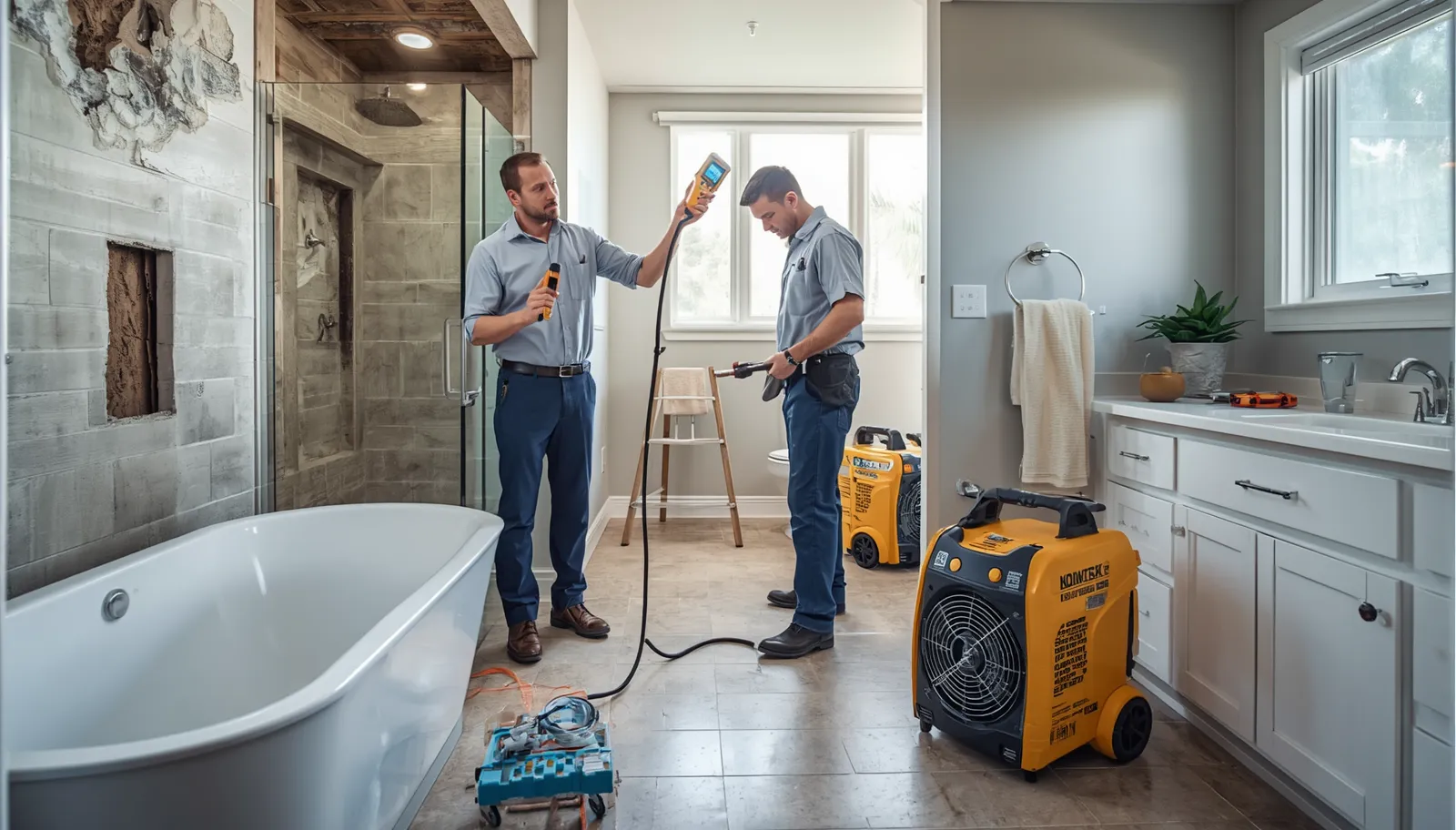
Where Enclosures Actually Fail
The shower pan. The waterproof liner beneath the shower floor is the enclosure’s foundation, and it has a service life the tile above conceals. In the 1970s and ’80s housing stock that fills Santee, El Cajon, La Mesa, and Mira Mesa, original mud-set pans are now decades past their design decades — and a failed pan leaks with every shower, straight into the subfloor or the ceiling assembly below. Pan failures are the heavyweight of this category.
Grout and the myth of waterproof tile. Tile and grout shed water; they do not seal it. The waterproofing is the membrane or backer behind them, and once cracked grout or failed caulk lets water reach an aging backer, the wall cavity starts drinking. Regular caulk joints are maintenance items precisely because they’re the fuse in this system.
The valve and its wall. Shower valves and their connections live sealed inside the wet wall. A weeping valve body, a loose slip connection, or a failed tub spout drop leaks inside the cavity — invisible until the back side of the wall or the ceiling below reports it.
Tub drains and overflow gaskets. The gasket sealing the tub’s overflow plate and the drain shoe beneath the tub dry out and fail with age — producing the classic leak that only appears when the tub is filled high or drained, and that stains the ceiling below in a ring under the tub’s foot.
Fiberglass and acrylic units. One-piece surrounds crack at stress points and at worn door tracks; the leak finds the pan’s edge and the wall it was supposed to protect.
Doors, tracks, and the humble curtain gap. Splash leakage past a misadjusted door sweep or a short curtain is the smallest leak in this list and still rots thresholds and subfloors given a few years of daily showers.
Why These Losses Are Mold Losses
Every water loss carries the 24–48 hour mold window; enclosure leaks blow past it as a way of life. The wetting repeats daily, the cavity behind tile never sees airflow or sunlight, and the materials in play — paper-faced wall board, wood framing, subfloor — are exactly what growth prefers. The practical result, seen over three decades of opening these walls: shower and tub leaks arrive with established mold more often than any other loss type on this site. That’s not a scare line — it’s the reason the inspection assumes nothing and the remediation, when needed, is done under containment with the result verified by independent third-party testing, never self-graded. Gold Coast’s mold remediation training and its testing philosophy exist for precisely this category of loss.
How Gold Coast Restores an Enclosure Loss
Confirm the source, map the spread. The crew correlates the evidence (use-pattern stains, meter readings, thermal imaging) to identify the failing component — coordinating with the homeowner’s plumber where a valve, drain, or pan flood-test is needed — and maps the true wet footprint: wall cavities, subfloor, adjacent rooms, ceiling below.
Open honestly, and only where the readings require. Enclosure losses are opened from the smart side — often the back wall or the ceiling below rather than the tile face — and demolition follows the moisture map, not momentum. Pre-1978 homes get lead-safe practice as standard (Gold Coast is a U.S. EPA Lead-Safe Certified Firm and Certified Renovator), and suspect older materials are tested before disturbance.
Remediate what the months built. Where growth is established, containment goes up, contaminated materials come out, the cavity is cleaned to remediation standards, and third-party testing verifies the result before anything closes.
Dry the assembly to standard. Directed airflow and dehumidification into the cavity and subfloor, monitored daily to documented dry standard — the applied discipline of the firm’s IICRC Applied Structural Drying certification. Enclosure assemblies are dense and slow; the instruments, not the calendar, call it done.
Rebuild the bathroom under one license. Here the general contractor license (CA #838802) earns its keep fully: new backer and waterproofing, tile, pan, drywall, paint, baseboards — the enclosure rebuilt correctly, with modern waterproofing behind it, so the repair outlasts the original. The valve or drain repair itself stays with the plumber, sequenced into the rebuild.
The Insurance Reality — Read This One First
Enclosure leaks are the water losses insurance likes least, and homeowners deserve that said plainly. The damage is by nature gradual — months of repeated seepage — which is exactly what maintenance and long-term-leak exclusions in standard policies are written to exclude. Some claims succeed on the “sudden discovery” of hidden damage; many are denied on the gradual mechanism; every policy and adjuster reads it differently, and no restoration company can promise which way yours lands. What Gold Coast provides is the honest file — cause, category, moisture documentation, scope — and three decades of experience presenting exactly these losses to San Diego carriers. Report promptly, expect scrutiny, and let the documentation make whatever case the policy allows. And whatever the coverage outcome: the loss itself still needs fixing, because it grows every day it’s bathed in.
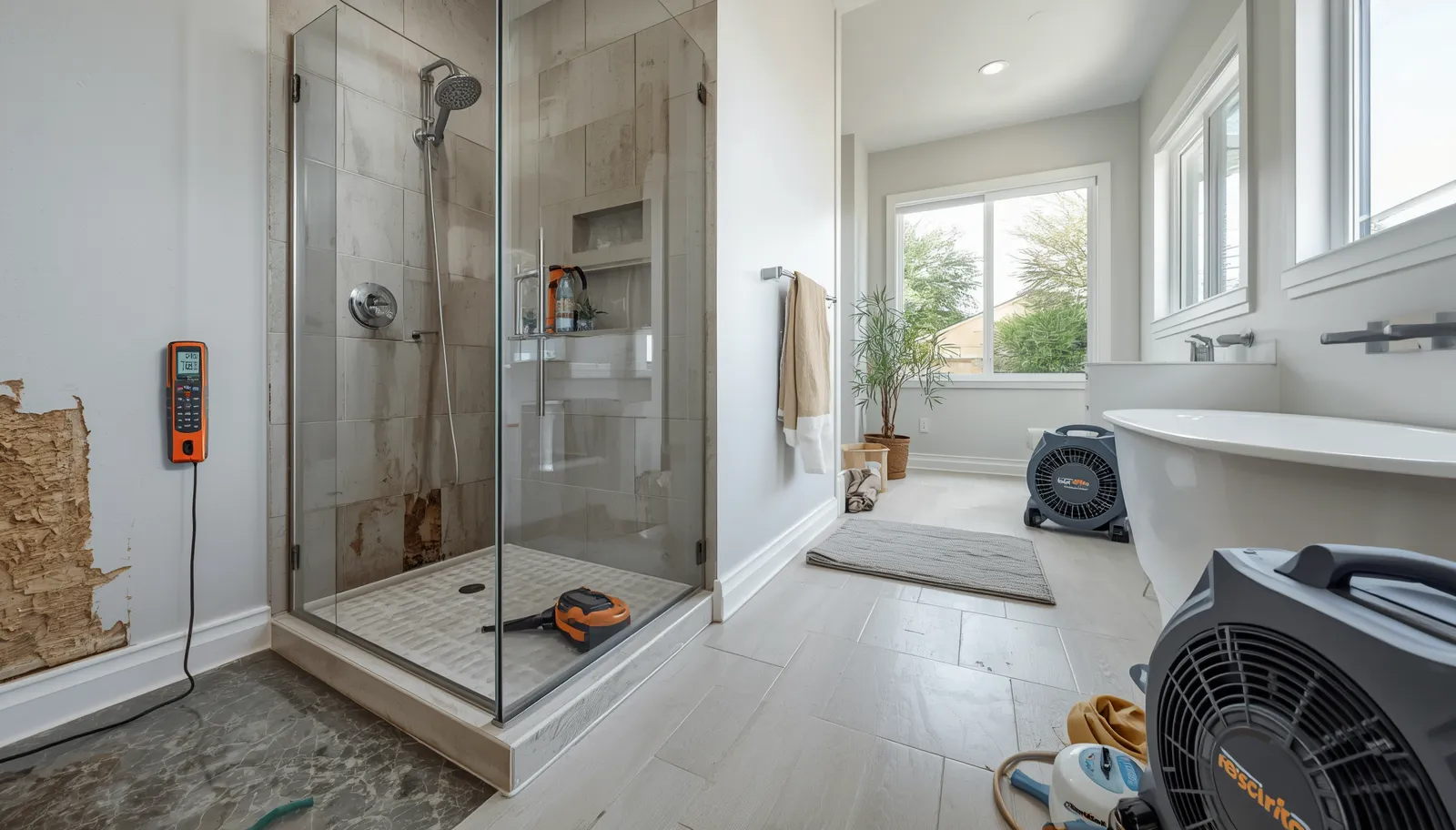
Frequently Asked Questions
Question: The ceiling below our shower stains after long showers. What is that?
Answer: The most diagnostic symptom in this category: water escaping the enclosure — pan, drain, or valve — with each use and collecting in the ceiling assembly. The correlation with showers is the clue that it’s an enclosure leak rather than a supply line. It’s confirmable quickly, and it never improves on its own.
Question: Can I just regrout and recaulk?
Answer: If the leak truly is a surface seam caught early — sometimes, and fresh caulk at the moving joints is legitimate maintenance regardless. But grout repair over a failed pan or a wet cavity seals the evidence in with the moisture. The honest sequence is verify what’s wet behind the wall first; then the right fix is obvious.
Question: How do you know what’s behind the tile without tearing it all out?
Answer: Instruments first: moisture meters and thermal imaging read through and around the assembly, and access is opened from the least destructive side — frequently the back wall or the ceiling below. Demolition follows the map, and only as far as the readings and (where present) the contamination require.
Question: We keep cleaning mold off the shower wall and it keeps coming back. Why?
Answer: Because the growth being cleaned is the surface expression of moisture inside the assembly. Scrubbing treats the symptom; the cause is the leak feeding the cavity. Fix the source, remediate the cavity under containment, verify with independent testing — then it stays gone.
Question: Does homeowners insurance cover shower leak damage?
Answer: This category faces the most exclusions of any water loss, because the mechanism is gradual by nature. Some hidden-damage claims are paid; many gradual-leak claims are not; policies differ and outcomes can’t honestly be promised. Documentation is provided either way — and the repair shouldn’t wait on the coverage answer, because the damage doesn’t.
Question: Can you rebuild the shower itself, or just dry it out?
Answer: Both, and that’s the point of one licensed company: the enclosure is rebuilt with modern waterproofing — backer, membrane, pan, tile, finish — under the same GC license that handled the drying and remediation. The plumbing components stay with the plumber, coordinated into the schedule.
The Leak Runs Every Time You Shower — End It
Months of quiet seepage stop the week the source is fixed, the cavity is dried and verified, and the enclosure is rebuilt right. One call starts the whole sequence.
Gold Coast Flood Restorations Serving San Diego and all of San Diego County
24/7 Emergency Line: (858) 495-9133 Book online: goldcoastflood.com/appointment-form
IICRC Certified | Licensed General Contractor #838802 | A+ BBB Rated | Serving San Diego County for 35+ Years | 24/7 Emergency Response
Service areas include: San Diego, Santee, El Cajon, La Mesa, Alpine, Lakeside, Spring Valley, Poway, Scripps Ranch, Rancho Bernardo, Rancho Penasquitos, Rancho Santa Fe, Del Mar, Solana Beach, Encinitas, Carlsbad, La Jolla, Carmel Valley, Mira Mesa, Sorrento Valley, University City, Tierrasanta, and throughout San Diego County